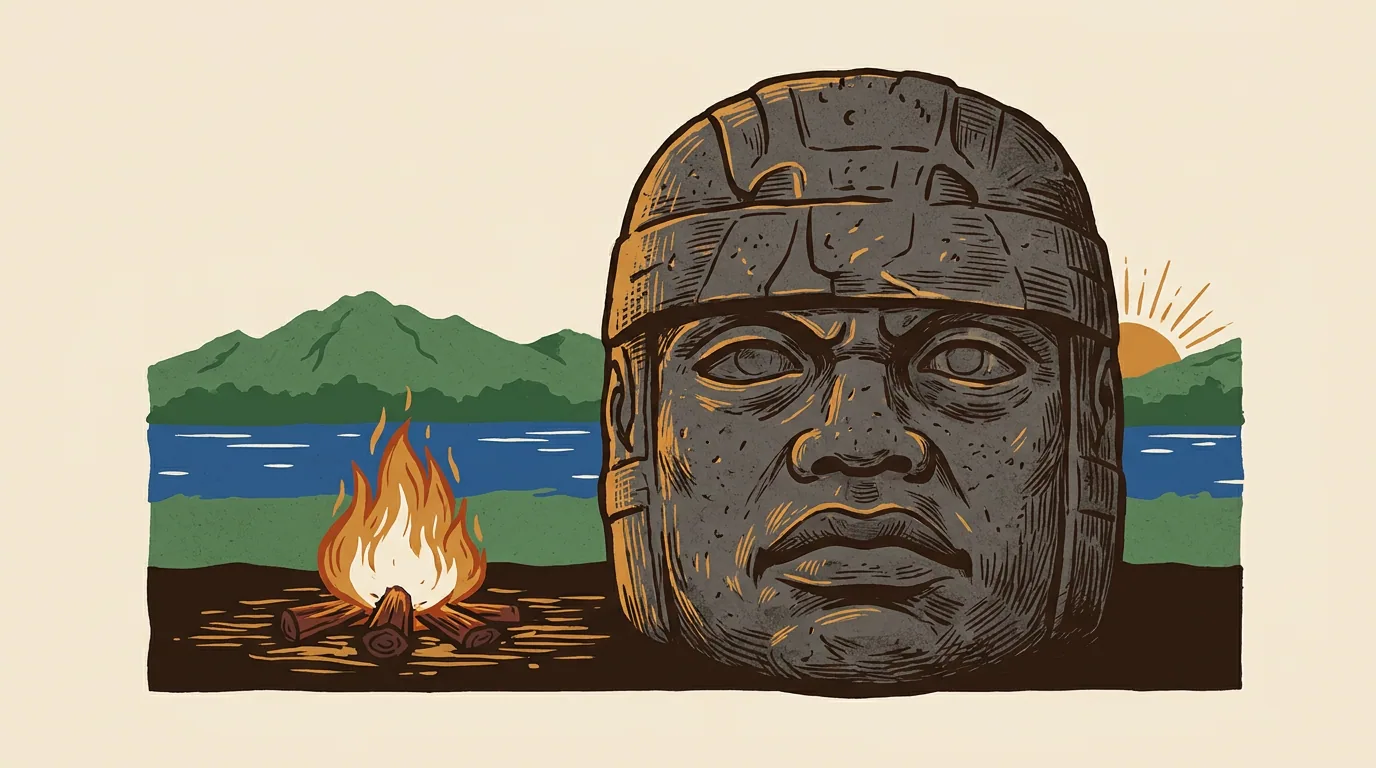
An Olmec head does not look abandoned: it looks as though it is waiting. The basalt preserves taut lips, a broad nose, firm cheeks and a gaze that needs no carved pupils to command a presence. Some stand nearly three meters tall and weigh several tons, but what is truly monumental is not their size: it is everything we still do not know about the person depicted. We know who made them in historical terms—the Olmec societies of the Gulf Coast—although we do not know the names of the sculptors, nor can we say with certainty the given name of a single person portrayed.
Who the Olmecs were
The word “Olmec” is modern in relation to the sculptures. It comes from Nahuatl and is commonly translated as “inhabitants of the rubber region”; the Mexica applied it to peoples of the Gulf Coast many centuries after the height of San Lorenzo and La Venta. In the 20th century, archaeology adopted the term to name a cultural tradition from the Mesoamerican Preclassic period, developed mainly in southern Veracruz and western Tabasco. It is a useful label, not necessarily the name those communities used for themselves.
For decades, the Olmecs were called the “mother culture” of Mesoamerica. The phrase acknowledges their great antiquity and the early emergence, within their sphere, of ceremonial centers, public sculpture, exchange networks and religious symbols that circulated widely. Today, however, a less familial and more interesting picture is preferred: different Mesoamerican regions maintained contact, exchanged materials and ideas, and developed their own solutions. The Olmecs were pivotal, yes, but Mesoamerica was not born of a single mother with an archaeological birth certificate.
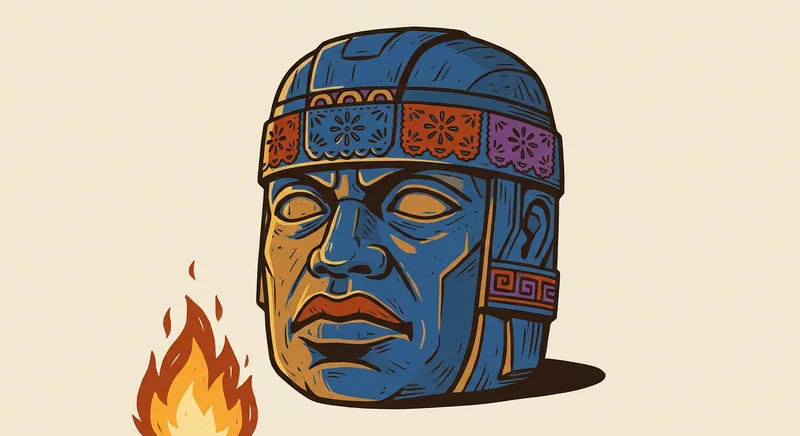
The heads were made by organized communities capable of bringing together specialists, food, labor and transportation routes. The carvers worked with stone tools—they had no iron chisels—using percussion, pecking, abrasion and polishing. Behind each face were stoneworkers, porters, navigators, leaders and people responsible for sustaining the daily work. The individual signature was lost; the work, by contrast, preserves the scale of a collective undertaking.
Faces of power, not generic gods
The most widely accepted interpretation is that the heads represent rulers, probably men. Each has a particular combination of features: mouth, cheekbones, eyes, chin and expression vary, as do the close-fitting headdresses. That individuality makes it unlikely that they are simply interchangeable gods or an abstract human type. We have no inscriptions revealing names or biographies, so “portrait of a ruler” is a well-supported explanation, not an identification complete with ID and photograph.
«They are not anonymous portraits because they lacked names; they are anonymous to us because their names did not survive.»
The headdresses have prompted comparisons with ballplayers’ helmets and even fantasies about visitors from other continents. The archaeological reading is far less sensational: they may be insignia of rank, ritual attire or protection associated with specific activities, decorated with bands, knots, claws or other emblems. There is no serious evidence that the heads represent Africans who arrived in the Americas or ancient astronauts; attributing their features to foreign peoples repeats modern racial categories and, in the process, denies the Olmecs credit for their own sculpture. Sometimes a mystery does not need a flying saucer: an ancient society with enormous political and artistic capacity is enough.
The keys to recognizing a colossal head are:
- 1It is carved from a single block of basalt.
- 2It depicts only a head and neck, with no torso added.
- 3It has an individualized face on a monumental scale.
- 4It wears a close-fitting headdress, different in each example.
- 5The back is usually flatter or less finely worked than the front.
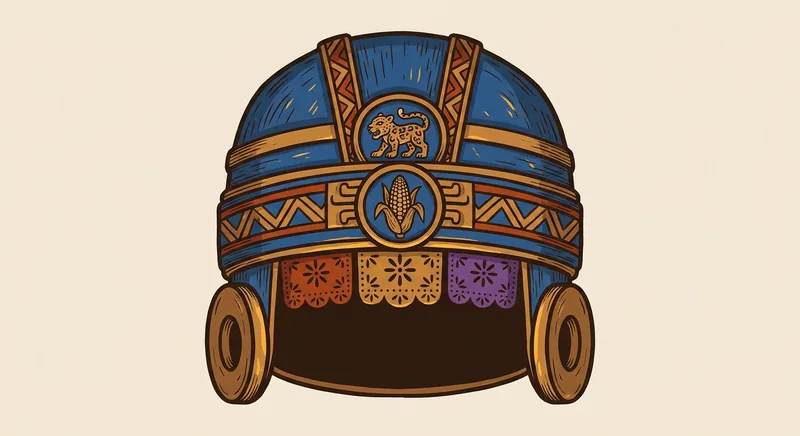
The basalt also holds biographies of use. Some heads have depressions and wear that may be associated with intentional mutilation, rituals or political episodes; others were buried or relocated when ceremonial spaces changed. In addition, several Olmec monuments were reworked from earlier pieces, and it has been proposed that certain heads came from recycled thrones or altars. Not everything has been resolved on a case-by-case basis, but the stone was not untouchable: it, too, played a part in the fall, replacement or remembrance of power.
From the volcano to the tropics
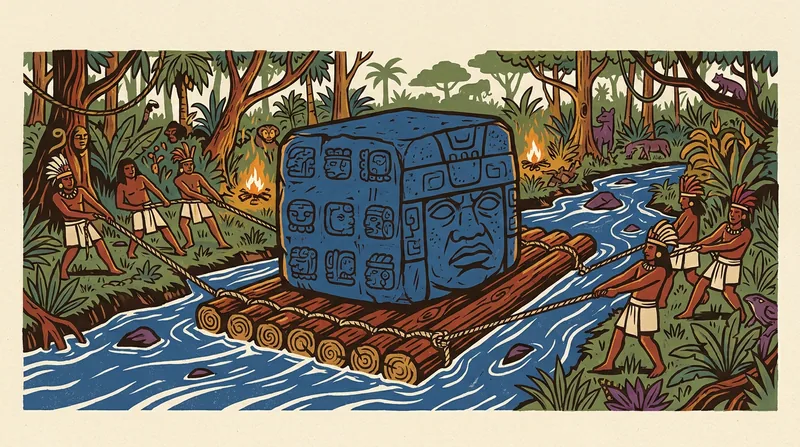
The material used for the heads was not available near the plazas where they were displayed. For San Lorenzo, geological analyses link much of the basalt to the Tuxtlas Mountains, especially volcanic sources around Cerro Cintepec, dozens of kilometers away. Moving blocks weighing many tons across a humid plain crisscrossed by rivers and swamps required formidable logistics. A combination of overland hauling, rollers or sledges, and transport by raft was probably used, although no Olmec instruction manual for monumental moving has survived.
The journey involved more than simply overcoming the weight. The block had to be chosen, broken free or selected from available rock, routes prepared, floods anticipated, work crews fed and the piece protected along the way. Some of the rough shaping may have been done near the quarry to reduce the load, although the precise process varied and remains under study. The ability to coordinate that effort speaks to authorities with resources and communities integrated into regional networks.
Carving them was another feat of patience. Blows from stone hammerstones removed bulk; smaller tools defined eyes, lips and ornaments; abrasives helped even out the surface. Differences in finish reveal aesthetic choices, but also each monument's later history of exposure, burial and erosion. Standing before these faces, it is better to imagine not a single stroke of genius, but thousands of precise blows delivered by trained hands.
Seventeen Heads, Four Sites
To date, seventeen colossal Olmec heads are recognized. Ten come from San Lorenzo Tenochtitlán, Veracruz; four from La Venta, Tabasco; two from Tres Zapotes, Veracruz; and one from Rancho La Cobata, also in Veracruz. They were not found lined up like a modern gallery: they were discovered in different contexts, some outside their original placement. Their distribution outlines the Olmec heartland along the Gulf Coast, a region of abundant rivers, fertile soils and waterborne travel.
San Lorenzo was the great early center. Its height is generally dated to between approximately 1400 and 1000 B.C., and its heads are usually dated within that broad horizon, although dating a stone sculpture is difficult because basalt contains no organic matter suitable for radiocarbon dating. Age is determined through archaeological context, stratigraphy, association with datable materials and the piece's place within the history of the settlement. San Lorenzo's ten heads form the largest and, overall, the oldest group.
After San Lorenzo's decline, La Venta became a major center, reaching its height between approximately 900 and 400 B.C. Its four heads belong to that long period of monument building and ceremonial planning. The two from Tres Zapotes and the one from La Cobata are harder to date precisely; several proposals place them in late phases of the Olmec tradition or in the transition toward later developments. It is best to resist the temptation to assign them all the same year: the tradition lasted for centuries and changed along with its cities.
The La Cobata head is a notable exception. At about 3.4 meters tall, it is the largest of the known group, but its carving appears less finished than that of several examples from San Lorenzo and La Venta. It was found outside a well-defined urban context, near the Tuxtlas Mountains, which complicates its interpretation. Its closed eyes have inspired various explanations, including that it represents a dead person, but none can be stated with certainty.
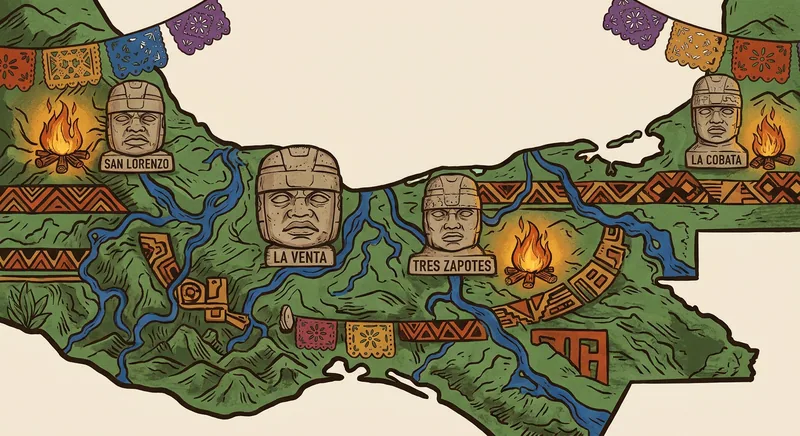
The number seventeen describes what is known, not a definitive inventory from antiquity. Some heads may have remained buried, been destroyed, been reworked or not yet been found. It is also important to distinguish originals from replicas: several cities and museums display high-quality copies, while the authentic monuments remain safeguarded in Mexico, in museums and archaeological parks in Veracruz, Tabasco and the nation's capital. Fame multiplies the faces; archaeology, by contrast, counts carefully.
What a Stone Can Tell Us
The first modern reports of a colossal head appeared in the nineteenth century. In 1869, José María Melgar y Serrano described the monument at Hueyapan—now known as the Tres Zapotes head—but it took decades to understand its antiquity and the place of Olmec culture. Twentieth-century excavations, including those of Matthew Stirling, and later work at San Lorenzo and La Venta established a more solid chronology. The discipline advanced when it stopped viewing the head as an isolated curiosity and began studying landscapes, occupation layers, workshops, routes and contexts.
Even so, the heads do not tell us everything. We do not know the rulers' names, what ceremony accompanied each installation or what word their peoples used for these portraits. Nor can we reconstruct a complete ethnic identity from seventeen male faces associated with the elite. Responsible archaeology does not fill those gaps with legends: it turns them into questions and seeks answers that can be tested.
We can say that they were made in Mesoamerica, primarily during the first millennium before the Common Era and perhaps beginning in the final centuries of the second; that they belong to the Olmec tradition; that they are concentrated at four sites in Veracruz and Tabasco; and that they probably portray leaders. In them we can see a politics of the face: power transformed into a public presence, immense, recognizable and enduring. Each headdress distinguished one person, while the scale reminded everyone that the individual was tied to forces and endeavors greater than himself.
Today the heads are national emblems, images printed in schoolbooks and figures reproduced even on keychains. That familiarity can render them mute, as happens with things that become too famous. Looking at them anew requires setting aside both the postcard image and easy fantasy, and recognizing an extraordinary undertaking: a society mobilized volcanic rock, technical knowledge and collective labor to preserve the memory of specific human beings. Their names were erased; what remains is the weight of their desire to be remembered.
- Ann Cyphers, Olmec Sculpture of San Lorenzo Tenochtitlán, National Autonomous University of Mexico, 2004.
- Beatriz de la Fuente, Los hombres de piedra: escultura olmeca, Universidad Nacional Autónoma de México, 1977.
- Christopher A. Pool, Olmec Archaeology and Early Mesoamerica, Cambridge University Press, 2007.
- National Museum of Anthropology, National Institute of Anthropology and History, collections and resources on Olmec culture.
- Robert J. Sharer and Loa P. Traxler, The Ancient Maya, sixth edition, Stanford University Press, 2006, sections on the Mesoamerican Preclassic.