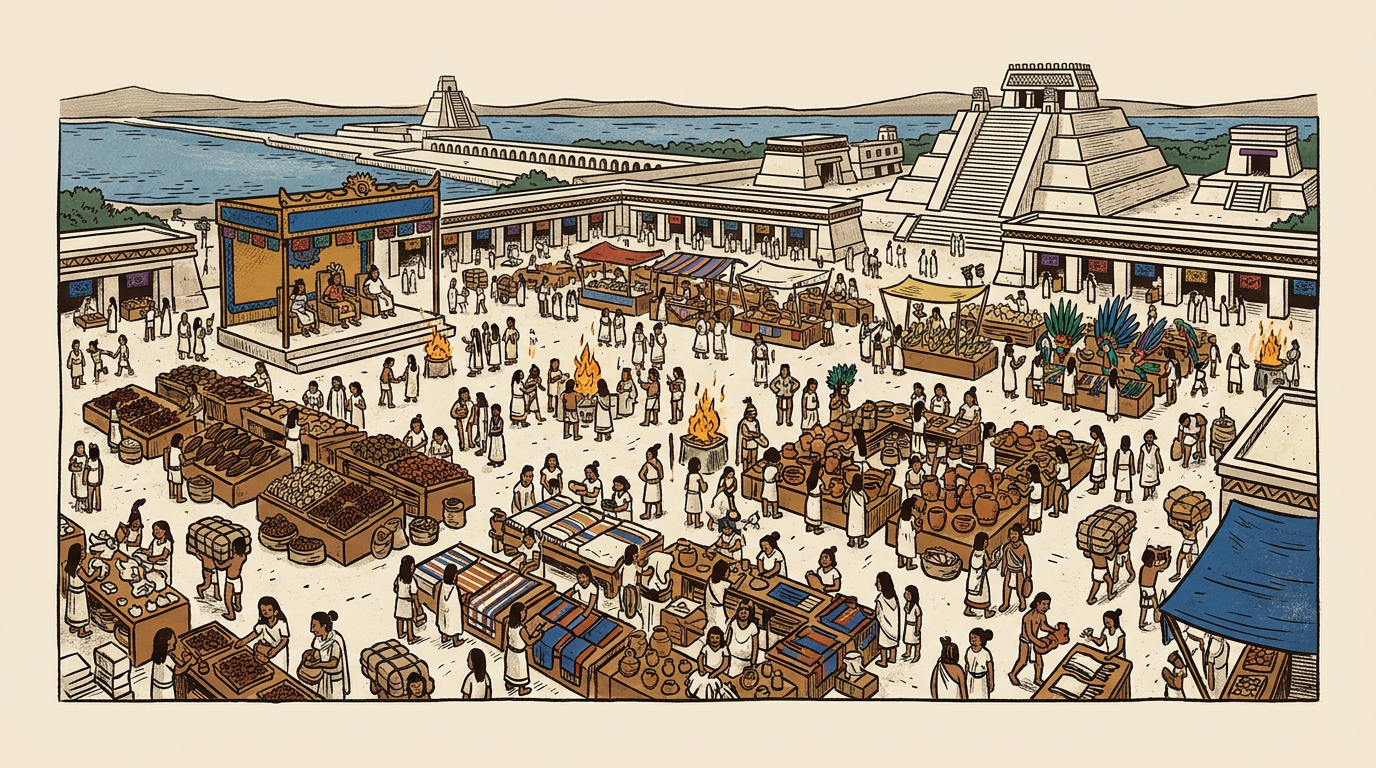
Before daybreak, Tlatelolco must already have echoed with footsteps, voices, canoes coming ashore, and bundles being arranged on petates. Tomatoes, chiles, corn, blankets, pottery, salt, cacao, feathers, and objects crafted by specialists arrived at the great plaza. It was not a picturesque jumble, but an institution capable of supplying an enormous urban population and connecting regions hundreds of kilometers apart. People who entered were not just going shopping: they were getting a glimpse of Mesoamerica’s economic map.
A plaza with an order of its own
Tlatelolco, a neighboring city that was ultimately subordinated to Mexico-Tenochtitlan, was home to the most celebrated market in the Basin of Mexico. Hernán Cortés claimed that the plaza was twice the size of Salamanca’s; Bernal Díaz del Castillo wrote that its crowds and order left him amazed. The conquistadors’ figures should be read with caution—they described what they saw, but they also wrote for European audiences—though their agreement on its scale and order is significant. Indigenous sources and archaeology confirm the site’s commercial importance, even if they do not make it possible to determine exactly how many people came each day.
Goods were arranged by section: food in one area, textiles in another, with luxury objects, animals, medicinal plants, pottery, and tools each in their respective spaces. This separation made it easier to compare quality and price, find vendors, and monitor exchanges. Market authorities settled disputes and supervised transactions, while other officials were responsible for maintaining order. Its efficiency did not depend on a cash register—such a device was still several centuries away—but on familiar rules, accepted measurements, and oversight that was far less improvised than is often imagined.
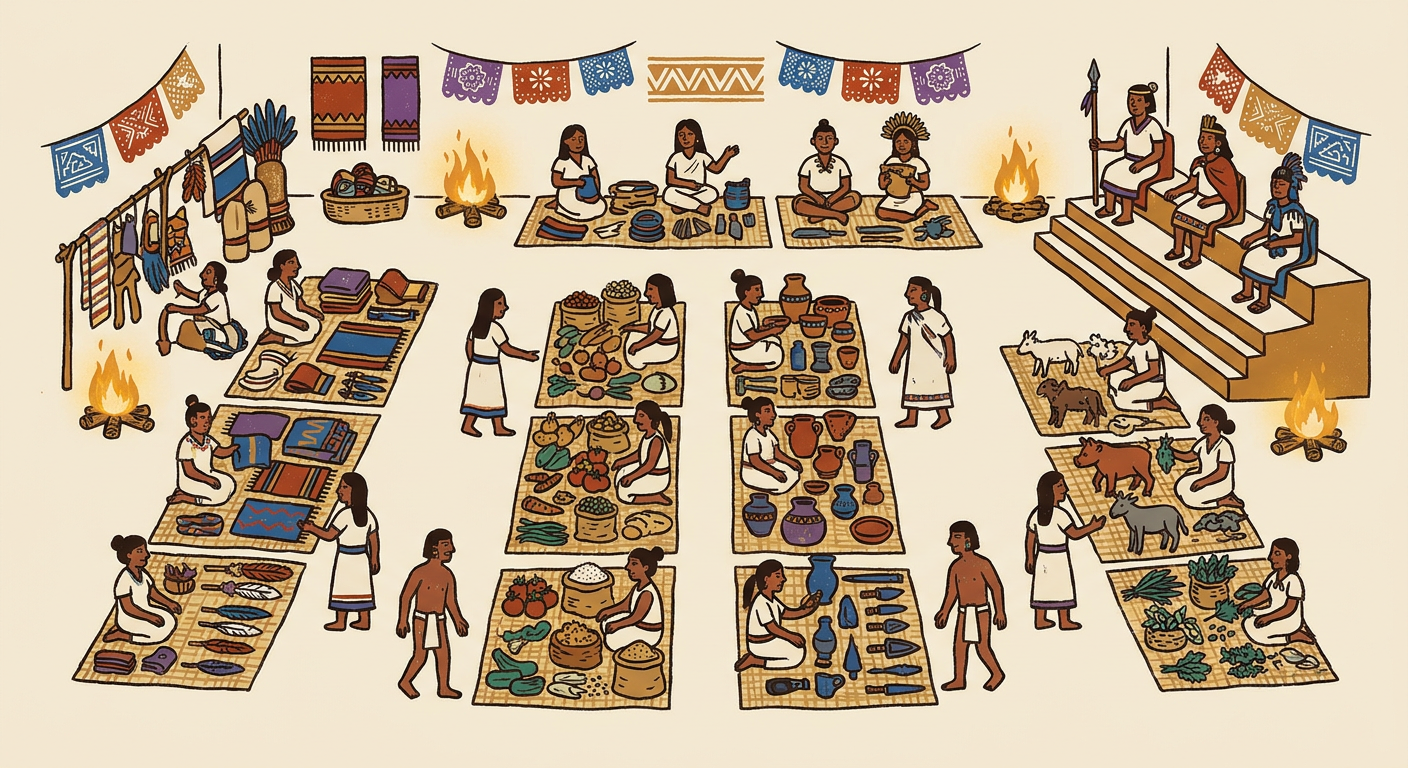
“We were amazed by the multitude of people and merchandise there, and by the great order and governance they maintained in everything.” —Bernal Díaz del Castillo, True History of the Conquest of New Spain
From the lake to the hotlands
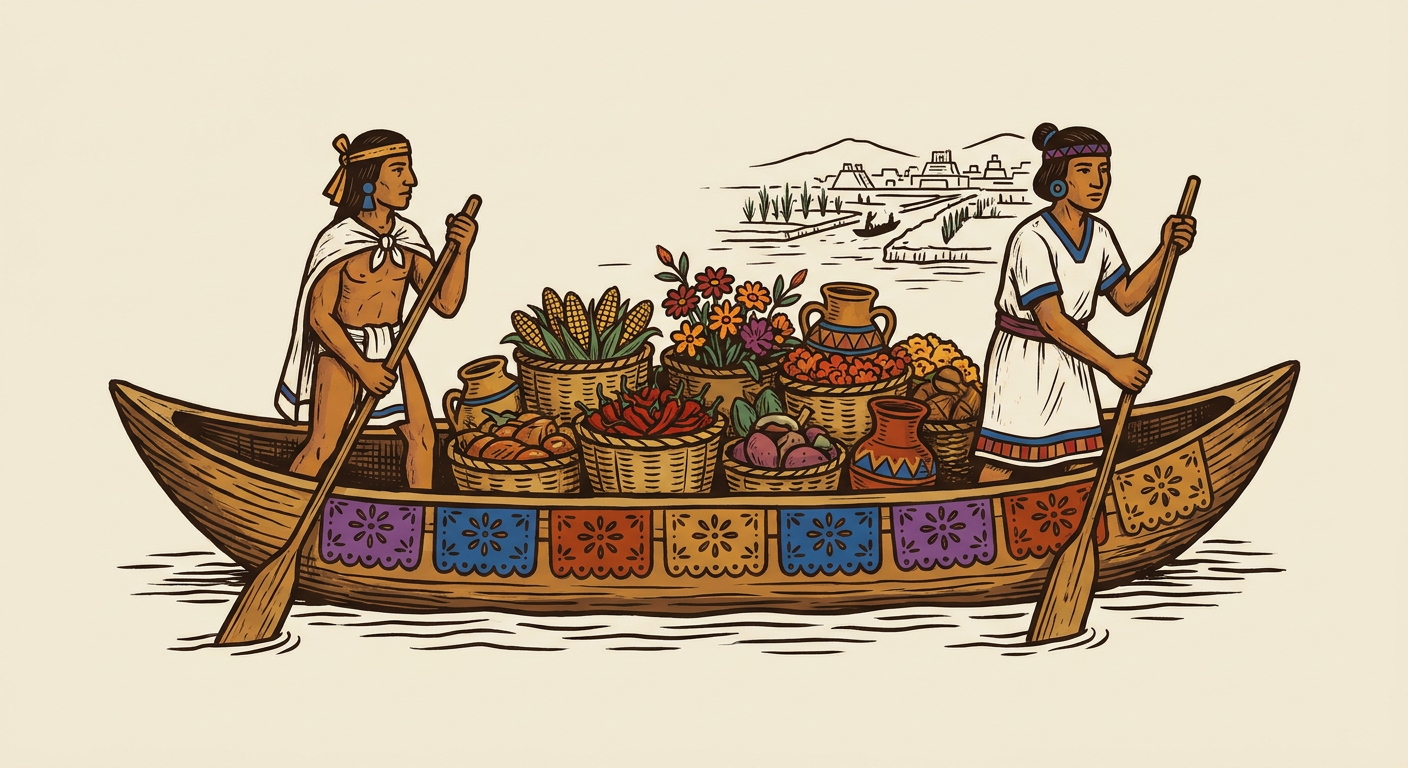
Some of the supplies came from within the Basin of Mexico itself. The chinampas to the south provided corn, beans, squash, chile, flowers, and other agricultural products; Texcoco and other lakeside towns sent manufactured goods and food, while the basin’s saltworks supplied an essential commodity. Canoes made it possible to move cargo across lakes and canals with remarkable efficiency, so that not everything had to travel on human backs. In that sense, Tlatelolco was an inland port as well as a marketplace.
Other goods arrived from more distant regions through trade, tribute, or both networks, which should not be confused even though they ultimately supplied the same metropolis. Cacao, cotton, vanilla, colorful feathers, and hides came from the warm regions of the Gulf Coast, Soconusco, and other producing areas. Guerrero and Oaxaca provided greenstones, cochineal dye, metals, pottery, and a variety of manufactured goods; shells and marine products arrived from the coasts. Every object carried its geography: a fine blanket spoke of tropical cotton, and a quetzal feather of humid forests far from the plaza.
- 1Basin of Mexico: corn, vegetables, flowers, fish, waterfowl, salt, and pottery.
- 2Tierra Caliente and the Gulf Coast: cotton, cacao, vanilla, hides, and feathers.
- 3Soconusco: highly prized cacao and other tropical products.
- 4Guerrero and Oaxaca: greenstones, cochineal dye, metals, and specialized manufactured goods.
- 5Pacific and Gulf Coasts: shells, conch shells, and marine goods.
Pochtecas: merchants and much more
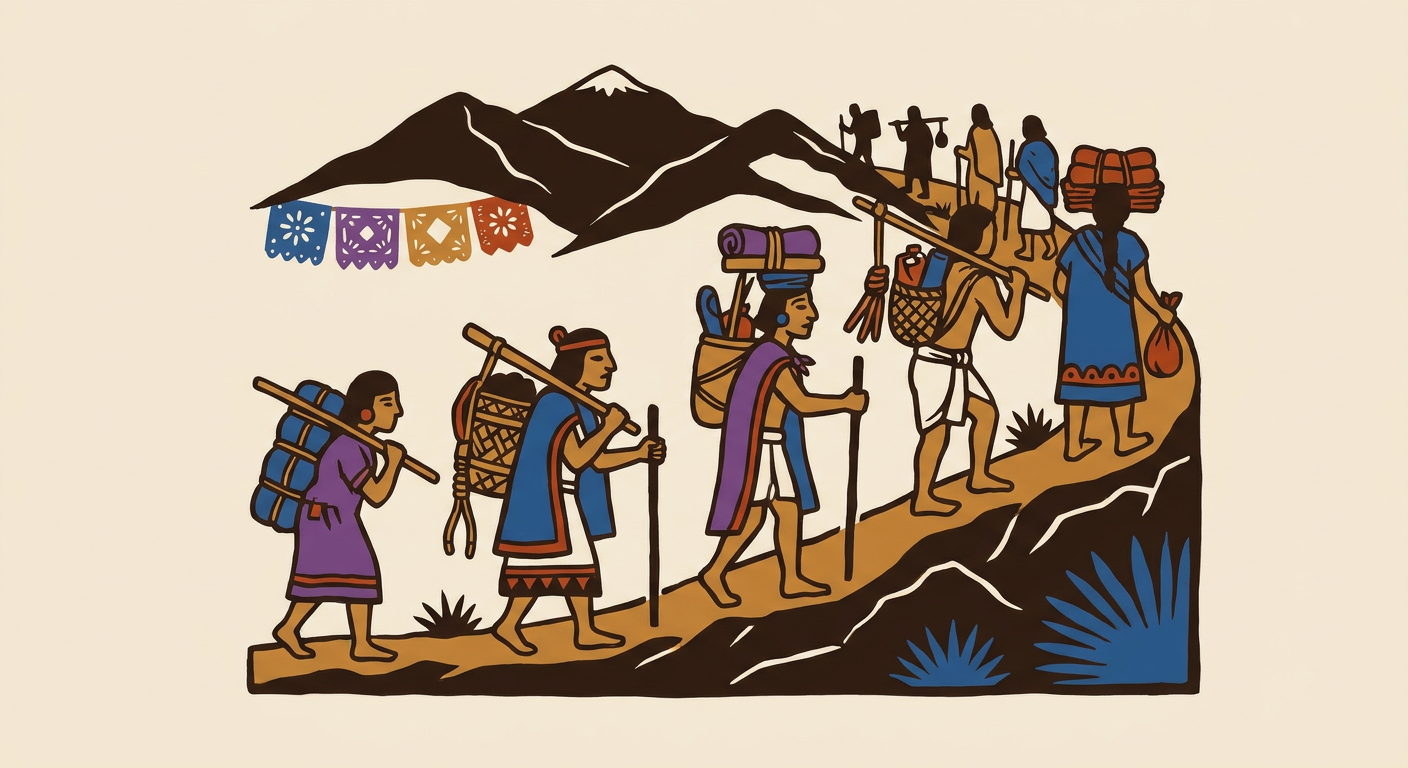
The pochtecas were professional long-distance merchants, organized into guilds with their own neighborhoods, authorities, rituals, and rules. They traveled in groups to remote regions to obtain scarce and valuable goods: cacao, cotton, fine feathers, precious stones, metals, shells, and luxury objects. They were not simply traveling vendors, nor were all the market’s merchants pochtecas. Their specialty was maintaining far-reaching trade networks, negotiating beyond the everyday sphere, and returning with goods that bolstered the prestige of nobles, temples, and rulers.
Some pochtecas also acted as informants for Mexica authorities in foreign territories, according to 16th-century sources. Their reports on roads, riches, alliances and defenses could aid future military campaigns; hence the partly deserved image of the merchant-spy. However, reducing them to secret agents erases their economic and religious role. They worshipped Yacatecuhtli, a deity associated with merchants and travel, and their wealth came with ceremonial obligations and social limits: they could be prosperous, but it was best not to flaunt it as though they were makeshift tlatoanis.
Their expeditions required logistics, contacts and endurance. Tlamemes carried the bundles from one stage to the next; at certain points, one group of porters relieved another, while regional routes and markets linked producers, intermediaries and consumers. Travel meant crossing political borders, negotiating safe-conducts and facing theft or conflict. Tlatelolco’s prosperity did not flow from a cornucopia: it rested on a human infrastructure of knowledge, trust and weary backs.
Cacao, cloth and clear accounts
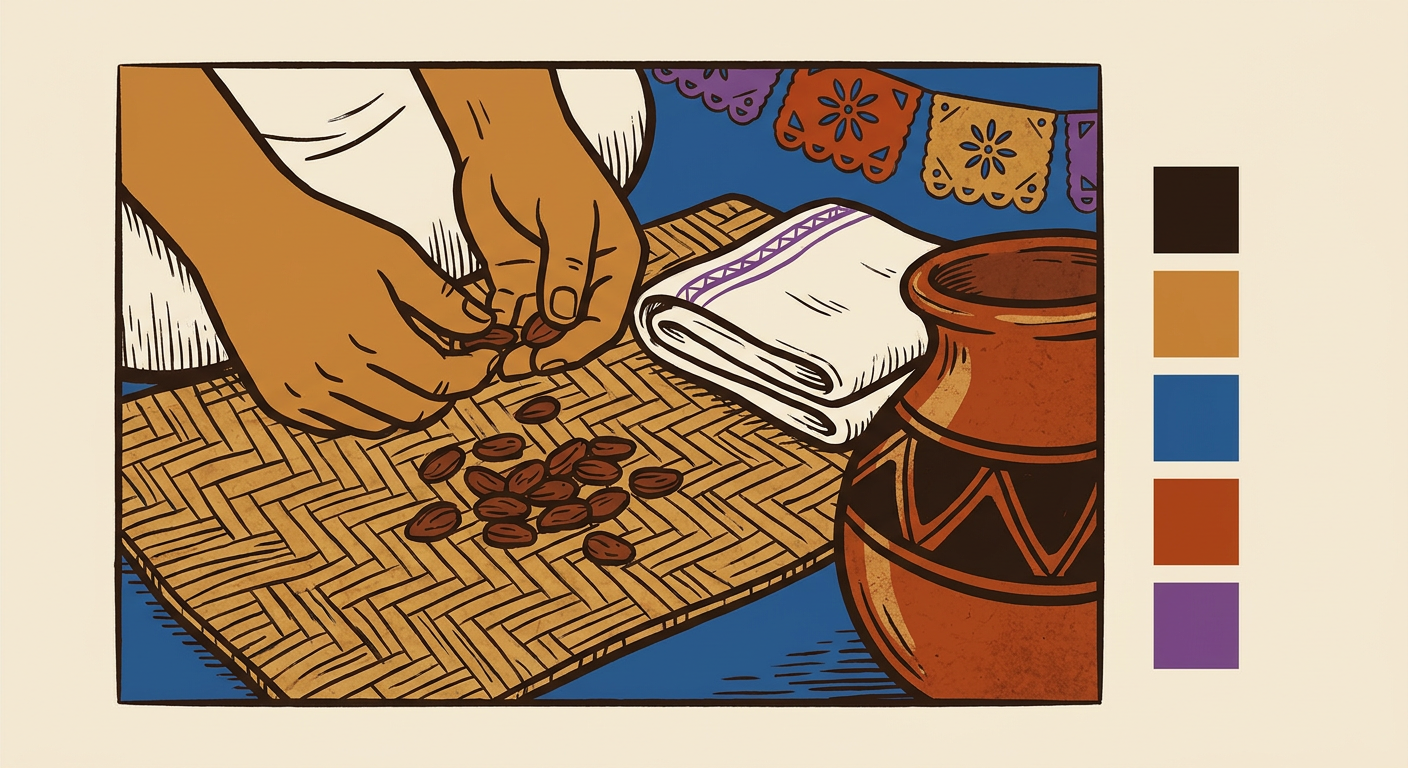
Cacao was indeed used as money, but it was not the only means of exchange. The beans were used for small purchases and counted individually or in groups; for larger transactions, cotton cloths of different sizes and quality circulated, and certain standardized pieces could serve as benchmarks of value. Direct barter also existed, especially when two parties agreed on convenient equivalencies. Rather than an economy with a single currency, it was a system with several instruments, suited to different goods and scales.
Cacao had obvious advantages: it was portable, divisible, recognizable and, moreover, edible. Precisely because it had value, it could be counterfeited: early colonial sources mention empty shells filled with mud or dough, a financial trick that long predated cloned credit cards. Judges and market overseers helped curb fraud, verify measures and settle disputes. Trust was not a moral ornament, but part of the economic machinery.
A city measured in a market
The fall of Mexico-Tenochtitlan and Tlatelolco in 1521 radically transformed these networks, but it did not immediately erase their practices. Indigenous markets continued under colonial rule, adapted to new authorities, currencies, products and obligations. Some routes survived; others were redirected toward mines, haciendas and cities in New Spain. Even cacao retained monetary uses for a long time in different regions of Mesoamerica.
To see Tlatelolco merely as an exotic crowd would be to miss what mattered most. Its market worked because it combined specialization, water and land transport, authorities, measures, regional networks and accumulated commercial experience. There, a chile grown a few kilometers away and a feather brought from a distant forest could be found side by side, placed there through thousands of coordinated decisions. The great lesson of Tlatelolco is not that the past resembled us, but that it knew how to organize its complexity with tools of its own; every cacao bean carried, in addition to a price, the memory of a road.
- Bernal Díaz del Castillo, The True History of the Conquest of New Spain.
- Hernán Cortés, Second Letter of Relation (1520).
- Bernardino de Sahagún, General History of the Things of New Spain, especially Book IX.
- Frances F. Berdan, Aztec Archaeology and Ethnohistory, Cambridge University Press, 2014.
- Kenneth G. Hirth, The Aztec Economic World: Merchants and Markets in Ancient Mesoamerica, Cambridge University Press, 2016.