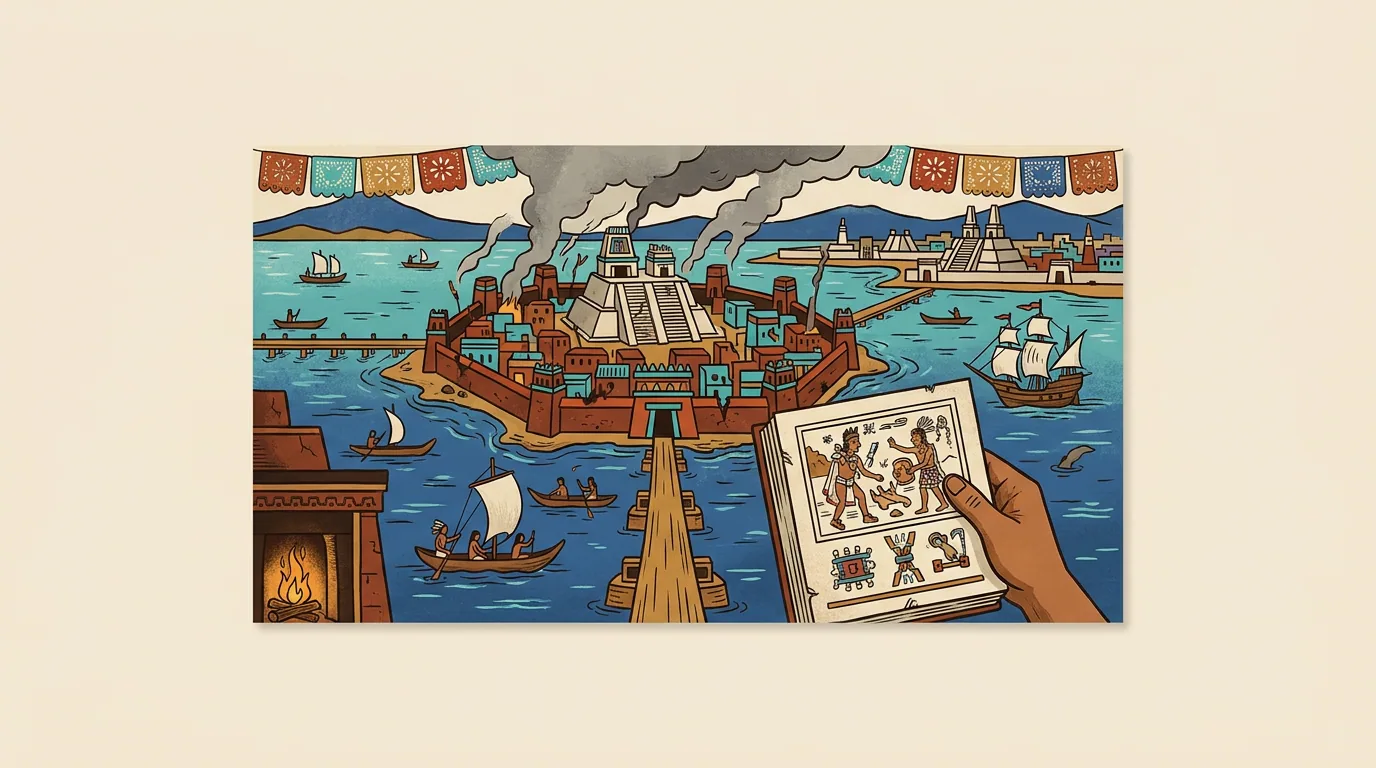
On August 13, 1521, Tenochtitlan did not fall in a single blow, nor was another country suddenly born. That day marked the end of the siege of a city exhausted by war, hunger, lack of water and smallpox; Cuauhtémoc was captured while trying to escape across the lake, and organized resistance reached its limit. Hernán Cortés and his men entered as victors, but they did not do so alone: tens of thousands of Indigenous allies fought alongside them, especially Tlaxcalans, Huejotzincas, Chalcas and other peoples opposed to Mexica power. The date marks a profound rupture, though not an instant replacement: beneath the rubble, languages, memories and hands capable of remaking the world continued to beat.
A city surrounded by water
The fall began long before August. In 1519, the Spanish expeditionaries arrived in a region woven together by alliances, tribute and enmities; the rule of the Triple Alliance —Tenochtitlan, Texcoco and Tlacopan— was powerful, but neither uniform nor beloved by all. Cortés knew how to exploit those fractures and also relied on interpreters and mediators such as Jerónimo de Aguilar and Malintzin. Without that Indigenous network of information, supplies and combat, the conquest of Mexico-Tenochtitlan would have been another story, perhaps a much shorter one for the Europeans.
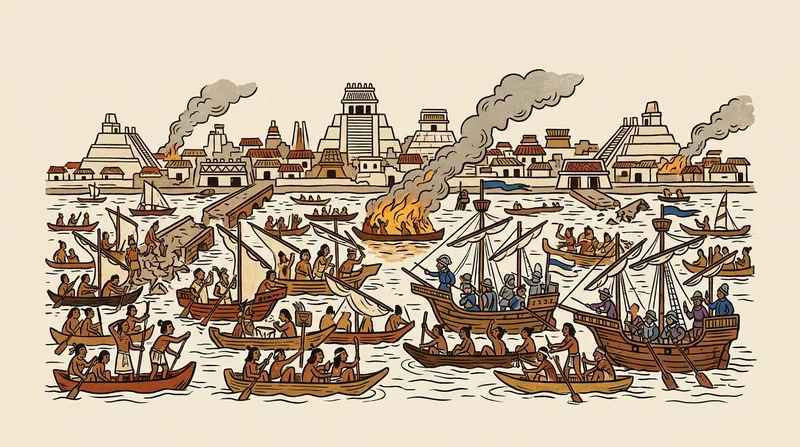
After the Spanish retreat in June 1520 —known as the Sad Night in the Hispanic tradition and the Victorious Night in contemporary readings— smallpox spread through the basin. The epidemic killed people with no prior immunity and claimed the tlatoani Cuitláhuac, successor to Motecuhzoma Xocoyotzin. Cuauhtémoc took command of a weakened city, while Cortés regrouped his forces in Tlaxcala and ordered the construction of thirteen brigantines. Built in sections and transported to Texcoco, those vessels made it possible to contest the lake, cut off supplies and turn the protective waters into a blockade.
The image of a few hundred Spaniards defeating an empire on their own is convenient, epic and false. The besieging army was predominantly Indigenous, although exact figures vary depending on the sources. Horses, steel, crossbows, firearms and brigantines provided important advantages, but local alliances, knowledge of the terrain, the epidemic and the strategy of destroying bridges, occupying causeways and cutting off the Chapultepec aqueduct also played a major role. History, like mole, cannot be explained with a single ingredient.
- 1The city was left without enough drinking water after the Chapultepec aqueduct was cut off.
- 2The brigantines restricted the movement of canoes and the arrival of food across the lake.
- 3The fighting advanced along the causeways and into the neighborhoods, with positions retaken and lost again.
- 4Smallpox and other diseases worsened an already extreme demographic and military crisis.
- 5Indigenous allies provided most of the fighters and land-based logistics.
The last day of Mexico-Tenochtitlan
For nearly seventy-five days, between late May and August 13, the siege reduced Tenochtitlan and Tlatelolco to a landscape of hunger, corpses and house-to-house combat. The defenders dug trenches, removed bridges and attacked from canoes; the besiegers demolished buildings to keep the streets from once again becoming traps. Spanish and Indigenous sources agree on the devastation, though they differ in figures, emphasis and responsibility. They should be read together: no single window, on its own, offers a view of the entire city.
“And all this happened to us. We saw it, we marveled at it.” — Nahua account collected in Book XII of the Florentine Codex, in the translation popularized by Miguel León-Portilla.
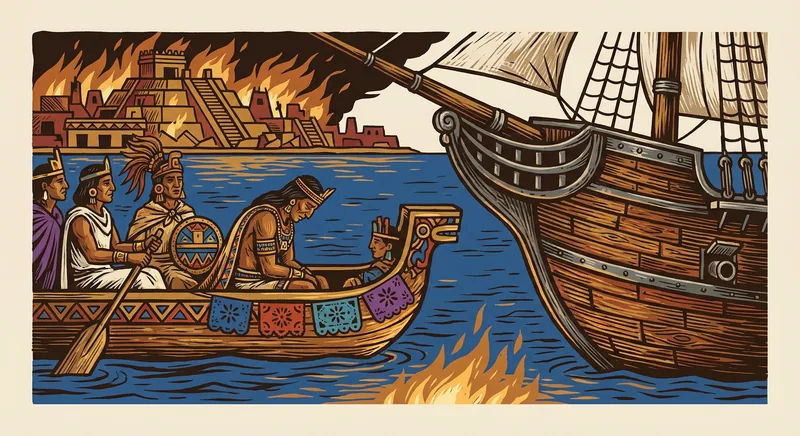
On August 13, the feast day of Saint Hippolytus in the Christian calendar, Cuauhtémoc left Tlatelolco in a canoe with other nobles. He was intercepted by a brigantine commanded by García Holguín and taken before Cortés. The well-known scene in which the tlatoani asks to be killed with the conquistador’s dagger comes from Spanish chronicles and should be treated with caution: it may have been a rhetorical formulation shaped by European codes of surrender. What can be confirmed is that his capture sealed the military defeat and unleashed a brutal plundering of survivors and their possessions.
The defeat did not mean the immediate extermination of the Mexica or automatic control over all of Mesoamerica. Numerous lordships retained their authorities, lands and room to negotiate; other regions resisted for decades, and colonial expansion into the north, west and southeast was long and violent. The city itself had to be rebuilt with Indigenous labor, over the old urban layout and using stone from temples and palaces. August 13 ended a war, not the entire Conquest or the Indigenous past.
After the Ruin, a City Both New and Ancient
Cortés decided to build the capital of New Spain atop Tenochtitlan, a political choice laden with symbolism. The Spanish grid was laid over existing causeways, canals and neighborhoods; the Templo Mayor was dismantled, and buildings housing the new civil and religious powers arose around its precinct. Yet reconstruction depended on Indigenous stonemasons, carpenters, porters and artists, organized in communities that continued to speak Nahuatl and defend their rights through town councils, maps and documents. The colonial capital was not a blank slate: it was a palimpsest, with plenty of recycled stone and no eraser.
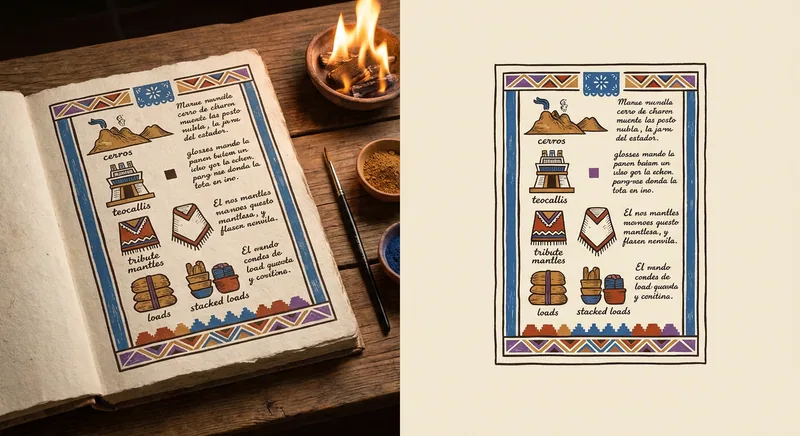
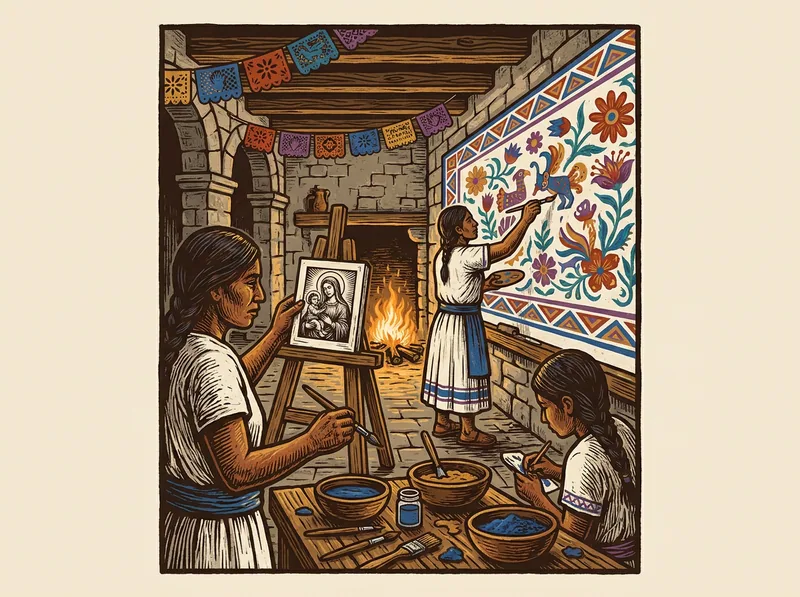
Art allows us to see that continuity without turning it into a postcard of “harmonious fusion.” In monasteries, atrial crosses, codices and murals, Indigenous techniques, pigments and forms appeared alongside European Christian programs. The tlacuilos—painter-scribes—adapted their craft to the Latin alphabet, European paper and new legal or religious needs, while preserving Mesoamerican visual conventions. Works such as the Codex Mendoza, produced around the 1540s, bring together Indigenous pictography and annotations in Spanish to explain tributes, conquests and daily life to readers across the ocean.
Languages also came together, sometimes under coercion and sometimes out of practical necessity. Friars learned Nahuatl to evangelize; Indigenous scribes used it in Latin characters to record wills, lawsuits and annals; words such as tomate, chocolate, petate and coyote entered Spanish. The exchange did not take place between two intact blocs: it involved diverse Mesoamerican peoples, Spaniards from different regions, free and enslaved Africans, and later Asians who arrived via Pacific trade routes. New Spain was unequal from its inception, but it was never culturally simple.
Mestizaje: Mixture, Power and Many Genealogies
Speaking of the “birth of mestizaje” in 1521 works as an image of a new era, as long as it is not taken as a birth certificate. Biological and cultural mixing had existed before, and relationships between Europeans and Indigenous people began with the earliest contacts, often shaped by war, servitude, forced alliances and sexual violence. Malintzin and Cortés had a son, Martín, probably born in 1522 or 1523, but casting them as Mexico’s founding couple erases countless women and men, while reducing history to a convenient genealogy. A country cannot fit into a family tree, no matter how neatly trimmed it may be.
Over the colonial centuries, the word “mestizo” acquired shifting social and legal meanings. The categories of Spanish, Indian, Black, mestizo, mulatto and others were used to organize a hierarchical society, although in daily life they could be negotiated based on appearance, wealth, reputation, occupation or place of residence. The famous eighteenth-century casta paintings attempted to classify mixtures with almost pantry-like precision, but they depicted an ideal of control rather than a stable reality. They are valuable documents of colonial thought, not neutral photographs of the population.
Nor was cultural mestizaje a blender in which everything lost its shape. There were appropriations, impositions, translations and forms of resistance: saints with local attributes, Christian festivals organized by Indigenous neighborhoods, Mesoamerican techniques used in the service of churches, and American flavors transforming European cuisines. Some practices survived under new names; others were hidden or disappeared. Calling all of this an “encounter” would be too kind, but calling it solely replacement would keep us from seeing Indigenous peoples’ capacity for adaptation and creation.
Remembering Without Erasing
For centuries, every August 13, Mexico City celebrated the Paseo del Pendón, a ceremony of Spanish victory dedicated to Saint Hippolytus. After Independence, the date lost its triumphant place and began to be viewed from other angles: Indigenous defeat, Cuauhtémoc’s resistance, the beginning of colonial rule or foundational trauma. Public art also changed the distribution of roles, from colonial canvases to the monument to Cuauhtémoc unveiled in 1887 and the murals of the twentieth century. Every era has painted 1521 in the colors of its own disputes.
Today we know that the simple opposition between “Spaniards” and “Indigenous people” conceals too much, but complexity should not be used to dissolve responsibility either. The Spanish monarchy established a colonial regime that exploited labor and resources, imposed a religion and created profound inequalities; at the same time, Indigenous peoples preserved institutions, knowledge and political agency, and participated in the new order in different ways. Cortés’s allies did not fight to found the mestizo Mexico we imagine in retrospect, but for their own urgent, local goals. Understanding them requires restoring their agency without blaming them for a future they could not have known.
The fall of Tenochtitlan was a human and political catastrophe, but not the endpoint of a civilization. In colonial codices, in the Nahuatl still spoken today, in the capital’s layout and in images created by Indigenous hands, there endure lives that the narrative of total victory sought to leave behind. Mestizaje was born many times and in many ways: some chosen, others imposed, nearly all unequal. From five centuries away, August 13 does not ask us to choose between celebration and mourning as though picking sides in an after-dinner debate; it asks us to learn to see the layers, because Mexico still walks atop that city and, at times, can still hear the water below.
- Hernán Cortés, Cartas de relación, especially the Tercera carta de relación (1522).
- Bernal Díaz del Castillo, The True History of the Conquest of New Spain.
- Bernardino de Sahagún, Historia general de las cosas de Nueva España, Book XII (Florentine Codex).
- Matthew Restall, When Montezuma Met Cortés: The True Story of the Meeting that Changed History, Ecco, 2018.
- Instituto Nacional de Antropología e Historia (INAH), materials from the México 500 project and the Museo del Templo Mayor.