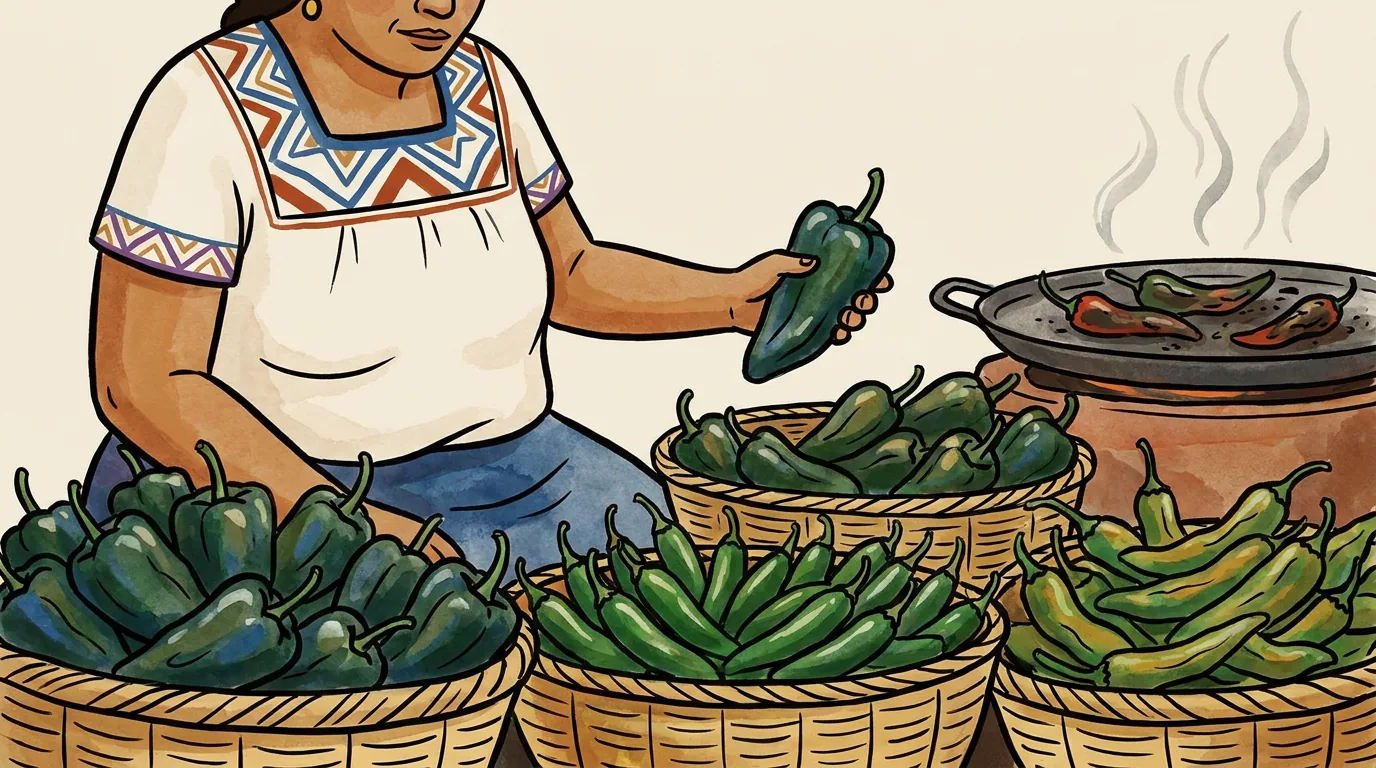
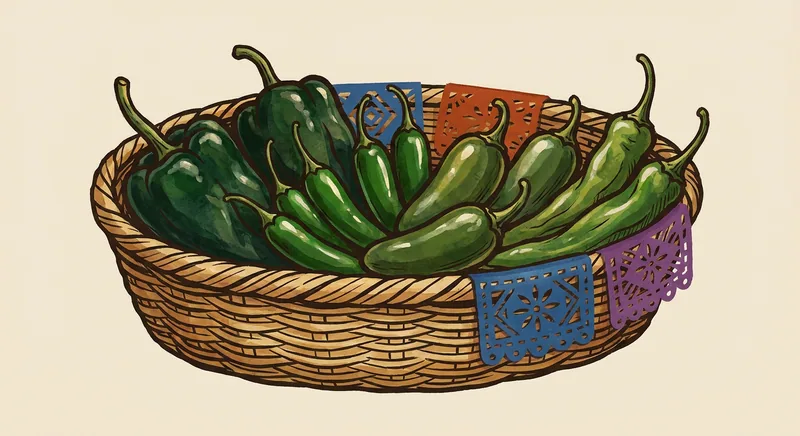
August brings to the markets a range of greens no paint box could hold: dark poblano, glossy serrano, fleshy jalapeño, and long, almost solemn chilaca. Although fresh chiles are now available for much of the year, the summer rains favor their abundance and variety in many regions of Mexico. Choosing them well is not about guessing which one will make the family cry, but about recognizing freshness, aroma, and texture. Before thinking about heat, it helps to listen to what each chile has to say; some speak softly, others arrive with a mariachi band.
The rainy season fits in a basket
The chile belongs to the genus Capsicum and was domesticated in the Americas thousands of years ago; in Mexico, its history is intertwined with the milpa and with a cuisine that predates the arrival of Europeans. In the 16th century, Bernardino de Sahagún recorded a remarkable diversity of ways it was eaten and sold in the markets of the Basin of Mexico. That abundance is not a frozen postcard: it remains alive in market stalls, regional seeds, and the everyday decisions of those who cook. Buying seasonal chiles means taking part, without an after-dinner speech, in that long history.
- 1Firm, taut skin: it may have curves, superficial scars, or color variations, but no sunken or wrinkled areas.
- 2Reassuring weight: when you pick it up, it should feel dense for its size; an overly light chile has usually lost water.
- 3Fresh stem: look for green or still flexible stems. A dry one does not doom the chile, but it indicates that more time has passed since it was picked.
- 4Clean, vegetal aroma: avoid any with a sour, fermented, or musty smell.
- 5No soft bruises: a superficial spot can be trimmed away, but watery, sticky, or moldy flesh is already asking for a farewell.
There is no need to demand prizewinning perfection. A scuff mark or crooked shape will not affect the flavor as long as the flesh remains firm and sound; in fact, rejecting every imperfection only fuels waste. If you are buying them for stuffing, choose wide poblanos of similar size, since they will roast evenly. For salsas, stews, or pickles, uniformity matters less than freshness.
Four chiles, four ways
The poblano has thick walls, a vegetal flavor, and notes that fire turns sweet and toasty. It is the natural choice for roasting, peeling, and stuffing, but it can also be cut into rajas with onion, corn, or cream. Its heat varies: two from the same stand may have different temperaments. It is wise to taste a piece before seasoning the whole stew, a modest precaution that prevents unnecessary heroics.
The serrano is small and crisp, with a direct, green flavor. Raw, it shines in pico de gallo, guacamole, or salsas martajadas; roasted, it gains depth without losing its fresh character. The jalapeño, wider and fleshier, works raw, tatemado, stuffed, or pickled; when it ripens and is smoked, it becomes chipotle. The chilaca, long and slender, usually offers medium heat and an earthy taste that works well in rajas, broths, and stews; dried, it is commonly called pasilla.
“The best chile is not the one that punishes the most, but the one that still tastes like chile.”
The Scoville scale measures pungency based on the concentration of capsaicinoids, but a number does not sum up flavor. Variety, ripeness, climate, and cultivation cause the heat to vary even among fruits from the same plant. To compare them at home, taste tiny portions of the flesh and avoid touching your eyes or nose; if you have sensitive skin, wear gloves. The goal is not to win an imaginary competition, but to decide how much chile allows the other ingredients to remain present.
Fire is not a griddle for punishment
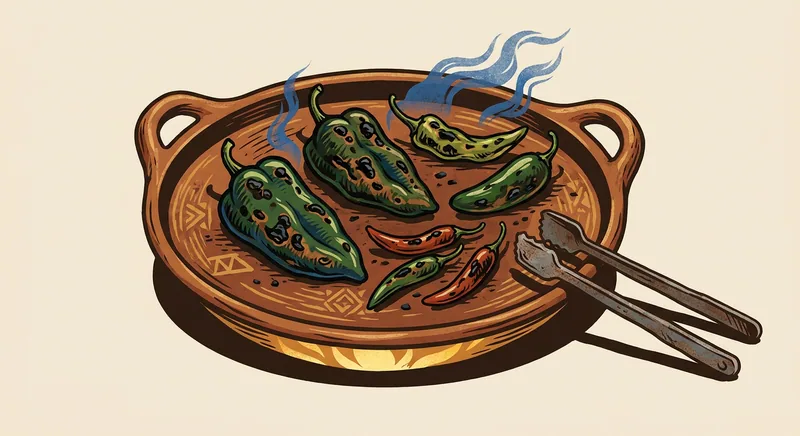
Roasting a chile is meant to blister and darken the skin, soften the flesh, and awaken toasted aromas, not reduce it to charcoal. On a comal, place it clean and dry over medium-high heat, turning it with tongs until most of the surface is blackened and the flesh yields a little. In the oven, set it under the broiler and turn it once; a direct flame also works, as long as it is controlled. Poblanos and chilacas stand up well to this treatment, while serranos and jalapeños require attention because their size takes them quickly from tatemado to funeral.
- 1Wash the chiles only just before using them and dry them very well so they roast instead of steaming.
- 2Charring them in batches keeps the comal from cooling down and lets you turn each piece in time.
- 3When you take them off, place them in a covered container for 10 to 15 minutes; their own steam will loosen the skin.
- 4Peel them with your fingers or a napkin. Do not rinse them under running water: it washes away juices and roasted aromas.
- 5Make an opening if you are going to stuff them; remove seeds and veins depending on the desired heat, without tearing the flesh.
The custom of letting the chiles “sweat” in a bag works, but a covered bowl or reusable container does the same thing without adding plastic. Nor is it necessary to remove every last black spot: a few small charred areas add flavor. If the chile is going into a salsa, more of the skin can stay on; if it will be stuffed, it is best to remove almost all of it for a pleasant texture. Cooking rewards precision, not fussiness.
To honor the flavor, combine without burying it. A roasted poblano needs little more than onion, salt and perhaps crema; a raw serrano welcomes tomato, cilantro and a few drops of lime juice; a pickled jalapeño shines with vinegar, carrot, onion and subtle spices. Chilaca can be stewed with tomato or mixed with queso fresco without losing its earthy note. Add the chile in stages: some at the beginning to blend in and the rest at the end to preserve aroma and texture.
Preserving August without locking it away
Fresh chiles should be stored dry and unwashed in the refrigerator’s crisper drawer. A perforated bag or a container with a paper towel helps control moisture; if condensation builds up, let it air out and replace the paper. Poblanos and jalapeños generally keep for about a week in good condition, while chilacas and serranos may vary depending on how fresh they were to begin with. Check them every few days and immediately remove any soft or moldy pieces so they do not affect the rest.
- 1Refrigerating roasted chiles: let cool, store in a clean, airtight container, and use within 3 or 4 days.
- 2Freezing whole: roast, sweat and peel; first freeze separately on a tray, then transfer them to a bag, pressing out the air.
- 3Freezing in strips: portion according to the dishes you usually make and add a tablespoon of their own juices to protect the flavor.
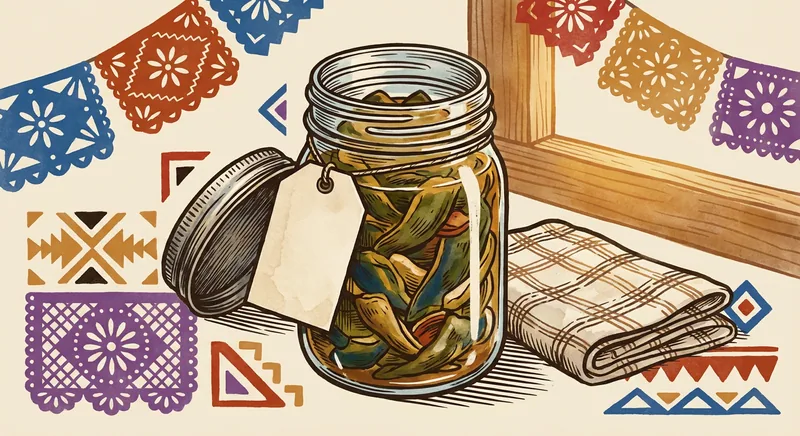
- 4Pickling jalapeños or serranos: use a tested recipe and keep refrigerated if you will not be following a safe canning process.
- 5Drying: use a dehydrator or low-temperature oven until all moisture is gone; store only when completely dry.
Freezing changes the texture somewhat, so those chiles are better in soups, salsas, rajas and stews than in raw preparations. Before storing them, label them with the variety and date: after three months, all the green packages look like distant relatives. To preserve them longer in jars at room temperature, simply pouring in hot vinegar and sealing is not enough; a tested canning recipe with safe acidity and processing is required. The refrigerator forgives plenty of improvisation; microbiology forgives none.
Buying chiles in August means reading simple signs: firmness, weight, aroma and vibrant skin, even if it is not perfect. Roasting them well means letting the fire reveal sweetness and depth; storing them well means preserving that voice without turning it into a freezer echo. Poblano, serrano, jalapeño and chilaca offer something more interesting than a scale of bravery: green, roasted, fruity and earthy nuances that have graced the Mexican table for centuries. When we open a bag of roasted rajas in November, the rainy season will return without fanfare: the aroma of the comal will be enough.
- National Commission for the Knowledge and Use of Biodiversity (CONABIO), Enciclovida: Capsicum annuum.
- Janet Long-Solís, Capsicum and Culture: The History of Chilli, Fondo de Cultura Económica, 1986.
- Bernardino de Sahagún, General History of the Things of New Spain, Book X.
- National Service for Agrifood Health, Safety and Quality (SENASICA), information on chile and agricultural production in Mexico.
- National Center for Home Food Preservation, University of Georgia, guides to freezing, drying and pickling peppers and chiles.