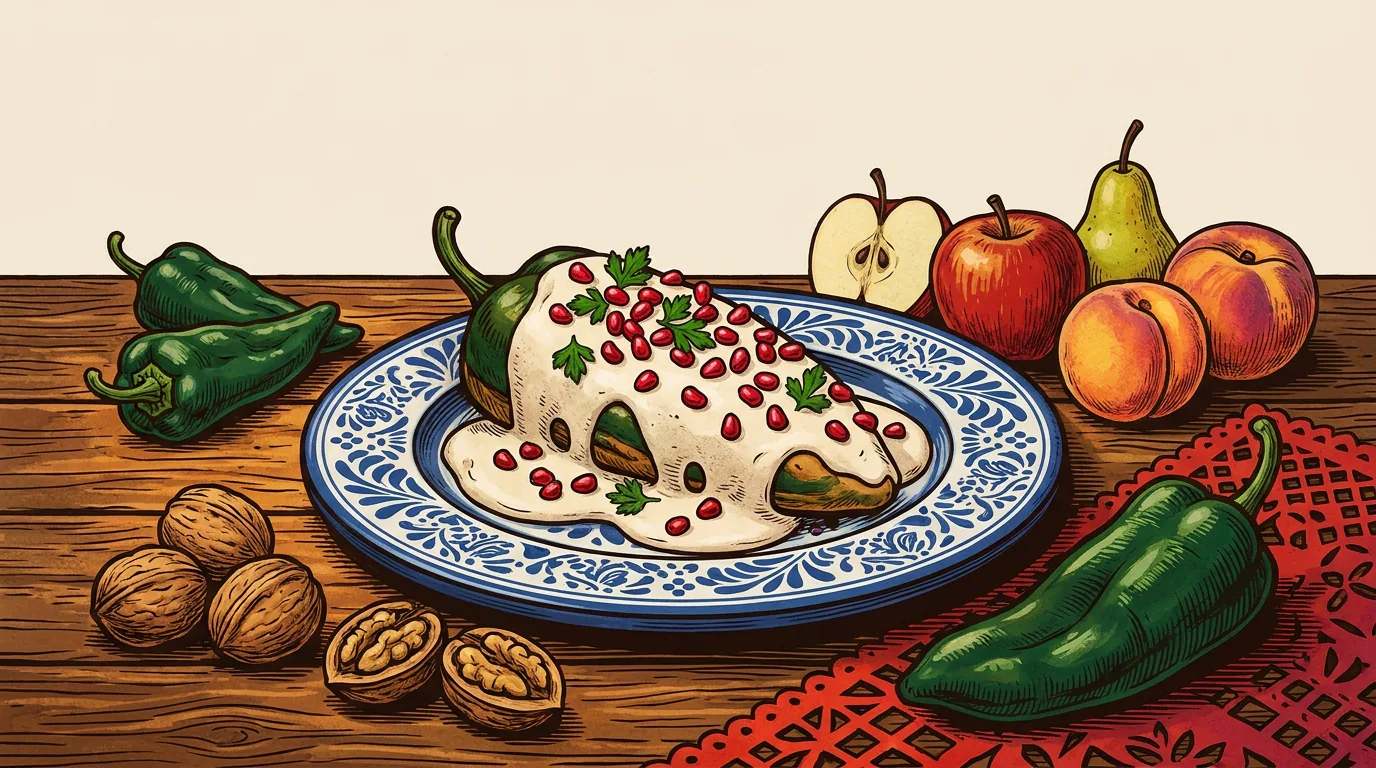
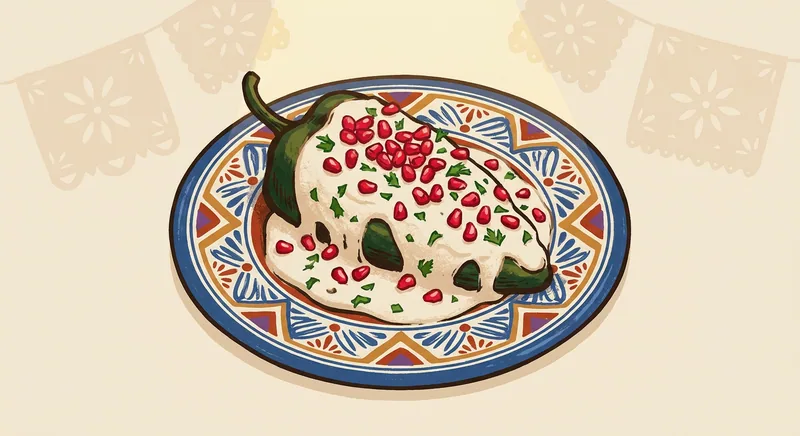
Some dishes arrive at the table, while others make a grand entrance. Chiles en nogada belong to the second kind: green and glossy beneath an ivory-colored sauce, sprinkled with pomegranate seeds and parsley. Their season coincides with Mexico’s Independence Day celebrations, but their charm does not rest solely on the edible flag: it lies in the balance of heat, fruit, meat, nuts and a touch of acidity. Preparing them takes time and good judgment; cape and sword, fortunately, are not required.
Between History and Legend
The most widely repeated version says that the Augustinian nuns of the convent of Santa Mónica, in Puebla, created the dish in 1821 to honor Agustín de Iturbide, using the colors of the Army of the Three Guarantees. It is a captivating story, but it is not supported by a convent recipe from that year. Nineteenth-century Puebla cookbooks show that stuffed chiles and walnut sauces were already in circulation, while the patriotic presentation we recognize today took shape over time. By all means, serve the legend alongside the dish, but do not pass it off as a notarized document.
Cooking also writes history, though it rarely signs at the bottom.
Before Turning On the Stove
- 16 large poblano chiles, firm and unblemished
- 2350 g ground or finely chopped pork
- 3350 g ground or finely chopped beef
- 42 tablespoons lard or oil
- 51/2 white onion and 2 garlic cloves, chopped
- 63 ripe tomatoes, roasted, peeled and puréed
- 71 panochera apple, 1 milk pear and 2 criollo peaches, peeled and cut into small cubes
- 81/2 ripe plantain, fried in cubes
- 91/3 cup raisins and 1/3 cup peeled, chopped almonds
- 101 pinch cinnamon, 1 ground clove, salt and pepper
- 11250 g shelled fresh walnuts
- 12120 g fresh goat cheese or mild cream cheese
- 133/4 cup milk, plus more as needed
- 142 tablespoons dry or semidry sherry and 1 teaspoon sugar, optional
- 15Seeds from 1 pomegranate and parsley leaves to finish
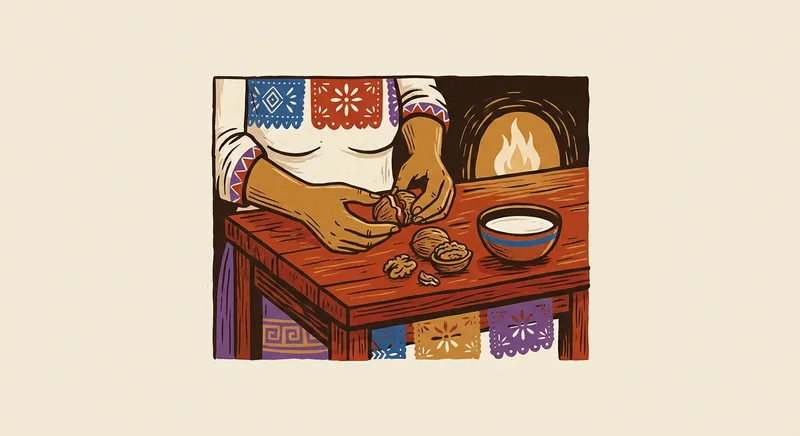
The filling: fruit, meat and patience
- 1Roast the chiles directly over the flame or on a comal until the skin blisters, without burning the flesh. Place them in a bag or covered container for 10 minutes; peel them, make a slit along one side and carefully remove the veins and seeds.
- 2Heat the lard or oil. Sauté the onion and garlic until translucent; add the meats, season with salt and pepper, and cook until no longer pink.
- 3Stir in the puréed tomato and cook until the mixture loses its excess liquid. Add cinnamon and cloves sparingly: they should lend fragrance, not announce a pastry shop.
- 4Add the apple, pear and peach. Cook for 8 to 10 minutes; stir in the plantain, raisins and almonds, and let the filling become juicy but not soupy.
- 5Adjust the seasoning, let cool until lukewarm and fill the chiles without packing them tightly. If one opens too much, arrange it with the opening facing down; culinary dignity allows for patchwork.
Many home-style versions are served without an egg batter, like this one, so the poblano and nogada retain a cleaner profile. Others have a coating of beaten egg and are fried, a documented and much-loved practice in Puebla. There are no egg-batter police: the deciding factors are that the chile is properly roasted, the filling is not cloying and the sauce does not resemble paste.
The nogada and when to serve
- 1Blend the peeled walnuts with the cheese, milk, sherry and sugar until smooth. Add more milk a little at a time if it is too thick.
- 2Taste before adjusting: the nogada should taste first and foremost of walnuts, with enough salt and only barely perceptible sweetness. Avoid overblending, as the heat from the blender can alter its texture.
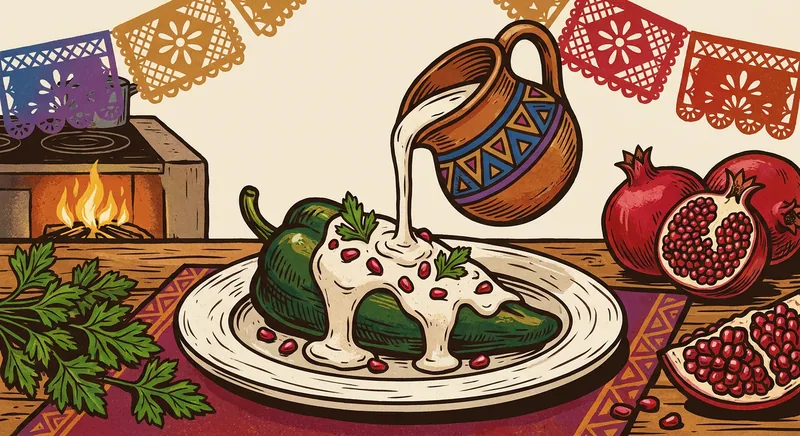
- 3Arrange the chiles at room temperature or slightly warm. Spoon the nogada over them just before bringing them to the table.
- 4Finish with pomegranate seeds and parsley. Serve immediately; the sauce loses its charm if it sits on the chile for hours.
To work at an easy pace, the picadillo can be made a day ahead and refrigerated; it is best to bring it back to room temperature before filling the chiles. The nogada is best made the same day, kept well covered and cold, though it should rest outside the refrigerator for a few minutes before blending or serving. If it thickens, adjust it with milk, one tablespoon at a time, not a deluge. The yield is six generous servings, the kind that make any discussion of dessert unnecessary.
A well-made chile en nogada does not need to look exactly like one on a postcard or swear loyalty to a single family. It needs seasonal ingredients, balance and a hand that tastes as it cooks. Every household changes the meat, cheese, sherry or egg batter; what remains is that unlikely conversation among the orchard, the barnyard and the walnut tree. Perhaps that is why it returns every year: not to repeat a legend, but to remind us that a recipe is also a way of caring for time.
- Muñoz Zurita, Ricardo. Diccionario enciclopédico de la gastronomía mexicana. Larousse Cocina.
- Pérez San Vicente, Guadalupe. Repertorio de tamales, chiles rellenos, moles y pipianes. Fundación Herdez.
- National Institute of Anthropology and History (INAH), public outreach materials on chiles en nogada and Puebla cuisine.
- Puebla Municipal General Archive, historical Puebla cuisine cookbooks, 19th and 20th centuries.