Before you see hammered copper, you hear it. In the workshops of Santa Clara del Cobre, Michoacán, blows fall rhythmically on the hot metal: sharp, precise, sometimes alternating like a conversation in which no one needs to raise their voice. From that measured clamor emerge pots, pitchers, vases and sculptures whose surfaces preserve thousands of tiny marks. It is not a finish that conceals the work: it is the work itself, transformed into shine.
An Ancient Metal, Several Worlds
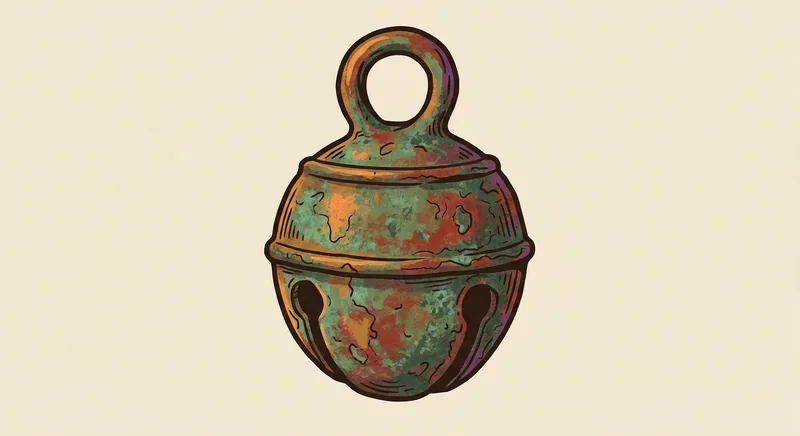
Copper was one of the first metals worked by humankind because it can be found in its native state and can be hammered without breaking easily. In Mesoamerica, however, its use developed relatively late, especially during the Postclassic period, between approximately 900 and 1521. In western Mexico—a region encompassing parts of present-day Michoacán, Jalisco, Colima, Nayarit and Guerrero—objects were made from copper and its alloys through casting, hammering and other processes. Axes, needles, tweezers, bells, fishhooks and ornaments speak to a complex technology, not a rudimentary experiment.
Mesoamerican metallurgy had technological ties to traditions from Central and South America, probably transmitted through maritime routes and trade networks. Specialists recognized properties we would now describe in physical terms: hardness, resonance, color, cutting ability and strength. Bells, for example, were not mere trinkets; their tone could play a role in ritual attire and in the sonic experience of a ceremony. Metal was useful, yes, but it also held meaning.
In the territory ruled by the Tarascan State—also called Purépecha—metallurgy became especially important. The Lake Pátzcuaro basin was the political center of that power, while different areas supplied raw materials, specialists and goods. 16th-century sources and archaeology show that metal objects had domestic, productive, military, ornamental and ceremonial uses. It bears saying without a romantic haze: the Purépecha did not “discover” copper only for Europe to later teach them how to work it; they already possessed knowledge of their own, although the conquest altered techniques, scales and the purposes of production.
From the Indigenous Workshop to the Colonial Order
After the Spanish conquest, regional metallurgy became part of a different economic system. Iron tools, new object designs, European methods and colonial demand focused on utensils, currency, weapons and mining were introduced. Working conditions also changed: tribute, population resettlement, encomiendas and extractive enterprises reorganized community life. The history of the craft, then, cannot be contained within the pleasant image of two cultures exchanging secrets before a forge; there was adaptation and innovation, but within a profoundly unequal relationship.
Santa Clara del Cobre is located near Pátzcuaro and is now part of the municipality of Salvador Escalante. During the 16th century, the settlement was known as Santa Clara de los Cobres, a name that already points to its specialization. Tradition credits Vasco de Quiroga, the first bishop of Michoacán, with organizing different crafts in the towns of the region. Quiroga promoted hospital-towns and productive projects inspired, in part, by humanist ideas; but the claim that he individually and systematically assigned a craft to each community is more local tradition than a fact documented with directory-like precision.
Legend makes Vasco de Quiroga the sole father of Santa Clara’s copper tradition; history reveals a much larger family.
The craft’s continuity is better explained by the combination of Indigenous knowledge, colonial transformations, the regional availability of metal, trade networks and transmission within families. Purépecha artisans incorporated new tools without abandoning the manual intelligence accumulated over generations. Rather than a sudden invention, there was a long negotiation with fire: techniques that endured, others that changed and new forms that responded to kitchens, temples, haciendas and markets. When tradition is alive, it does not merely repeat; it also corrects, experiments and comes to terms with the present.
Hammering Without Harming
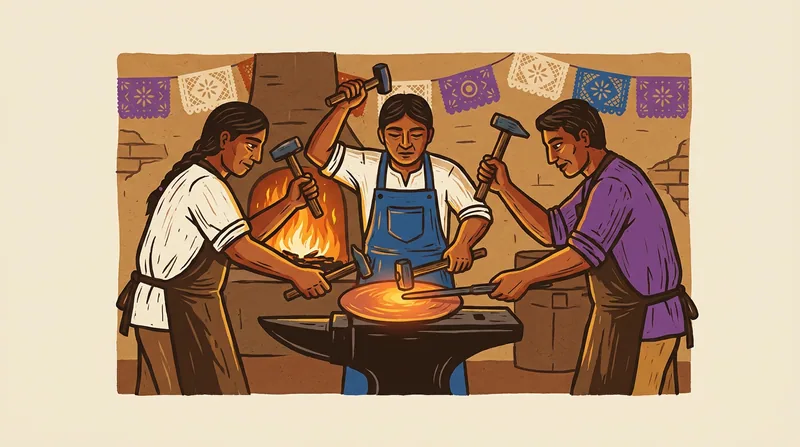
Hammered copper usually begins with metal gathered and melted in a forge or crucible until it forms a mass or ingot. From there, heating and hammering alternate to spread, raise and close the piece. The artisan must recognize the metal’s color, the resistance it offers and the sound of each hammer blow; copper that is too cold can crack, and copper that is poorly heated makes the work clumsy. Here, the main thermometer has eyes, ears and years of experience.
- 1Melt or prepare the copper and form an appropriately sized ingot.
- 2Heat the metal until it becomes malleable, without melting it again.
- 3Hammer it out on the anvil to create a sheet or disk.
- 4Raise the walls of the piece through successive blows and intermediate annealing.
- 5Even out the form, riveting or soldering components when the design requires it.
- 6Chisel, engrave, polish or patinate the surface according to the desired finish.
Annealing—heating the copper and letting it cool to restore its ductility—is essential because hammering hardens the metal. This phenomenon, called work hardening, gives a piece strength, but requires stopping before the material becomes fatigued. That is why the process moves forward like breathing: fire, blow, pause; fire, blow, pause. In this case, haste is not only a poor advisor: it leaves dents that not even the finest polishing can make the piece forget.
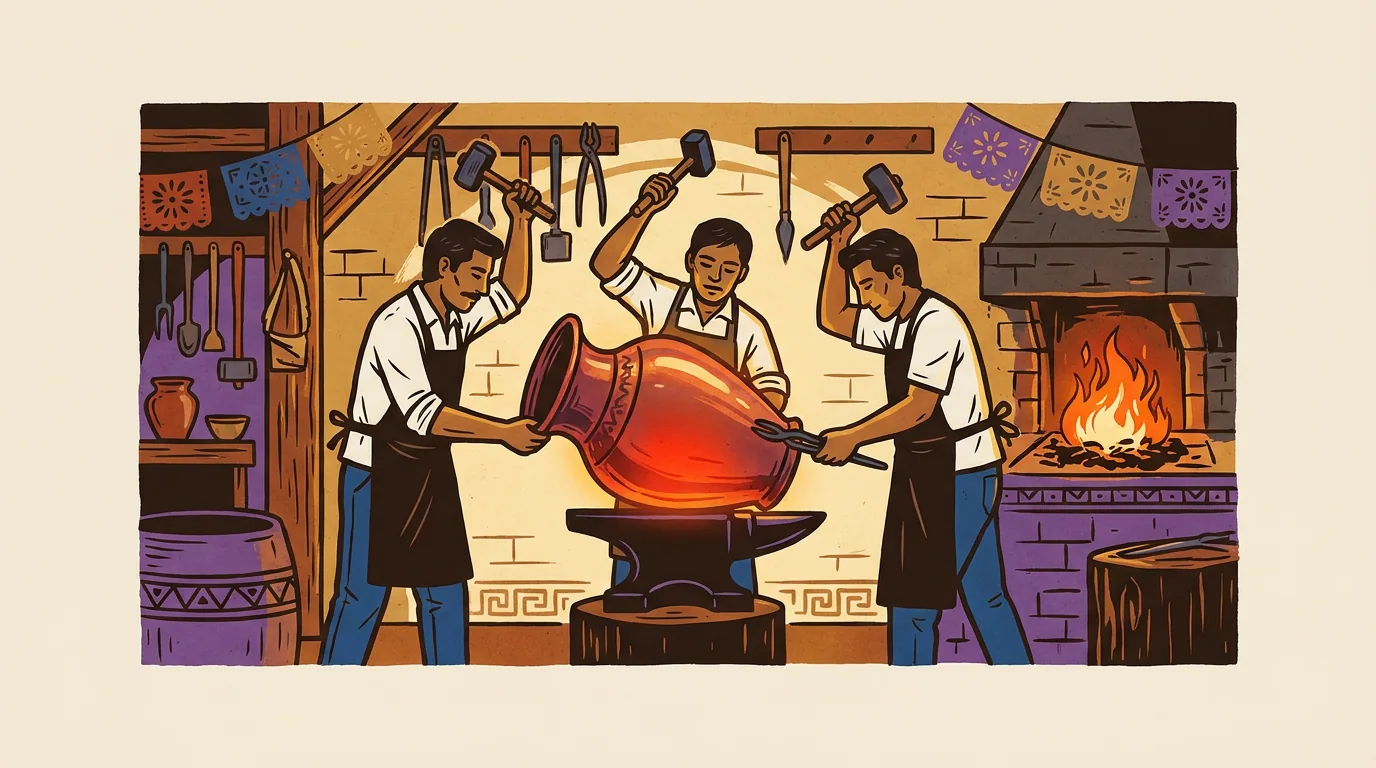
Each hammer has a job. Some spread the metal, while others raise walls, refine curves, correct edges or imprint textures; the anvils and stakes supporting the piece also vary. Several people work on large pieces, taking turns hammering to distribute the force and maintain the rhythm. That rhythm is not a folkloric flourish for visitors: it helps control the movement of the metal and keeps the hammers from meeting a little too amicably on someone’s fingers.
Form Holds Memory
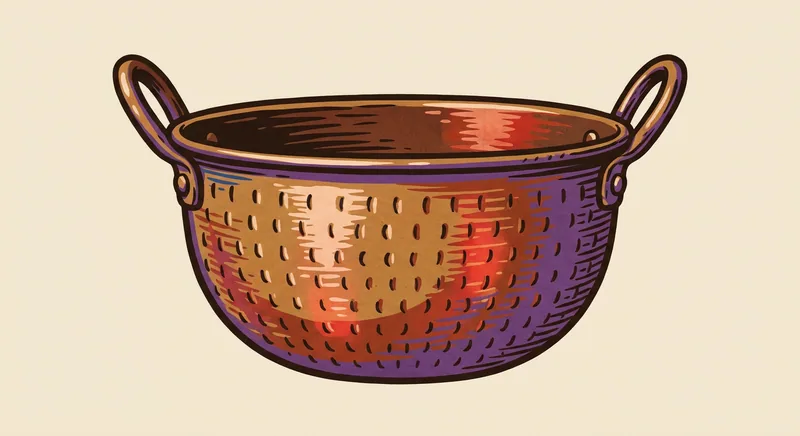
For centuries, much of the production was tied to utilitarian objects: pots for cooking and processing food, cooking pots, pitchers, ladles, trays and vessels for different tasks. Utility demanded precise formal solutions: bottoms able to distribute heat, durable rims, sturdy handles and bodies that could withstand fire and cleaning. Even the hammered texture helped harden the sheet metal and smooth over small irregularities through a deliberate pattern. Beauty did not come after function; it was at work from the very first blow.
In the 20th century, workshops greatly expanded their repertoire to include decorative and sculptural pieces. One decisive figure was the artisan José Rubén Romero, known as Tata Vasco, who, along with other masters, promoted new forms and an artistic appreciation of the craft. Artisan competitions, exhibitions and the Feria Nacional del Cobre, held in Santa Clara, also flourished, giving visibility to large-scale works of virtuosic execution. This broadening did not replace the pot: it gave it a place at the table alongside vases, reliefs, sinks, animals and abstract forms.
Today it is possible to find pieces made from recycled copper, a practice consistent with the metal’s ability to be melted down and reused. Wire, scraps and discarded objects can return to the crucible, although the material’s composition and cleanliness must be controlled to obtain consistent results. Recycling does not automatically make the entire process sustainable: fuel burned in the forge, coatings, transportation and working conditions also matter. Even so, there is a kind of material wisdom in a metal that can live several lives, a rare virtue in the age of “use it and throw it away.”
Buying a piece means looking beyond the shine. The hammer marks should be integrated into the form; the joints, rivets and handles should feel sturdy; and if it is a cooking utensil, it is worth asking about the interior lining and care instructions. It is also valuable to learn about the workshop and the name of the person who made the work, since the generic label “Mexican craft” often erases authorship with almost industrial efficiency. A signed or documented piece is not more authentic by decree, but it makes it possible to recognize the body of work behind the object.
A Town That Still Rings
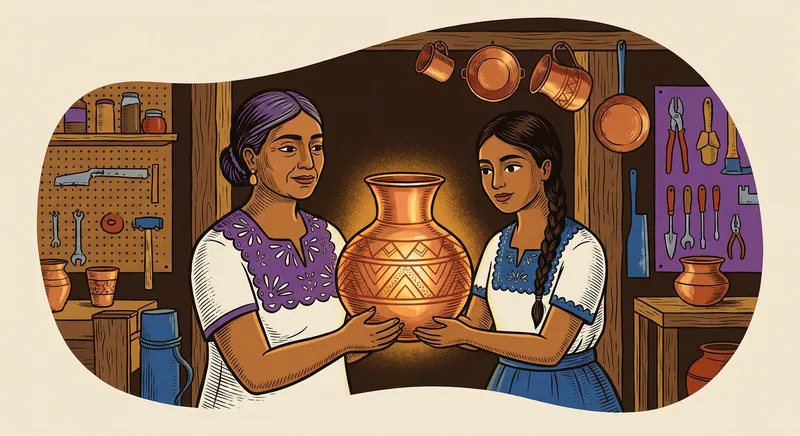
Santa Clara del Cobre is not a place frozen in the 16th century. It is a community where the craft coexists with schools, commerce, migration, tourism, contemporary commissions and concrete challenges in obtaining raw materials or keeping a workshop running. Family transmission remains fundamental, although there are also training spaces, competitions and organizations that bring producers together. As with many forms of folk art, the challenge lies in innovating without letting the market turn every difference into a souvenir.
Fame brings opportunities, but also mass-produced imitations, haggling and simplified stories designed for a quick sale. Defending hammered copper means paying a fair price and recognizing that a piece embodies fuel, tools, experience, design and many hours of physical effort. It also means accepting that artisans can create new objects without losing legitimacy: no one demands that a painter repeat the same landscape forever to prove that they belong to a tradition. Copper, too, should not be condemned to play only one role.
There is a reason these surfaces move us even before we know their history. Unlike the anonymous perfection of an industrial sheet, hammered copper preserves decisions: where it was heated, how much it yielded, at what point it needed more work and when it was wise to stop. Each individual mark may seem like little, but together they build a vessel, a sculpture and a shared memory. In Santa Clara del Cobre, the metal does not forget the blow; it learns to give it form.
- Dorothy Hosler, The Sounds and Colors of Power: The Sacred Metallurgical Technology of Ancient West Mexico, MIT Press, 1994.
- Relación de Michoacán, edition and studies by El Colegio de Michoacán.
- National Museum of Anthropology, INAH, collections and materials from the Hall of Western Cultures.
- Casa de las Artesanías de Michoacán, information on craft traditions and hammered copper competitions.
- National Fund for the Promotion of Handicrafts (FONART), materials on folk art and Mexican metalwork.