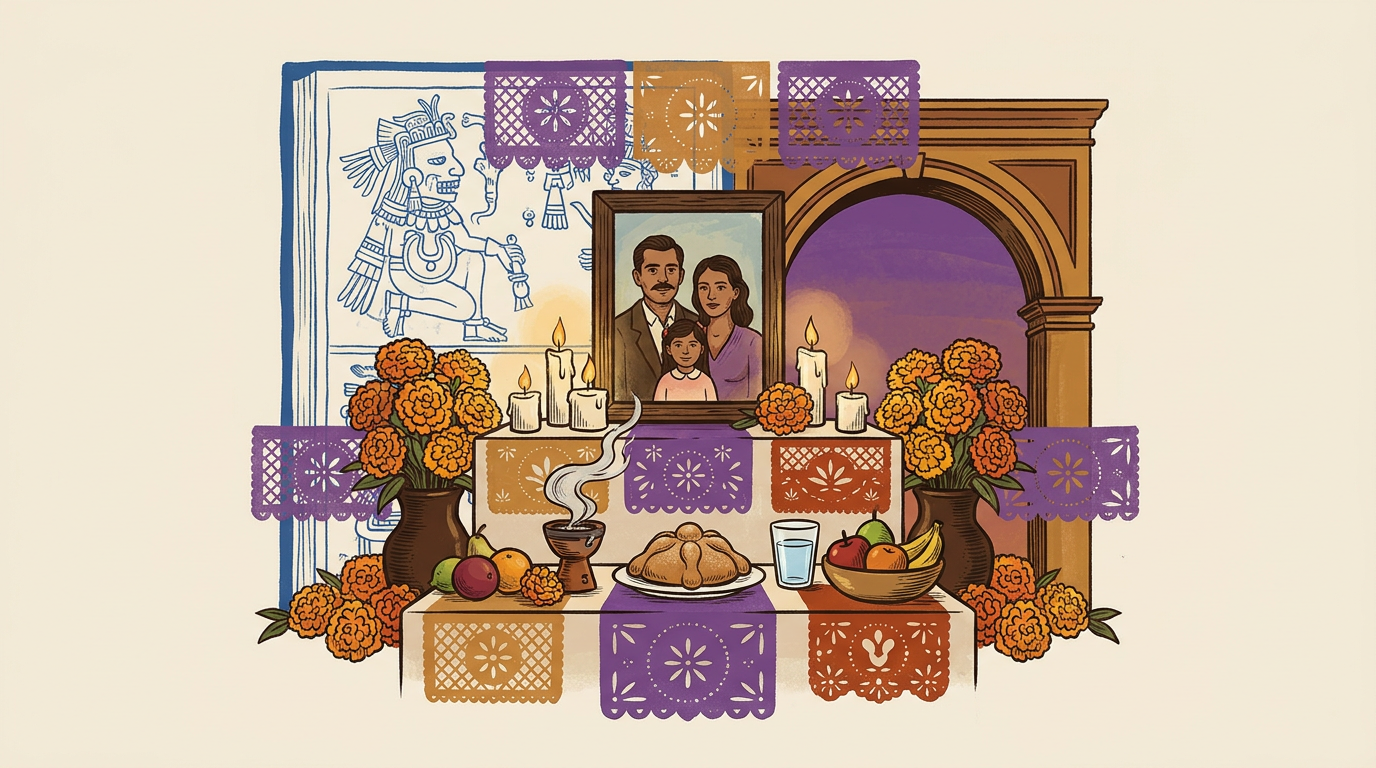
On a household ofrenda, time arranges itself as best it can: a recent photograph shares the table with a great-grandmother’s recipe, a candle lights a glass of water and the scent of cempasúchil mingles with that of bread. Day of the Dead feels ancient and familiar, as though it had arrived whole from a distant past. But its history is less linear and far more interesting: it is not a pre-Hispanic relic preserved under glass, but a tradition built from Indigenous calendars, Catholic rites, family decisions, printed images and political change. To put it without taking away its charm: it has not one origin, but many genealogies seated at the same table.
Before November, Other Calendars
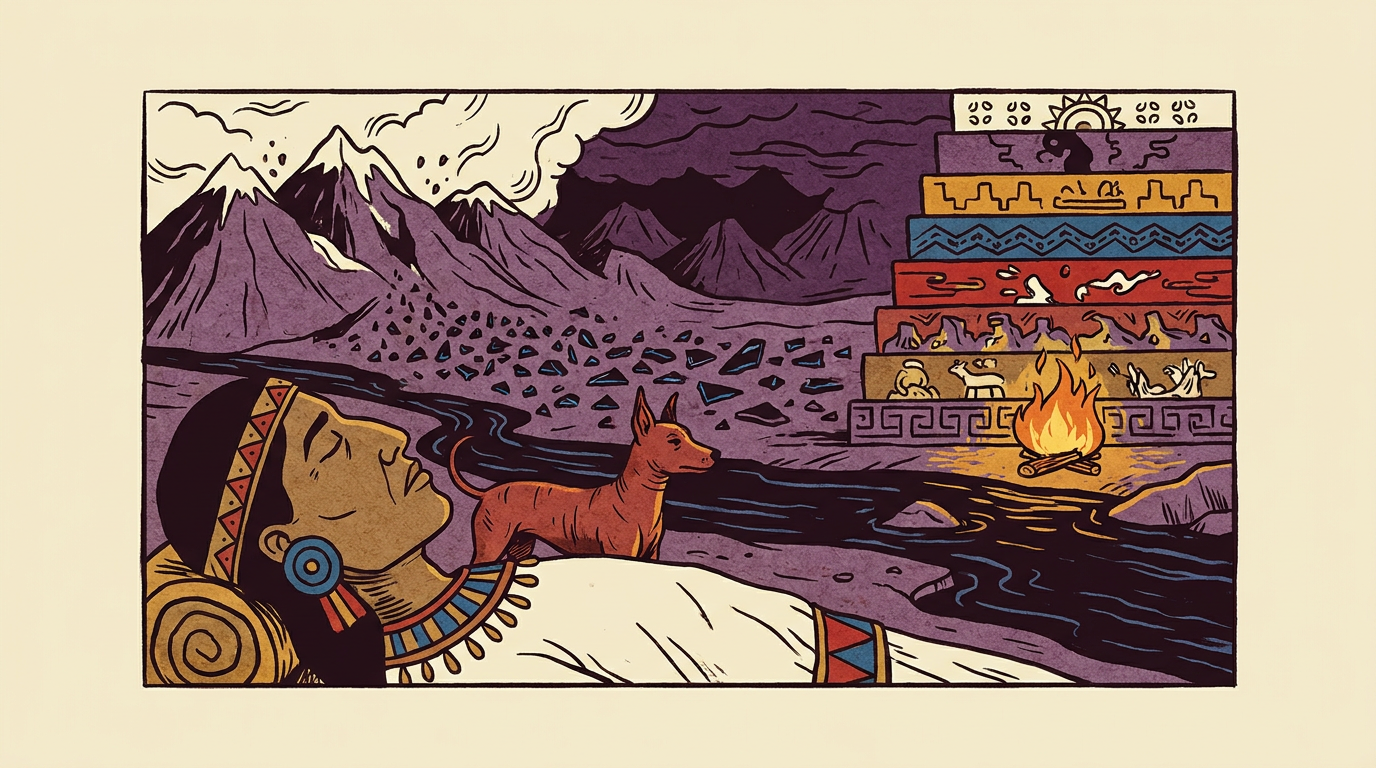
Mesoamerican peoples did not share a single doctrine about death. Mexicas, Maya, Purépechas, Mixtecs and many other societies had different languages, calendars, ceremonies and destinations in the afterlife. Among the Mexicas, for example, a person’s destination after death depended largely on how they died, not on a moral judgment equivalent to the Christian heaven and hell. Those who died from causes associated with water could go to Tlalocan; warriors killed in battle and certain sacrificial victims accompanied the Sun; many others set out on the arduous journey to Mictlan.
Colonial sources describe several twenty-day ritual periods connected with the dead in the Nahua solar calendar. Among them are Miccailhuitontli, the feast of the little dead, and Huey Miccailhuitl, the great feast of the dead, although the names and correspondences vary depending on the source and its interpretation. They were not simply celebrated on November 1 and 2, nor did they constitute an ancient version of the contemporary ofrenda. There was food, singing, ritual images, sacrifices and communal commemorations embedded in a religious order that the conquest profoundly dismantled.
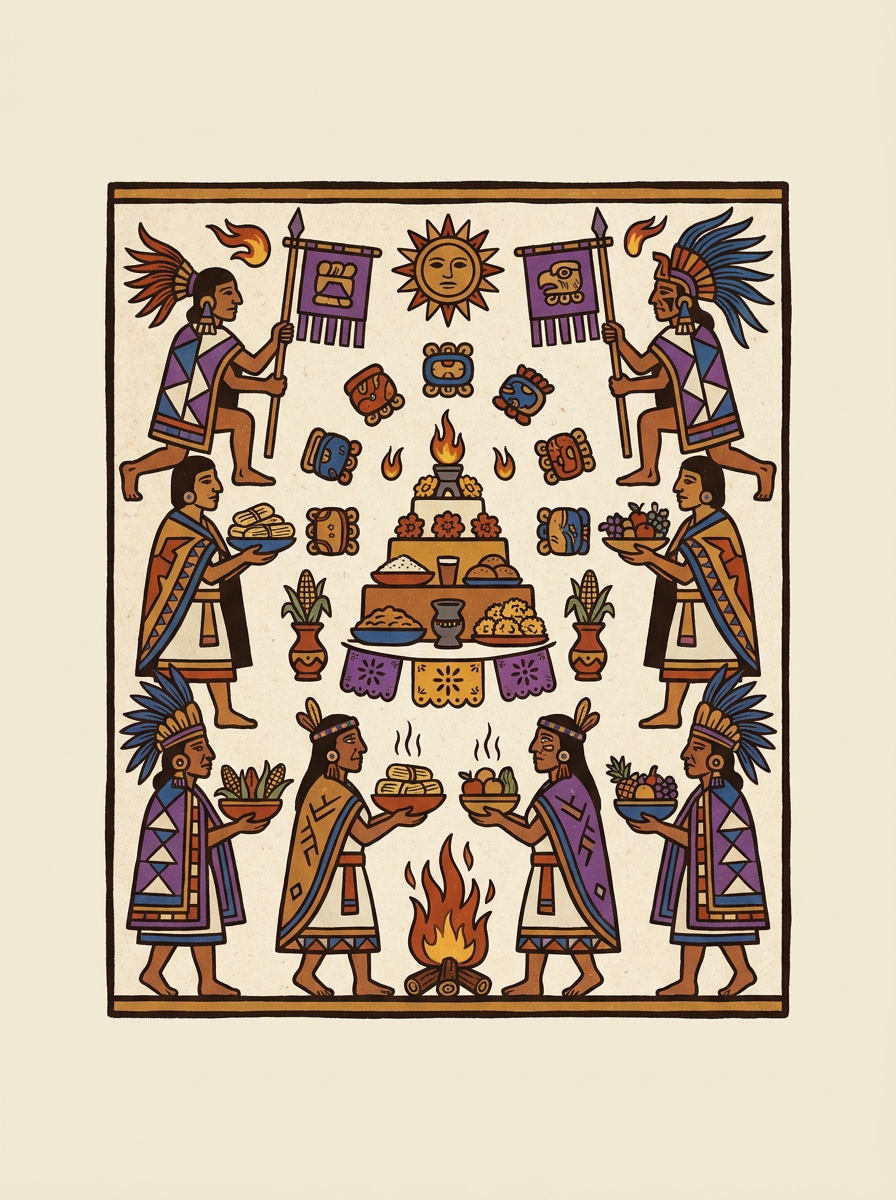
It is also wise to be wary of an overly uniform image of “the pre-Hispanic.” The accounts we know were largely written or painted after the conquest and under colonial conditions; Fray Bernardino de Sahagún, Diego Durán and their Indigenous collaborators recorded valuable knowledge, but they did so in a world already transformed. Their pages allow us to reconstruct earlier practices while also revealing translations, censorship and comparisons with Christianity. History comes to us with words crossed out: that is not a flaw in the archive, but part of the story.
Bells Over Ancient Calendars
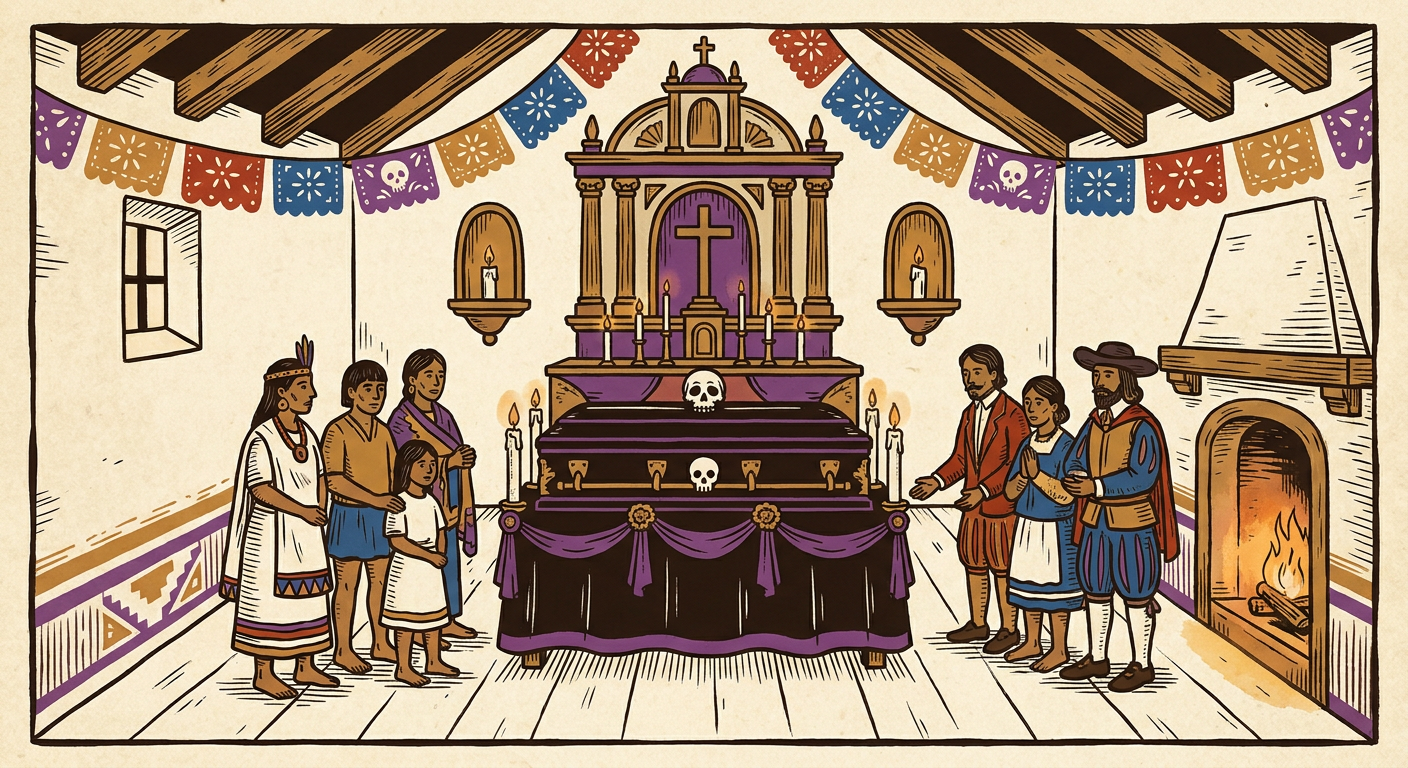
With the Spaniards came war, epidemics, evangelization and a new political order. The Catholic liturgical calendar also arrived, dedicating November 1 to All Saints’ Day and November 2 to the Commemoration of All the Faithful Departed. These dates had a long European history: Masses, the ringing of bells, prayers for souls in purgatory, visits to cemeteries, alms and foods associated with the memory of the dead. The thematic overlap made encounters easier, but not a clean substitution, like replacing one tablecloth with another.
The friars sought to concentrate and reinterpret Indigenous ceremonies within a Christian framework. They destroyed temples and images, banned sacrifices and labeled many practices idolatry; at the same time, they learned local languages, organized confraternities and used theater, music, painting and processions to teach the new faith. Indigenous communities did not receive all of this passively: they adapted forms, preserved memories, negotiated obligations and gave their own meanings to Christian images and observances. This process is often called syncretism, although the word can conceal conflict if it is used like a historical blender in which everything ends up smooth.
Rather than an intact survival, Day of the Dead is a historical tradition: it remembers, adapts, debates and puts itself back together.
During the viceroyalty, the November commemorations were observed in different ways across cities, towns and neighborhoods. In churches and convents, funeral catafalques and ephemeral displays were erected to honor powerful figures; in parishes, people prayed for the souls of the dead; in homes, foods and objects associated with the occasion circulated. The household altars we recognize today cannot be traced in their entirety to any one ceremony from the 16th century. They took shape gradually through Catholic devotional practices, Indigenous customs of feeding and receiving the dead, regional traditions and later changes.
- 1Indigenous calendars that placed ceremonies for the dead at different times of the year.
- 2All Saints’ Day and All Souls’ Day, incorporated through Catholic evangelization.
- 3Devotions to the souls of the dead, Masses, bells, cemeteries and confraternities in New Spain.
- 4Foods, flowers, scents and local objects offered according to each community’s customs.
- 5Urban, commercial, educational and artistic transformations from the 19th to the 21st centuries.
From the soul to the printed skull
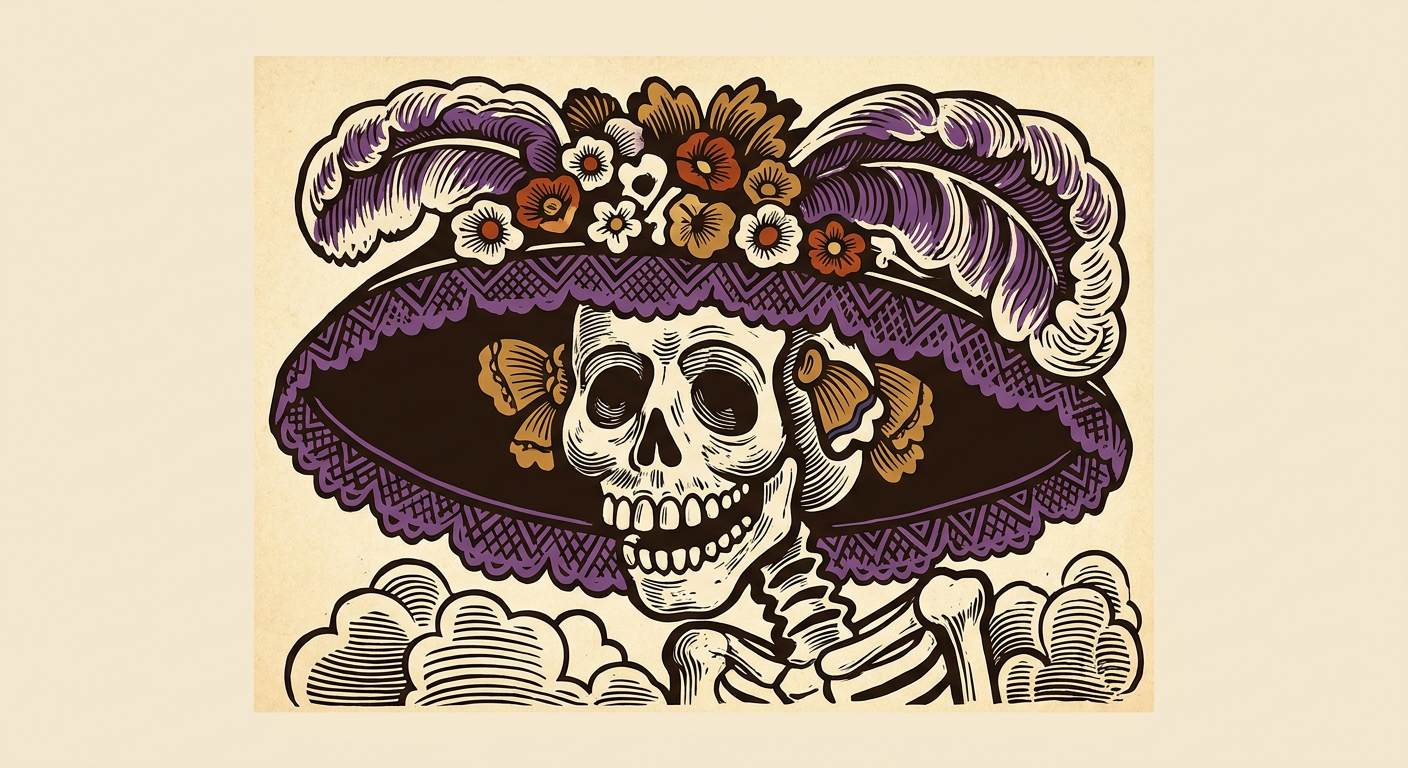
The 19th century added new layers. After Independence, liberal elites promoted the secularization of cemeteries and reshaped the institutional relationship among Church, State and death. At the same time, the popular press turned skeletons and skulls into tools of satire: the dead danced, drank, argued about politics or exposed the vanity of the living. They were not merely macabre decorations; they extended the European tradition of the dances of death and engaged with New Spanish imagery, but took on a local edge in broadsheets and inexpensive prints.
José Guadalupe Posada is central to this visual history, though he too has become shrouded in legend. The print now known as La Catrina first appeared as a female skull wearing an elegant hat, associated with criticism of those who disavowed their Indigenous origins to imitate European fashions; the name “Catrina” and the body dressed in finery became established later, especially thanks to Diego Rivera’s mural Dream of a Sunday Afternoon in Alameda Central, painted between 1946 and 1947. Posada did not invent Day of the Dead, nor did he single-handedly create Mexico’s relationship with the skull. But he did give death an extraordinary life in print.
In the 20th century, artists and institutions helped present Day of the Dead as a national emblem. Muralists, museums, public schools, photography and cultural policies selected certain images—skulls, papel picado, cempasúchil, tiered altars—and spread them beyond their regions. This national construction does not make the celebration false; it reveals that traditions, too, are edited, displayed and learned. In 2008, UNESCO inscribed the Indigenous festivity dedicated to the dead on the Representative List of the Intangible Cultural Heritage of Humanity, particularly recognizing its community roots, not a single recipe for assembling altars.
An ofrenda never speaks in the singular
Today, there is no single Day of the Dead celebrated identically throughout Mexico. In Janitzio and other Purépecha communities in Michoacán, in the Huasteca during Xantolo, in Mixquic, in Pomuch, Campeche, and in numerous towns across Oaxaca, Puebla, Veracruz or Yucatán, practices differ in dates, music, foods, processions and connections to the cemetery. Even within the same city, a family ofrenda may be Catholic, Indigenous, secular or a blend that no one needs to put to the test. Diversity is not a footnote: it is the historical heart of the celebration.
Nor is there a universal dictionary for the elements of the altar. Water may quench the visitor’s thirst; candles guide and offer prayers; copal cleanses or lends solemnity; food welcomes the dead with what they enjoyed. But meanings vary among regions and families, and some widely circulated explanations—such as assigning each level of the altar a fixed, ancient meaning—are recent systematizations, not Mesoamerican laws. If an aunt sets out orange soda because it was Grandfather’s favorite, her gesture holds more family truth than any seven-tier infographic.
- 1Ask which community, period and family a practice comes from before calling it “pre-Hispanic.”
- 2Distinguish among continuity, colonial adaptation and modern creation.
- 3Remember that a decorative skull is not, by itself, an ofrenda.
- 4Avoid presenting all Indigenous peoples as a single, unchanging culture.
- 5Recognize that the celebration belongs first to those who maintain living bonds with their dead.
The international expansion of the celebration has brought recognition, tourism and economic opportunities, but also simplifications. Movies, parades, skull makeup and merchandise can spark curiosity or turn an intimate practice into interchangeable décor. Mexico City’s grand parade, for example, began in 2016 after the James Bond film Spectre imagined one that did not yet exist in that form. It is a recent and entirely real tradition, just not an ancient one: even young customs deserve an accurate birth certificate.
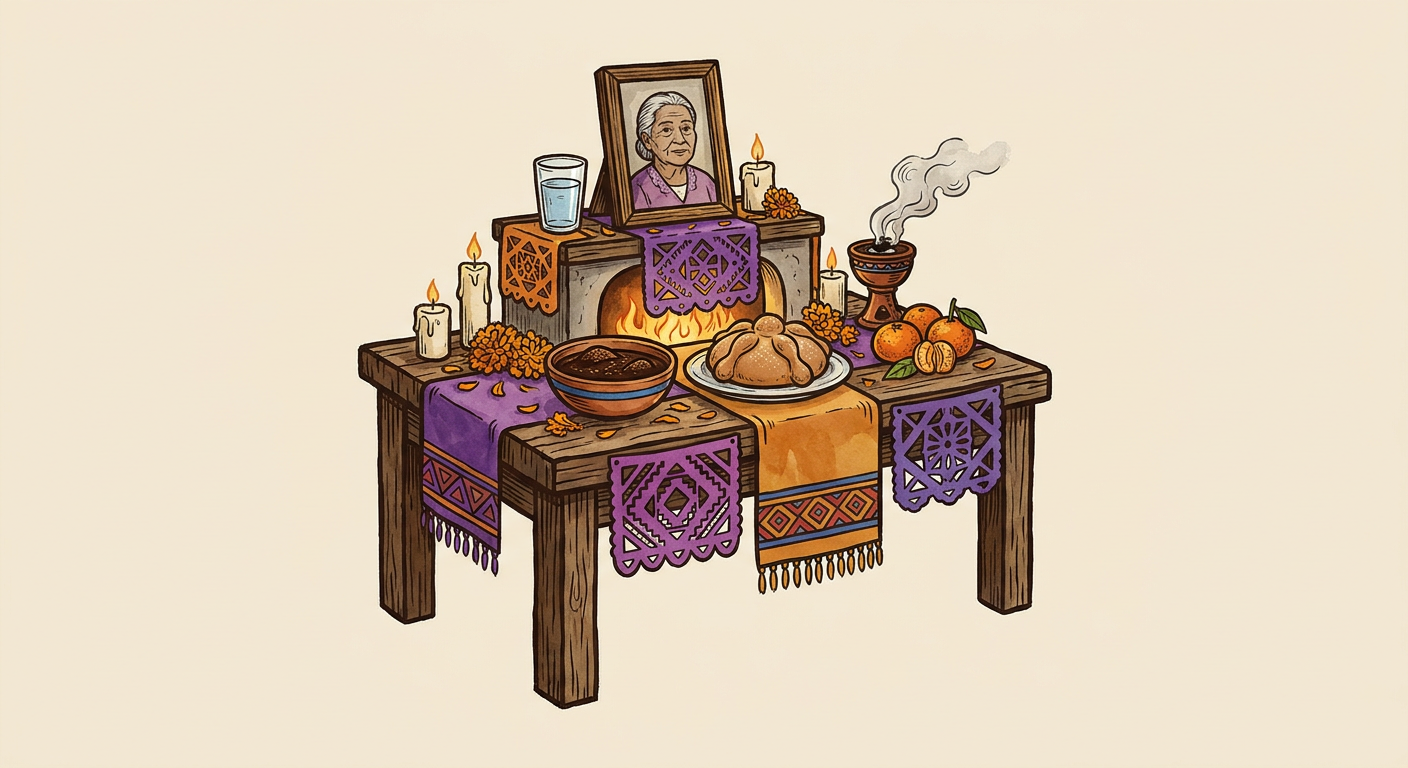
Looking at Day of the Dead through art allows us to recognize its materiality: scent, light, paper, dough, music, photography and gesture. It also compels us to see the hands that have remade it over the centuries, from the peoples subjugated by the conquest to the printers, cooks, florists, musicians, children and families who still set aside a place at the table. The celebration has survived not because it has remained intact, but because it knows how to change without ceasing to ask who is missing. Every November, that question lights a candle; and for a moment, the absent once again cast shadows among us.
- Bernardino de Sahagún, General History of the Things of New Spain (Florentine Codex), 16th century.
- Diego Durán, History of the Indies of New Spain and the Islands of the Mainland, 16th century.
- Stanley Brandes, Skulls to the Living, Bread to the Dead: The Day of the Dead in Mexico and Beyond, Blackwell Publishing, 2006.
- Claudio Lomnitz, Idea de la muerte en México, Fondo de Cultura Económica, 2006.
- UNESCO, “Indigenous Festivities Dedicated to the Dead,” Representative List of the Intangible Cultural Heritage of Humanity.