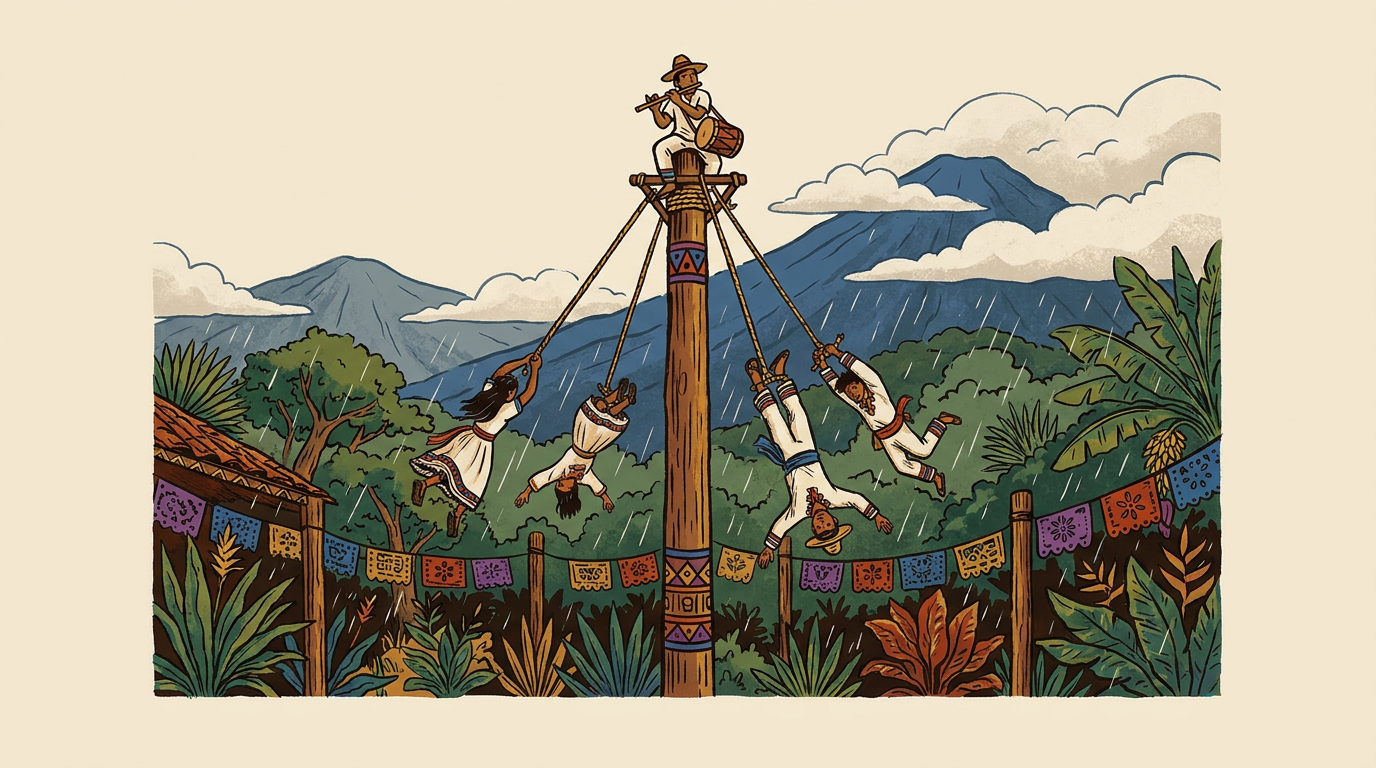
First comes the sound of a high-pitched flute, almost the size of a bird. Then the drum answers, and up there, where simply looking makes you dizzy, five men stand on a tiny platform: one plays music and dances; four commend themselves, lean out over the void and begin to circle the pole. The scene is famous, but its fame sometimes strips it of depth: this is not a circus act invented to entertain crowds in public squares, but a Mesoamerican ceremony linking sky, rain, earth and community. To understand it, you have to look up, yes, but also listen to what is happening at the foot of the pole.
It is known throughout Mexico as the dance of the Voladores de Papantla, though the name may simplify a much broader history. Papantla, Veracruz, is one of its living centers and the Totonac people its most widely recognized guardians, but variants exist or once existed among Nahua, Teenek, Otomí and other peoples of Mexico and Central America. Specialists trace its origins to the pre-Hispanic Mesoamerican world; there is, however, no birth certificate that would let us point to a year, a village and a first flight. As is often true of long-standing traditions, its origin cannot be contained in a single date, nor does it belong to a single voice.
A Ritual with Deep Roots
Colonial sources and Mesoamerican images reveal ancient practices of ascent, rotation and descent involving poles, ropes and suspended figures. The so-called palo volador was documented in different places during the viceregal period, a sign that the ritual was once more widespread than its current geography suggests. Over the centuries, some communities stopped practicing it while others preserved it, adapting it to new religious, political and festive contexts. That continuity does not mean immobility: a living tradition changes its clothing, its setting and sometimes its calendar, without necessarily losing the deeper conversation at its heart.
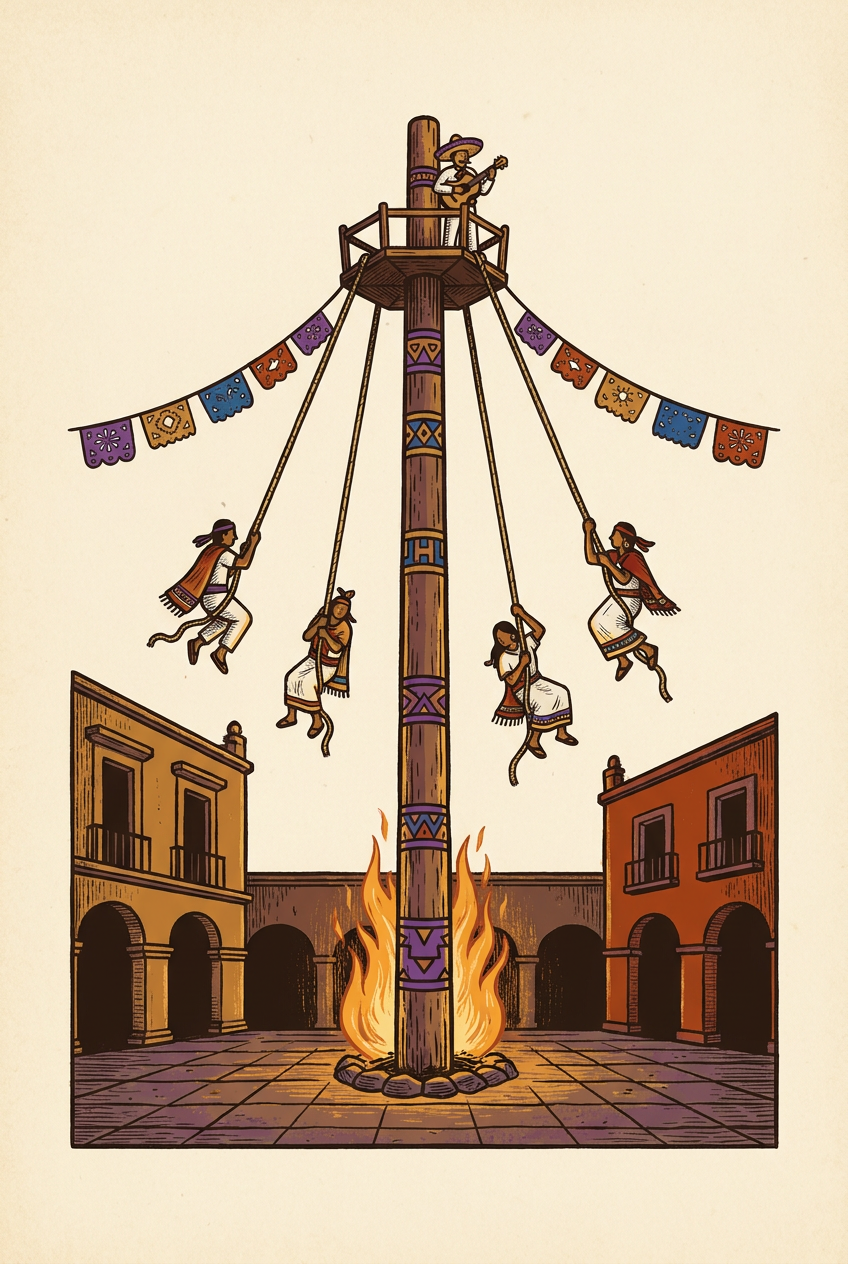
One widely told oral account says that the ceremony arose during a severe drought: elders are said to have asked chaste young men to venture into the forest, choose the tallest tree and offer music and flight to ask divine forces for rain. It is a powerful explanation, consistent with the practice’s agricultural meaning, but it should be presented as oral tradition, not as a proven documentary fact. Its versions change depending on who tells it, just as the paths through the same mountain range change. Rather than seek a literal chronicle in it, we would do well to heed what it teaches: the community depends on water, the forest and shared obligations.
They climb into the sky not to leave everything behind, but to ask that life return to the earth.
During colonial evangelization, many Indigenous ceremonies were banned, partially tolerated or reinterpreted through the Catholic calendar of saints. The flight survived through local negotiations and eventually became part of patron saint festivals, fairs and civic celebrations, without completely erasing its references to the agricultural cycle and the powers of the natural world. That is why it may appear beside a church while still preserving gestures directed toward the earth and sky. Mexico’s religious history rarely moves in single file; it favors intersections, patchwork and double readings.
The Tree Turned Path
In its traditional ceremonial form, the pole is not simply a prop. Choosing the tree, asking the forest for permission, cutting it down, transporting it and setting it upright can form a ritual sequence in which the community takes part and offers food, drink, music or other gifts, depending on local custom. The upright trunk serves as an axis connecting levels of the universe: its imagined roots belong to the earthly realm; its crown, replaced by the platform, draws close to the sky. Even when permanent metal poles are now used for practical reasons, the memory of the tree continues to pulse through the ceremony.
At the top is the tecomate, or rotating frame, from which the ropes extend, along with a small platform where the caporal performs. With a reed flute and drum, he plays sones addressed to the directions of the universe and to entities associated with rain, the Sun and the earth; the repertoire and its names vary among communities and masters. Then the four voladores fall backward, secured at the waist, and the ropes unwind as their bodies trace a spiral. The mechanism is easy to describe and far from easy to carry out: balance, coordination and trust must work together, without showing off.
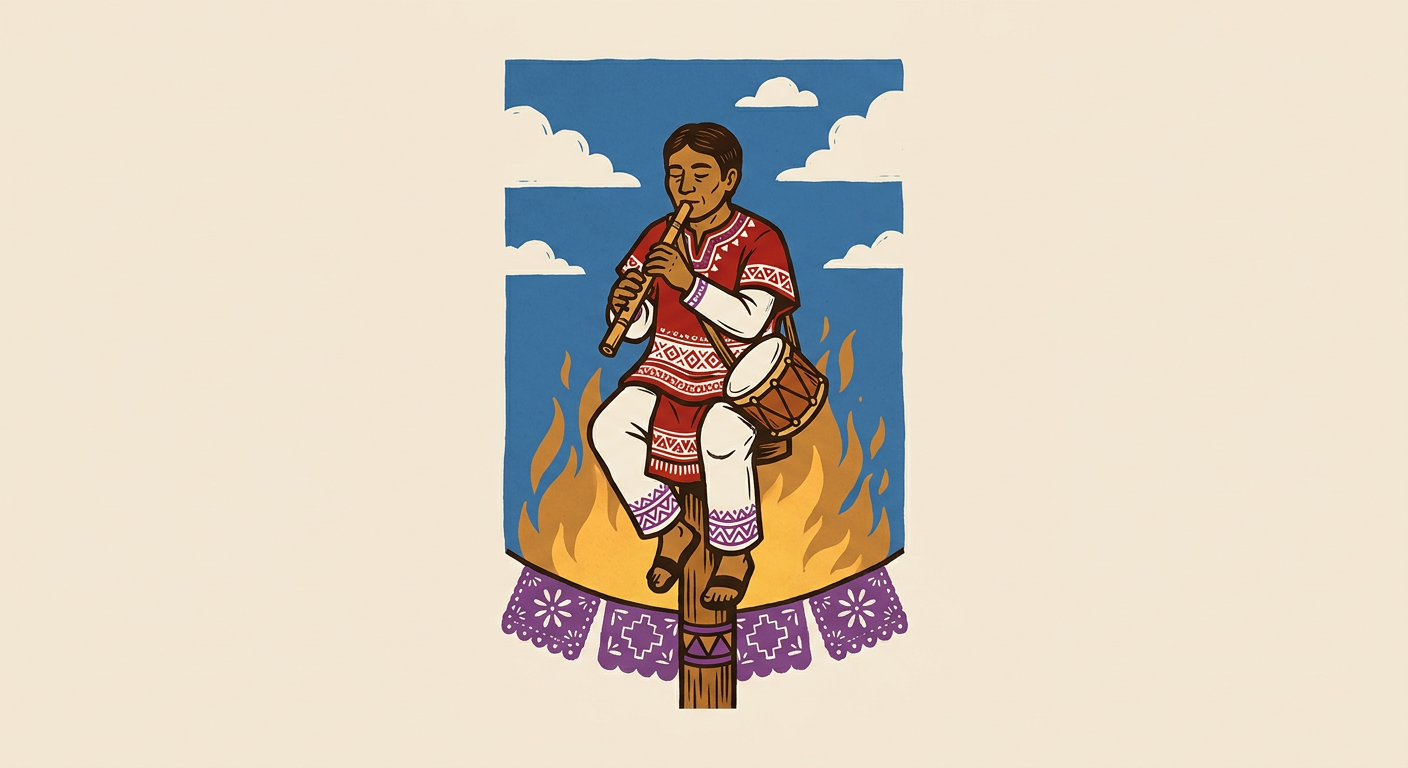
The clothing we now identify with the Voladores—red pants, white shirt, ribbons, embroidery, mirrors, flowers and a conical or semicircular headdress—condenses layers of history. Some elements evoke birds, sunbeams, rainbows or vegetation, but their interpretations are not the same in every group. The mirrors and gleaming ornaments also reflect changes that occurred after colonial contact and access to new materials. It would be convenient, though false, to speak of an ancient, unchanging uniform: the attire is archive, stage and festive skin all at once.
Thirteen Turns and a World Counted
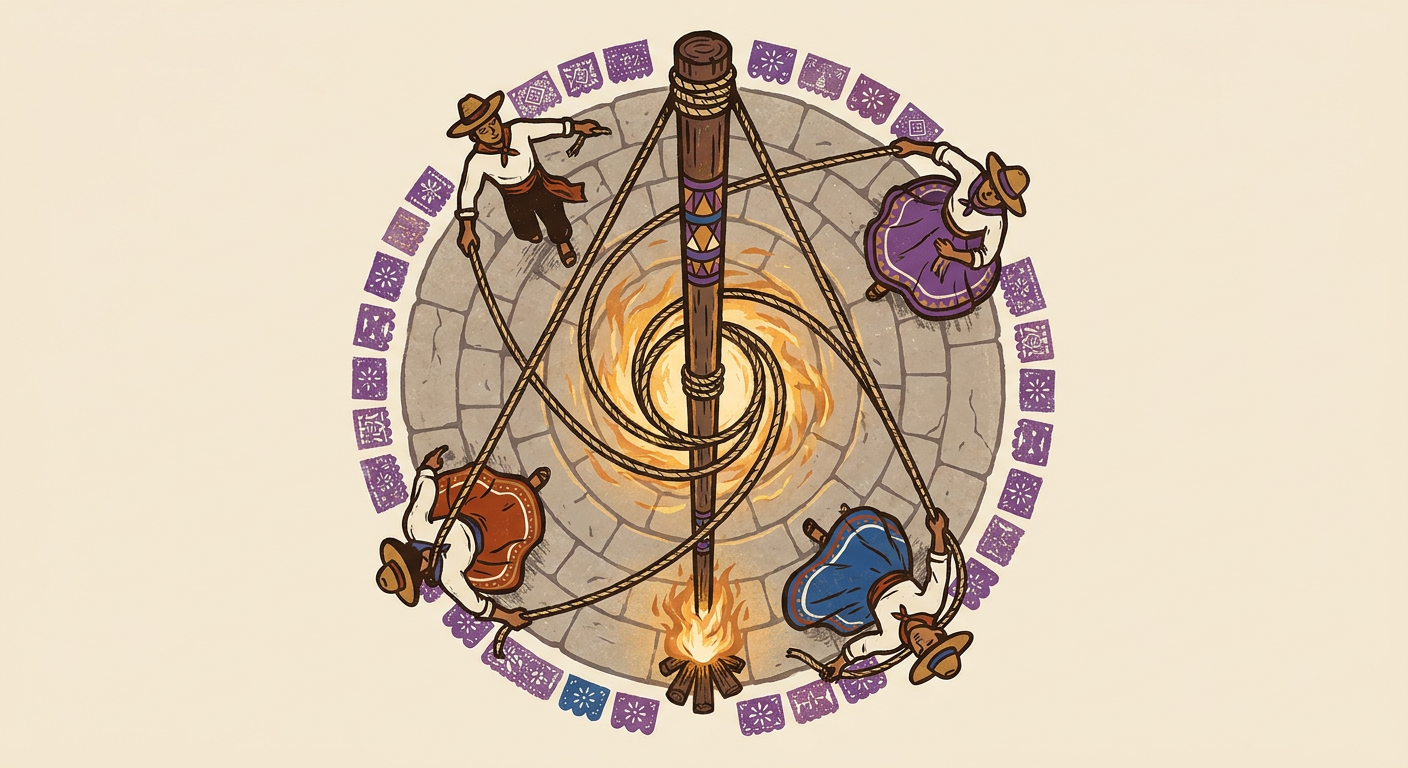
The best-known numerical explanation holds that each of the four voladores makes thirteen turns before touching the ground. Four times thirteen is fifty-two, a number associated with the Mesoamerican calendar round, that is, the period after which the 260- and 365-day counts aligned again. This interpretation circulates widely among tradition bearers, cultural institutions and researchers, although the actual number of turns may vary according to the height of the pole, the length of the ropes and the local form. Ritual arithmetic sheds light on the flight, but it should not be used as a master key to force open all its doors.
- 1Four voladores: they are often associated with the directions of the universe and the horizontal expanse of the world.
- 2The caporal: he directs the ceremony through music, steps and signals from above.
- 3The flute and drum: the melodic voice and pulse that accompany the petition and the descent.
- 4The pole: an axis of communication between earth, sky and sacred realms.
- 5The spiral: a cyclical descent that evokes time, movement, rain and renewal.
The central purpose has been described as a petition for rain and fertility, tied to the cultivation of corn and the renewal of life. It is not simply about obtaining water as though turning on a heavenly faucet: the ceremony expresses reciprocity, gratitude and responsibility toward a living universe. In the ritual worldview of many Mesoamerican communities, human beings receive sustenance, but must also offer work, music, respect and remembrance. The flight dramatizes that exchange: something human rises and takes a risk so that fertile forces may descend.
The ceremony also brings order to space. The caporal greets different directions with his music and movements, while the voladores form a four-armed figure around the pole. Above and below, center and direction, ascent and fall become visible for a few minutes. Here, art does not represent an idea from the outside: it performs it through bodies, sound, fibers, wood and gravity.
Flying today, without becoming a postcard
In 2009, UNESCO inscribed the ritual ceremony of the Voladores on the Representative List of the Intangible Cultural Heritage of Humanity. The recognition brought international visibility to its practitioners and to transmission efforts, but it also confirmed a longstanding tension: the more famous a ceremony becomes, the greater the risk that the public will see only the feat. Photography tends to capture the moment of the fall and leave out the preparation, the offerings, the sones and the years of learning. Heritage does not mean an object under glass; it means knowledge practiced by real people, with rights and voices of their own.
Transmission usually begins in childhood or youth at community schools and traditional groups, especially in the Totonacapan. Apprentices learn the music, ritual language, movements, equipment care and community obligations, in addition to training their bodies. The Center for Indigenous Arts, in Veracruz’s Takilhsukut Park, has fostered spaces for teaching and reflection from a Totonac perspective; its educational practices were recognized by UNESCO in 2012 as an experience in safeguarding intangible cultural heritage. Preserving the flight takes much more than oiling a pulley: it requires teachers, territory, language, time and young people willing to listen.
Women’s participation has also changed. Although for a long time many groups reserved the flight for men, in recent decades some girls and women have trained as voladoras and caporales, not without debate within and beyond their communities. There is no single Totonac position on the matter, so it is best to avoid both outside condemnation and condescending applause. A tradition can debate with itself; in fact, that conversation is one of the signs that it is still alive.
For those watching, respect begins with not reducing the ceremony to “birdmen” or asking for it to be repeated like an instant trick. It matters who presents the flight, in what context, how the participants are paid and whether the community controls the way its practice is explained. Applauding the skill is natural, but listening to its meaning is better. The difference between watching folklore and encountering a ritual work often comes down to one thoughtful question.
The Voladores de Papantla bring together music, dance, clothing, calculation, oral memory and mastery of space; that is why they belong fully to the realm of art, even as they overflow our tidy divisions among function, beauty and devotion. Their historical purpose was not to decorate a celebration, but to care for the community’s relationship with that which sustains it. Each descent is a reminder that life depends on vertical and horizontal bonds: with the sky that gives rain, with the earth that receives the seed and with those below who hold the same story. In the end, the voladores touch the ground, but the question keeps spinning above: what are we willing to offer so that the world may continue to bear fruit?
- UNESCO, “Ritual Ceremony of the Voladores,” Representative List of the Intangible Cultural Heritage of Humanity, 2009 inscription.
- UNESCO, “Xtaxkgakget Makgkaxtlawana: the Center for Indigenous Arts and its contribution to safeguarding the intangible cultural heritage of the Totonac people of Veracruz, Mexico,” Register of Good Safeguarding Practices, 2012.
- Guy Stresser-Péan, Le Soleil-Dieu et le Christ: la christianisation des Indiens du Mexique vue de la Sierra de Puebla, L’Harmattan, 2005.
- National Institute of Anthropology and History (INAH), outreach materials on the ritual ceremony of the Voladores and the cultural heritage of the Totonacapan.
- Mexico’s Ministry of Culture, Cultural Information System, entry on the ritual ceremony of the Voladores.