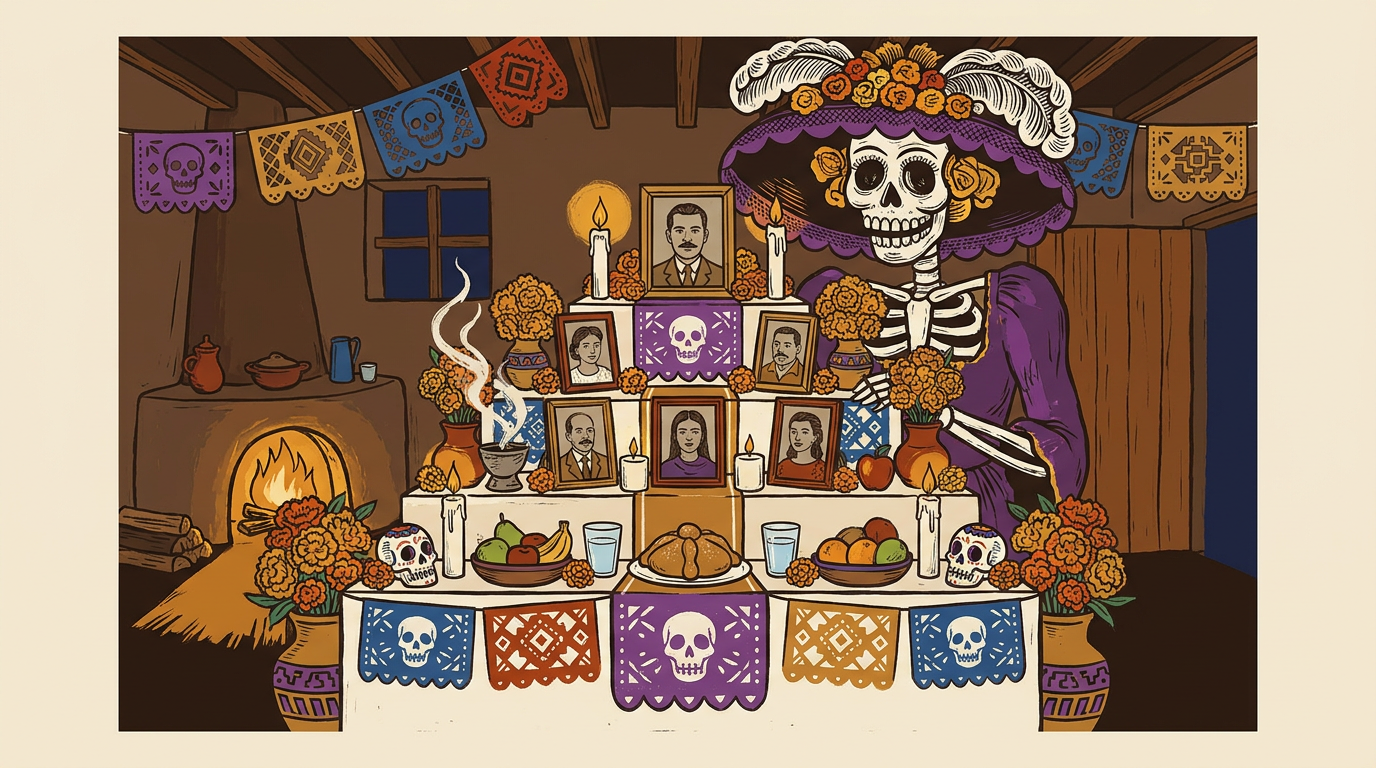
An ofrenda is not only something to look at: it is smelled, tasted, recognized. Cempasúchil lays the sun on the table; copal traces paths in the air; a cup, a portrait and a certain dish call someone by name. Every Day of the Dead, Mexican homes, markets, schools and plazas turn remembrance into an ephemeral installation created by cooks, bakers, florists, artisans and entire families. The world marvels at its beauty, but its true power does not lie in the decoration: it lies in making room for someone who is missing.
An ancient celebration that never stopped changing
Day of the Dead is often described as the intact survival of a pre-Hispanic ceremony, but the history is more interesting—and less tidy—than that. Various Mesoamerican peoples practiced funerary rites and made offerings for their dead; after the conquest, those customs entered into dialogue, clashed and blended with the Catholic observances of All Saints’ Day and All Souls’ Day, celebrated on November 1 and 2. Over the centuries, agricultural calendars, regional traditions, European imagery and family practices also played a part. There is therefore no single original Day of the Dead kept under lock and key, but rather many Mexican ways of relating to absence.
The differences matter. In some communities, people hold vigils in the cemetery; in others, the main welcome takes place at home; there are places where the souls arrive according to age or on different days, and regions with their own breads, flowers and foods. Janitzio, Mixquic and the towns of the Oaxaca Valley are famous, but they do not represent all of Mexico on their own. The celebration is alive precisely because each community adapts it without asking permission from a national identity handbook.
The altar: architecture for the return
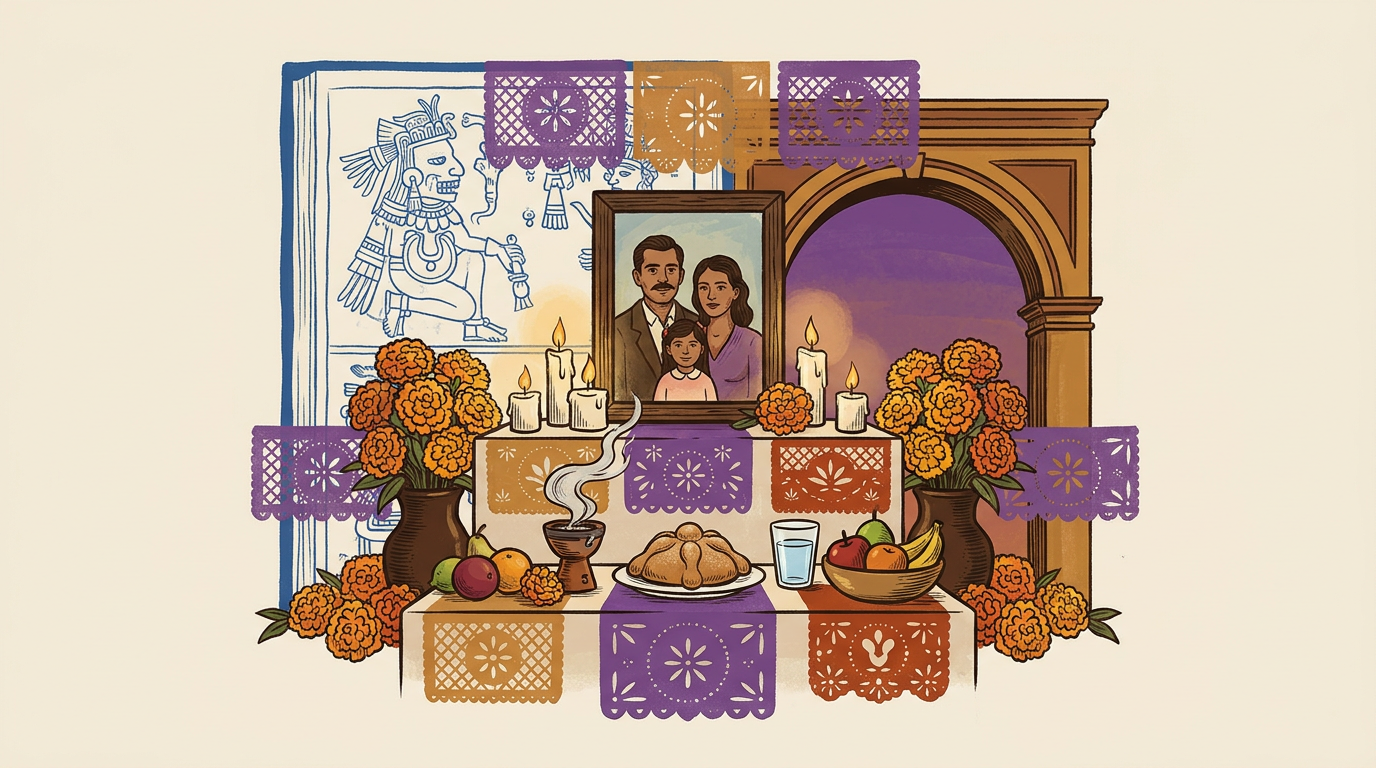
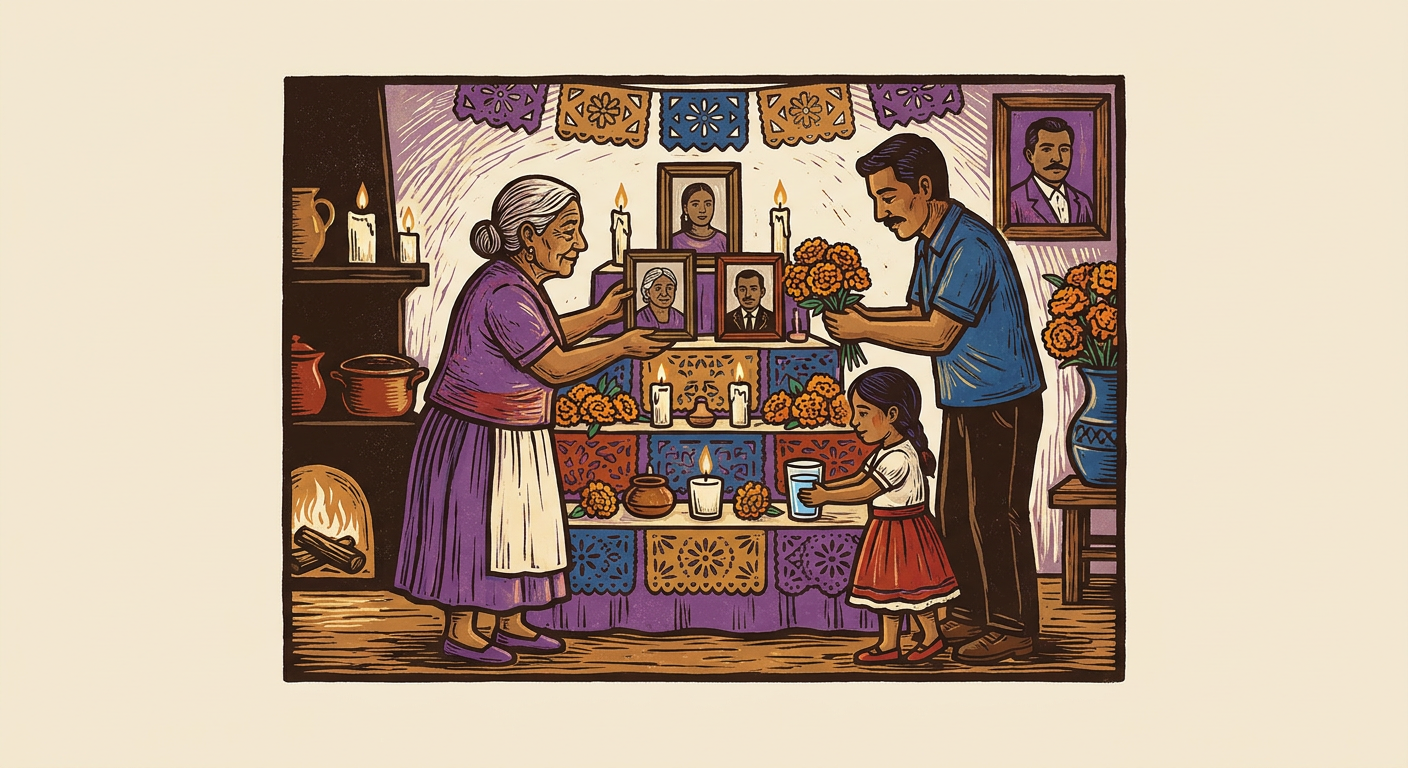
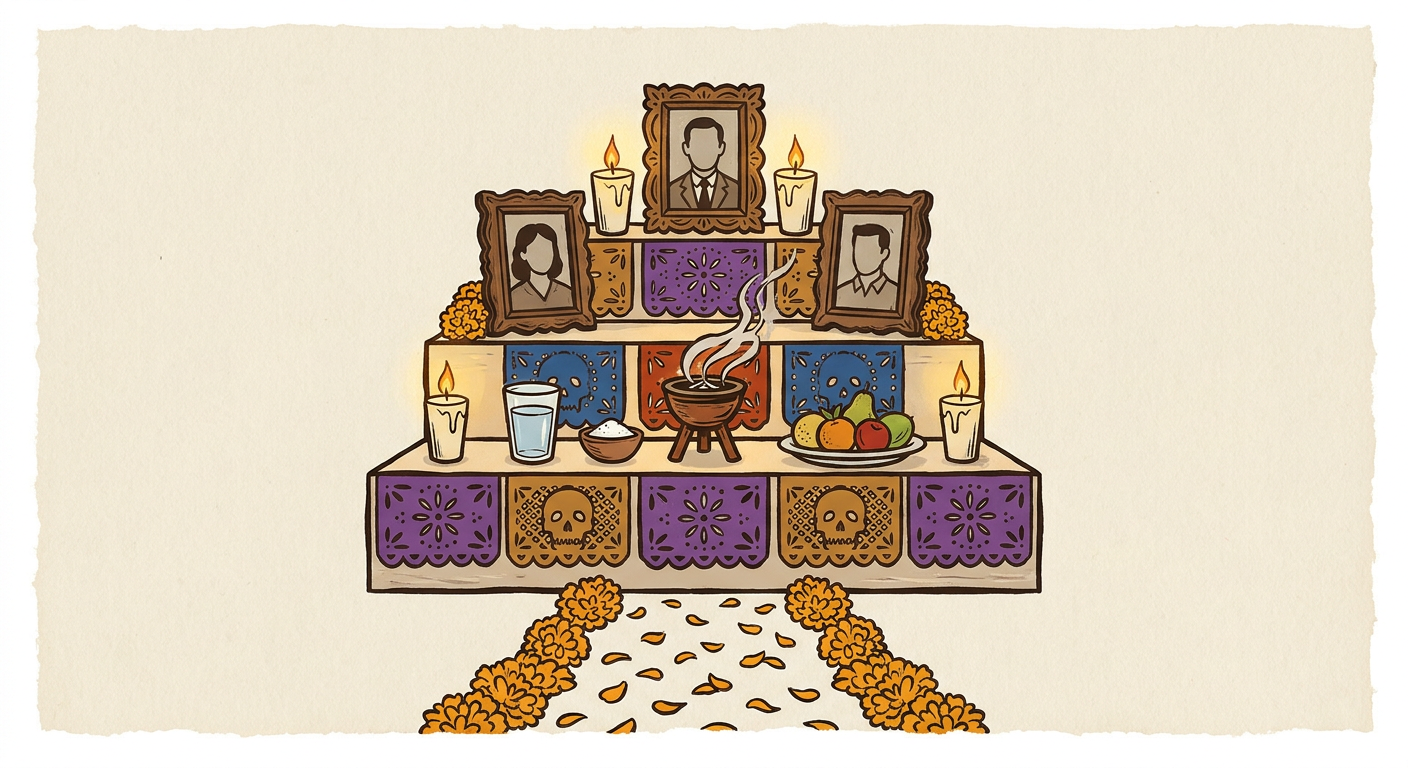
The home altar organizes memory through concrete objects. Portraits identify the visitors; candles light the way; water welcomes those who arrive thirsty; salt may allude to purification, and copal or incense perfumes and sanctifies the space. Flowers and petals mark paths, while food brings back personal tastes: mole, tamales, fruit, coffee, mezcal or that treat the deceased defended with suspicious vehemence. Not every altar includes the same elements or the same number of levels, though school exhibits can sometimes make it seem as if there were an official customs checkpoint for the afterlife.
- 1Portrait: gives a face and name to the person being remembered.
- 2Light: votive candles or tapers symbolically accompany the journey.
- 3Scent: copal, incense and flowers transform the everyday space.
- 4Water and food: express hospitality and preserve the tastes of the absent person.
- 5Personal objects: a hat, a tool, a toy or a book tell the story of a life without the need for a speech.
Seen through the lens of art, the altar combines composition, color, scent, volume, light and narrative. It is a collective, temporary and participatory work: how it looks matters as much as who puts it together, for whom and with what memories. Papel picado adds movement and fragility; cempasúchil draws the eye with its intense orange; votive candles make everything change as the night wears on. But reducing the ofrenda to its appearance—copying it without understanding its family or community bond—would be like framing a recipe and forgetting to cook.
In an ofrenda, remembering is not looking back: it is setting another plate at the table.
Bread and calaveritas: eating the symbol
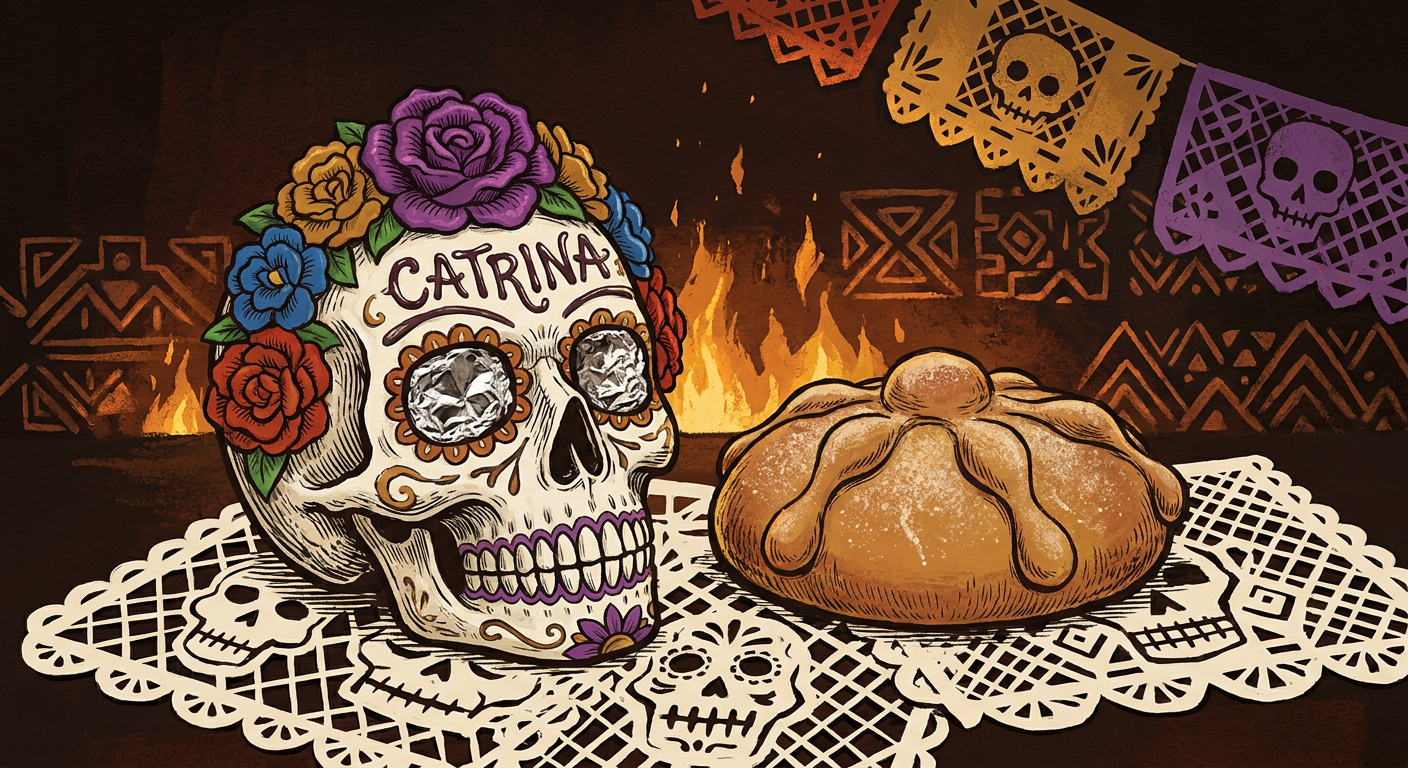
Pan de muerto brings the celebration into the most direct realm: sharing and taking a bite. There is no single national recipe. Across much of central Mexico, it is round, aromatic and topped with strips of dough commonly interpreted as bones; in other regions, there are anthropomorphic breads, decorated figures, rings, souls and local shapes made for the ofrenda. Its origins are connected to the baking traditions introduced during the colonial period and to ritual traditions that changed over time; attributing a single, perfectly documented origin to it would be like serving up legend as if it were archival fact.
Sugar calaveritas belong to the art of alfeñiquería, the craft of shaping sugar paste, which arrived in New Spain through Mediterranean traditions and developed its own repertoire here. With shiny paper eyes, colorful decorations and a name written across the forehead, they make death personal and the living honoree slightly uncomfortable. There are also calaveritas made of chocolate, amaranth and clay, depending on the region and workshop. Putting our name on a sweet skull is not denying the end: it is taking it down from its pedestal and offering it dessert.
La Catrina Was Not Born Wearing a Legendary Hat
The figure now known as Catrina began as a social critique associated with José Guadalupe Posada. His famous female skull, published in the early 20th century and known as “Calavera Garbancera,” wore an elegant hat but not the full dress with which we now identify her. “Garbancera” was a mocking term for those who disavowed their Indigenous roots while trying to adopt a European appearance. Posada drew on a long tradition of satirical skeletons to remind us that beneath the feathers, money and pretensions, we all share a fairly democratic anatomy.
Diego Rivera cemented her full-body image and the name “Catrina” in the mural “Dream of a Sunday Afternoon in Alameda Central,” painted between 1947 and 1948. There she appears holding the hand of Rivera as a child, alongside Posada and a crowd of historical figures. From then on, she escaped the mural and made her way onto posters, ceramics and makeup, and into film and parades. That popularity is proof of her visual power, though it is worth remembering her satirical edge: before becoming November’s glamorous ambassador, she was a graphic jab at classism and vanity.
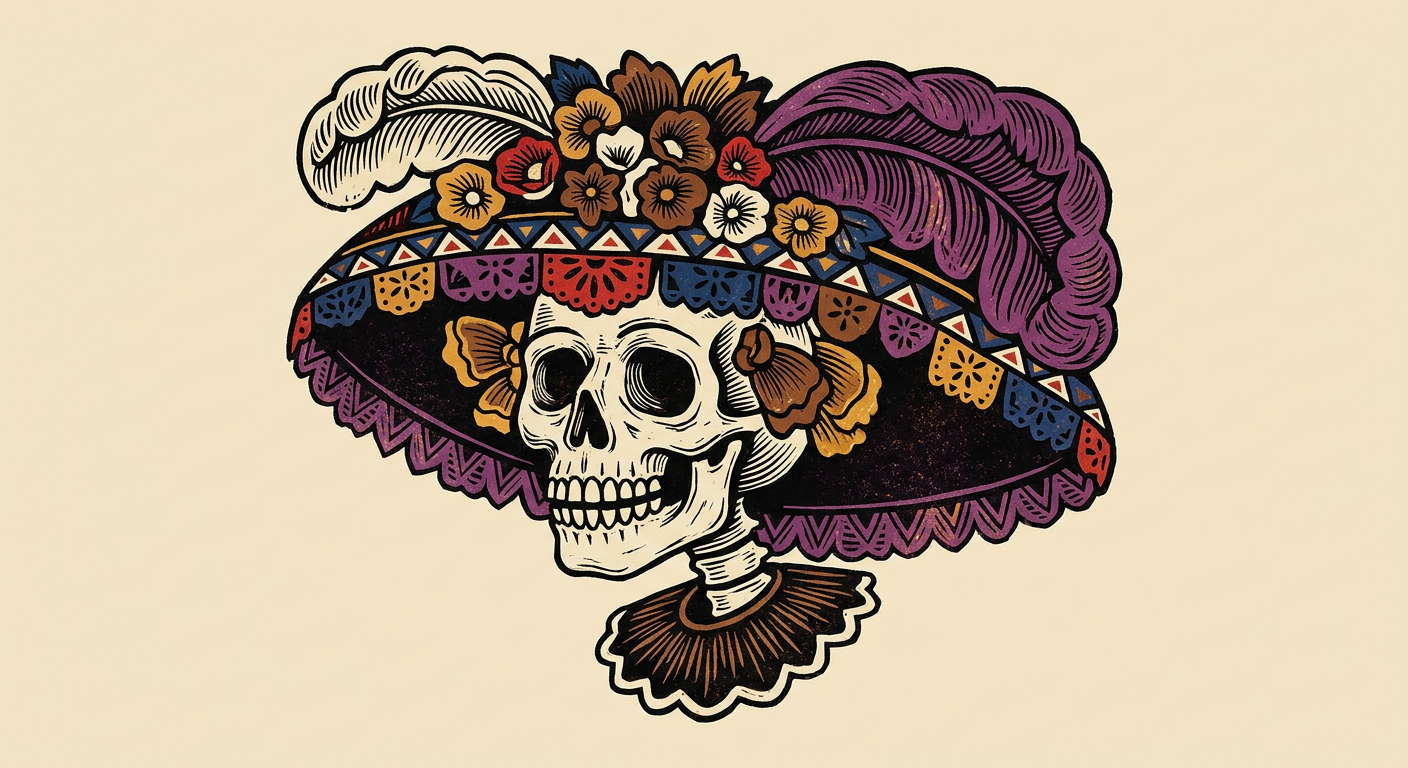
The worldwide success of Day of the Dead has brought fruitful exchanges, but also oversimplifications. Not every face painted like a skull is a Catrina, nor does every costume party express a community’s relationship with the dead; neither is it “Mexican Halloween,” though the two celebrations now coexist and nod to each other. Recent films, exhibitions and parades have broadened its reach and even given rise to new traditions. Popular culture does not need to pretend to be ancient to be valuable: it is enough to say when it began and why people decided to make it their own.
In the end, the altar, bread, calaverita and Catrina speak different languages to say something similar: death is part of life, but forgetting does not have to prevail. The celebration amazes with its colors; it endures through the names, recipes, gestures and stories those colors sustain. Each ofrenda will disappear, the flowers will dry and the bread will leave behind only a few crumbs—if it was lucky—but the act of welcoming the dead renews a community among the living. Perhaps that is its masterpiece: turning absence, for one night, into companionship.
- National Institute of Anthropology and History (INAH), educational materials on Day of the Dead and cultural heritage.
- UNESCO, “Indigenous Festivities Dedicated to the Dead,” Representative List of the Intangible Cultural Heritage of Humanity.
- Claudio Lomnitz, Idea of Death in Mexico, Fondo de Cultura Económica.
- Diego Rivera Mural Museum, information on Dream of a Sunday Afternoon in Alameda Central.
- Agustín Sánchez González, José Guadalupe Posada: An Artist in Black and White, National Council for Culture and the Arts.