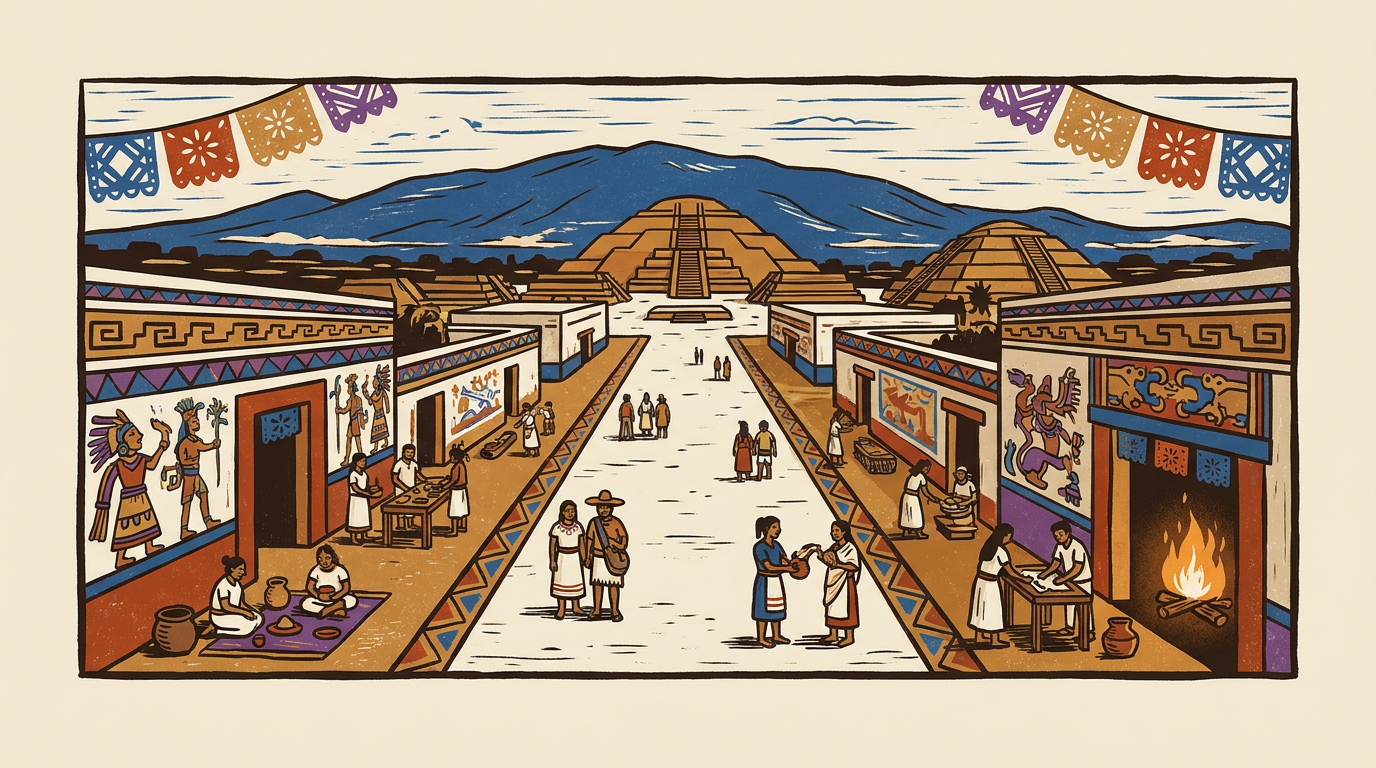
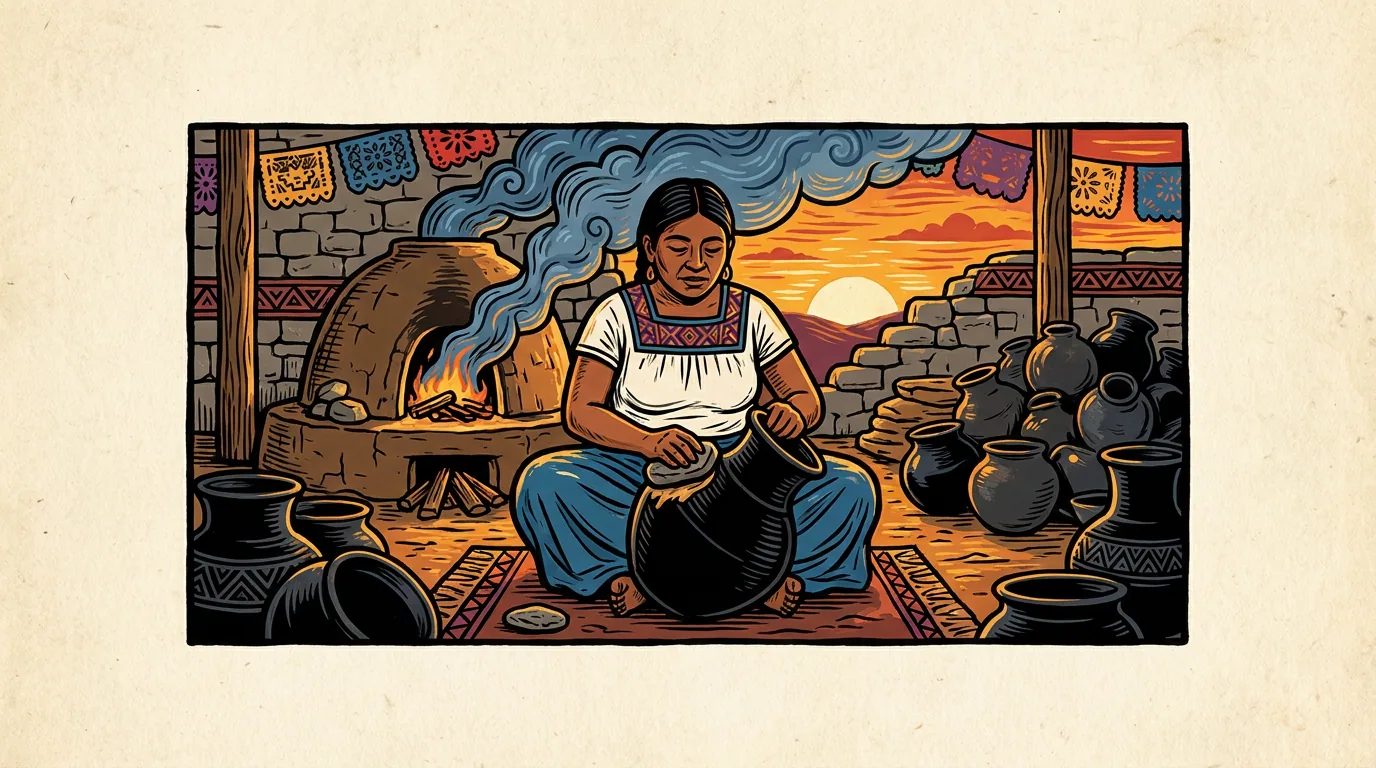
Black clay is not born black. It comes from the earth in shades of gray and brown, passes through patient hands, and only takes on its deep color when fire works with little oxygen. That transformation happens above all in San Bartolo Coyotepec, a Zapotec community in Oaxaca’s Central Valleys, about fifteen kilometers south of Oaxaca City. There, a vessel can hold water, accompany a ceremony, adorn a room, or tell—without saying a word—the story of a pottery-making community.
San Bartolo Coyotepec: Land of Potters
San Bartolo Coyotepec lies in the Ocotlán Valley, a region where pottery has pre-Hispanic roots. For centuries, Zapotec communities made vessels for cooking, storing water, serving food, and taking part in funerary offerings or rituals. Not all that ancient clay had the lustrous black finish we now recognize in shop windows and museums: forms, finishes, and firing methods changed over time. The tradition today is therefore ancient and contemporary at once, like almost everything that is truly still alive.
The name Coyotepec is often explained as coming from the Nahuatl coyotl, “coyote,” and tepetl, “hill”: “on the hill of the coyote.” San Bartolo refers to the patron saint introduced during the viceregal period. Distinct layers of history coexist under that name: a community with Zapotec roots, a Nahuatl place name, and a Christian dedication. Even the mailing address carries its own archive.
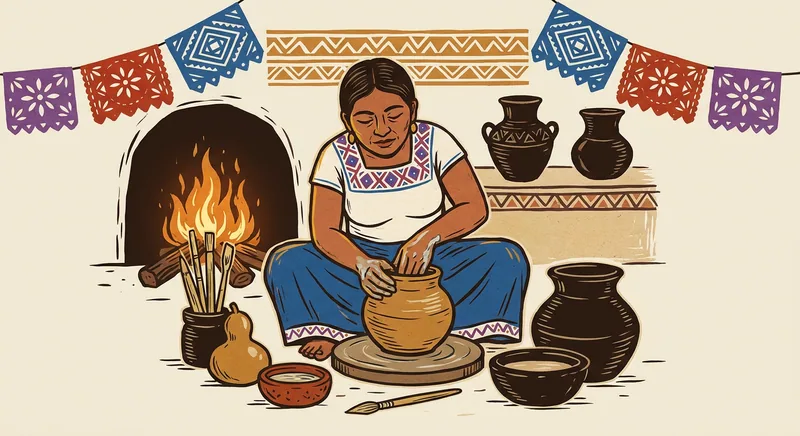
For generations, pottery production was closely tied to women’s work. They passed down knowledge about the location of clay deposits, mixtures, drying, burnishing techniques, and kiln behavior. Today, women and men both take part, and family workshops organize their tasks in different ways, but women’s memory remains at the heart of the story. In San Bartolo, learning clay has meant watching mothers, grandmothers, aunts, and neighbors until the eye and hand begin to understand each other.
The Piece Begins Underground
The raw material comes from local clay deposits, whose mineral composition lends itself to making the community’s characteristic pieces. Once extracted, the clay is cleaned to remove stones, roots, and other impurities; then it is left to soak, mixed, and kneaded. The goal is a homogeneous, pliable mass without air pockets, because one inconspicuous pebble can become a most untimely thunderclap during firing. The quality of the piece depends as much on this quiet work as on its visible decoration.
- 1Gathering and selecting clay from local deposits.
- 2Drying, crumbling, or soaking the material, according to each workshop’s practice.
- 3Removing stones, roots, and particles that could weaken the piece.
- 4Mixing the clay with water until it reaches a uniform consistency.
- 5Kneading to distribute moisture and expel trapped air.
- 6Keeping the clay covered and moist until it is time to shape it.
Unlike the classic image of a potter’s wheel spinning quickly, many pieces from San Bartolo are built through hand-shaping and simple rotating devices. The potter may work on two plates or disks, one placed on top of the other, allowing her to turn the piece little by little as she raises its walls. Coiling, pinching, adding portions of clay, and using molds all come into play, depending on the desired form. Water jugs, pots, vases, figures, and large decorative pieces emerge from that combination of technique, muscle memory, and visual calculation.
“Black clay is not painted: the color appears during firing.”
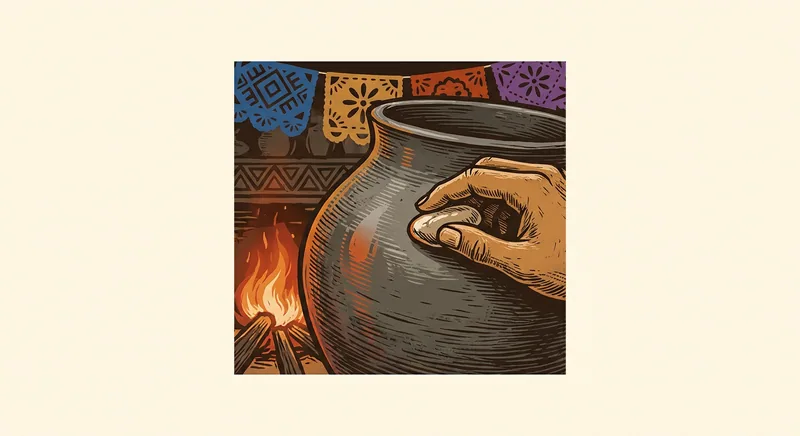
Once the form has been built and reached the right firmness—what is known in ceramics as the leather-hard stage—smoothing begins. The surface can be polished with a smooth stone, a tool that compresses and aligns the clay particles. That burnishing will produce reflections after firing, provided the piece survives an unhurried drying process without treacherous drafts. In pottery, speeding up time is often a very elegant way to make a crack.
The Sheen That Changed How It Was Seen
Utilitarian black clay existed long before its glossy finish became a commercial emblem. In the mid-20th century, the potter Rosa Real Mateo de Nieto, better known as doña Rosa, developed and popularized a way of burnishing pieces before firing to intensify their sheen. Her innovation did not invent the entire tradition or the black color, but it did transform the appearance of many works and expand their presence in national and international markets. Precision matters: crediting her with all black clay would erase centuries of history; denying her contribution would be unfair as well.
Doña Rosa worked in San Bartolo Coyotepec, and her family workshop became a turning point in bringing this pottery to wider attention. The polished pieces attracted collectors, travelers, merchants and public figures, and soon the glossy black finish gained a fame that seemed to encompass the entire tradition. Yet the community continued to make objects with matte finishes, pieces for everyday use and works reflecting each family’s own style. There is no single barro negro: under one common name are different repertoires, hands and decisions.
The prestige of the lustrous finish also changed what the pieces were made for. Many highly burnished, openwork pieces are produced mainly as decoration, since the intense polishing and certain forms are not designed to withstand direct use over a flame. Traditional pots, by contrast, met specific household needs and could have surfaces that were less spectacular in a display case but made perfect sense beside the hearth. Judging all pottery by how much it gleams would be like evaluating a good mole by its photograph: it helps, but it does not nourish you.
The secret is not smoke: it is atmosphere
The black color emerges during reduction firing, meaning in an atmosphere with little oxygen. Near the end of the process, airflow into the kiln is restricted, and incomplete combustion generates carbon and gases that react with the iron compounds in the clay. Instead of developing the reds and ochers typical of oxidation firing, the piece turns dark gray or black. It is not magic, although in front of a blazing kiln, chemistry certainly knows how to put on a show.
Traditionally, simple-draft kilns are used, built and operated according to each family’s experience. The pieces must be completely dry before they are arranged inside, because any remaining moisture can turn to steam and break them. The fuel is loaded, the rise in temperature is controlled and, at the right moment, oxygen is restricted by covering or sealing the kiln’s openings. Temperatures are usually lower than those used for high-fired vitrified ceramics; as a result, barro negro retains some porosity and requires care depending on its use.
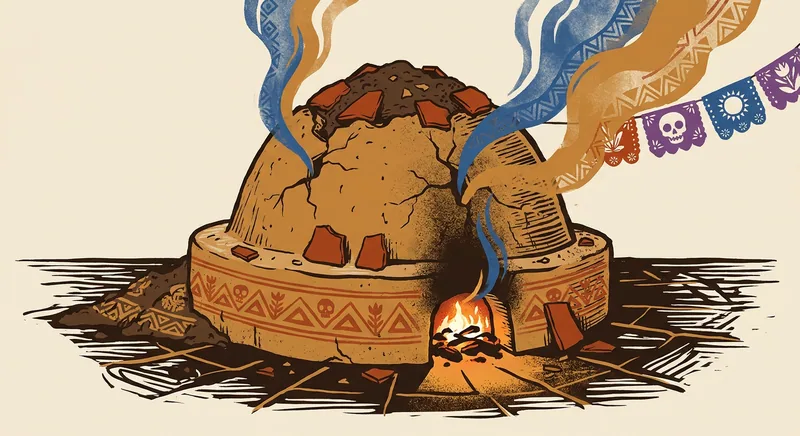
Firing requires reading the signs: the color of the fire, the intensity of the smoke, the sound of the pieces and the time elapsed. Although thermometers, modified kilns or other tools may be used today, much of the knowledge still resides in practice. Two firings using the same clay are rarely identical; the size of the works, their position, the fuel, the weather and the way the kiln is sealed all play a part. The artisan does not control fire like someone turning a knob: they negotiate with it.
- 1Clay contains minerals, including iron compounds.
- 2With abundant oxygen, those compounds can produce reddish or brown tones.
- 3When oxygen inside the kiln is reduced, the chemical reaction changes during firing.
- 4The burnished surface reflects more light because it was compressed and smoothed before firing.
- 5The result combines black color, metallic nuances and a sheen that varies from piece to piece.
After firing comes cooling, a thoroughly unglamorous and absolutely necessary wait. Opening the kiln too soon can cause thermal shock and shatter hours or weeks of work. When the pieces finally emerge, some are uniformly black; others retain gray clouds, silvery reflections or marks from contact with the fuel. These variations are not necessarily flaws: they are also the unique signature of an atmosphere of fire.
A tradition that cannot fit inside a display case
The fame of barro negro has provided income and visibility for many families in San Bartolo Coyotepec, but it has also brought imitations, haggling and oversimplifications. A handmade piece embodies the extraction of raw material, preparation, shaping, drying, decoration, burnishing, firing and risk; if it breaks inside the kiln, pity does not pay for the labor. Asking who made the work, getting to know the workshop and paying a fair price are tangible ways to respect the craft. Buying directly does not make anyone a Renaissance patron, but it does help make the chain less exploitative.
At the Oaxaca State Museum of Popular Art, located in San Bartolo Coyotepec, visitors can see pieces from different communities and understand barro negro within a broader landscape of craft traditions. There are also family workshops open to visitors, each with its own language: exquisitely delicate openwork, sculptural figures, understated vessels, animals, plant motifs or contemporary designs. It is best to listen to local explanations and avoid presenting as an “ancestral secret” something that has a technical name and identifiable creators. Understanding does not diminish the wonder; on the contrary, it stops being mere scenery and brings the people back into view.
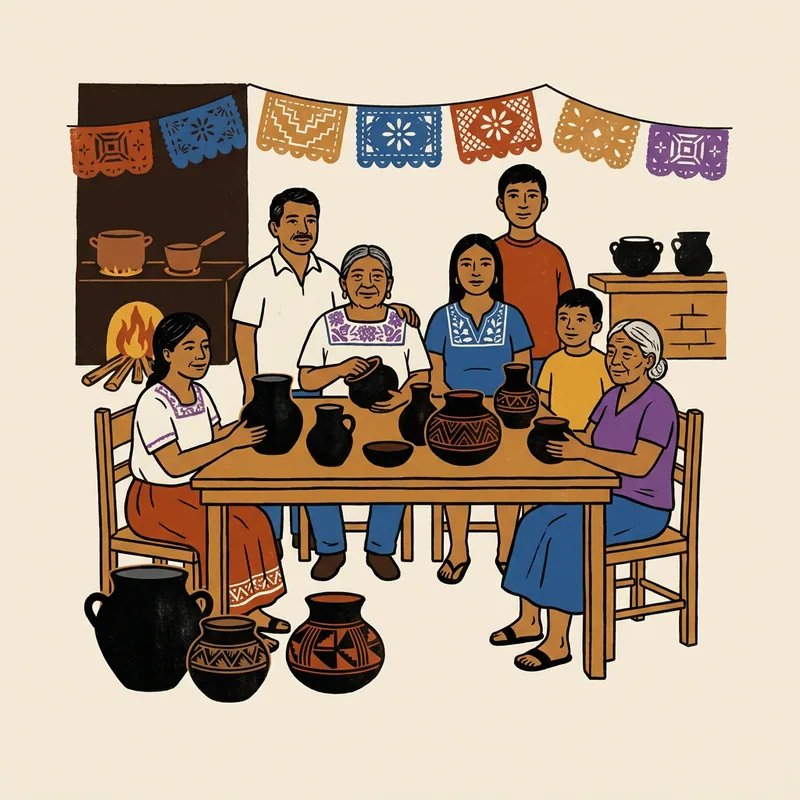
The continuity of this pottery depends on very current concerns: responsible access to clay and fuel, the transmission of knowledge, fair markets and opportunities for younger generations to innovate. Forms change because homes, tables and buyers change; demanding that a tradition remain static is a refined way of condemning it. Contemporary workshops experiment with scale, design and artistic language while continuing to engage with inherited techniques. Tradition is not endlessly repeating a piece, but preserving the ability to make it meaningful.
Barro negro is created in San Bartolo Coyotepec, but it is also created in every act of transmission: when someone teaches another person to recognize the exact moisture level, to seal the kiln at the right moment or to accept that a lost vessel is part of learning. Its color encapsulates a beautiful paradox: to turn black it needs less air, but to stay alive it needs space, recognition and circulation. When looking at a piece, it is worth remembering that it was not pulled from the earth like a gleaming stone. It was ordinary earth that a community taught to hold the night.
- Oaxaca State Museum of Folk Art (MEAPO), San Bartolo Coyotepec, Government of the State of Oaxaca.
- National Institute of Indigenous Peoples, materials on pottery and the cultural heritage of San Bartolo Coyotepec.
- National Institute of Anthropology and History, INAH Media Library and publications on traditional Oaxacan ceramics.
- Bartra, Eli. Women in Folk Art: On Promises, Betrayals, Monsters and Celebrities. Universidad Autónoma Metropolitana / FONCA, 2005.
- Sayer, Chloë. Arts and Crafts of Mexico. Chronicle Books, 1990.