Making mole starts long before lighting the fire: it begins with deciding that today’s cooking will not be rushed. Dried chiles, spices, seeds, a tortilla, perhaps chocolate, and a stained notebook where someone wrote “a small handful”—that household unit no laboratory has managed to tame—appear on the table. Then come the comal, the grinding, and a cazuela that will demand unwavering attention. Mole is not a single recipe, but a Mexican way of building depth through layers of flavor.
There Is No One Mole, but Many
The word mole comes from the Nahuatl molli, a word referring to a sauce or ground preparation. Before the Spanish arrived, sauces made with chiles, seeds, and other crushed ingredients already existed; during the colonial period, products from Europe, Asia, and Africa were incorporated, including spices, sesame seeds, and nuts. From that prolonged exchange emerged numerous families of moles, not an inaugural formula with a date and signature. History, like the cazuela, was made over low heat.
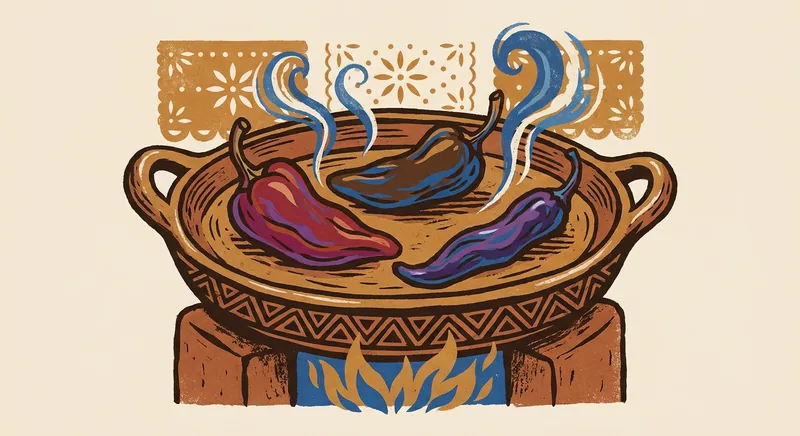
The most commonly repeated stories credit nuns from the convents of Santa Rosa or Santa Clara, in Puebla, with inventing mole poblano as they rushed to receive a dignitary. They are culinary legends: charming, yes, but they do not prove that a single kitchen suddenly created a preparation with Indigenous roots and contributions from several continents. There is also the story of Friar Pascual, who supposedly tripped and accidentally mixed ingredients meant for another dish. It is best savored as a tale, not as a birth certificate.
Flavor Is Built in Layers
A balanced mole usually brings together several families of ingredients. Chiles contribute aroma, color, sweetness, bitterness, and varying degrees of heat; seeds and nuts provide body; spices add fragrance; tortilla or bread helps thicken it. Jitomate or tomate, depending on the variation, adds acidity and moisture. Chocolate is important in certain moles, but it is not required, nor should it turn the sauce into dessert with chicken.
- 1Dried chiles: ancho, mulato, pasilla, chilhuacle, or others called for by the regional recipe.
- 2Seeds and nuts: sesame seeds, pumpkin seeds, peanuts, almonds, or walnuts.
- 3Aromatics: cinnamon, cloves, pepper, anise, garlic, and onion, used in moderation.
- 4Thickeners: tortilla, bolillo or bread, masa, and, in some versions, plantain.
- 5Liquid and seasoning: broth, salt, a touch of sweetness when needed, and fat for frying the paste.
- 6Protein or vegetables: turkey, chicken, pork, mushrooms, quelites, or pieces of vegetables, depending on the mole and the occasion.
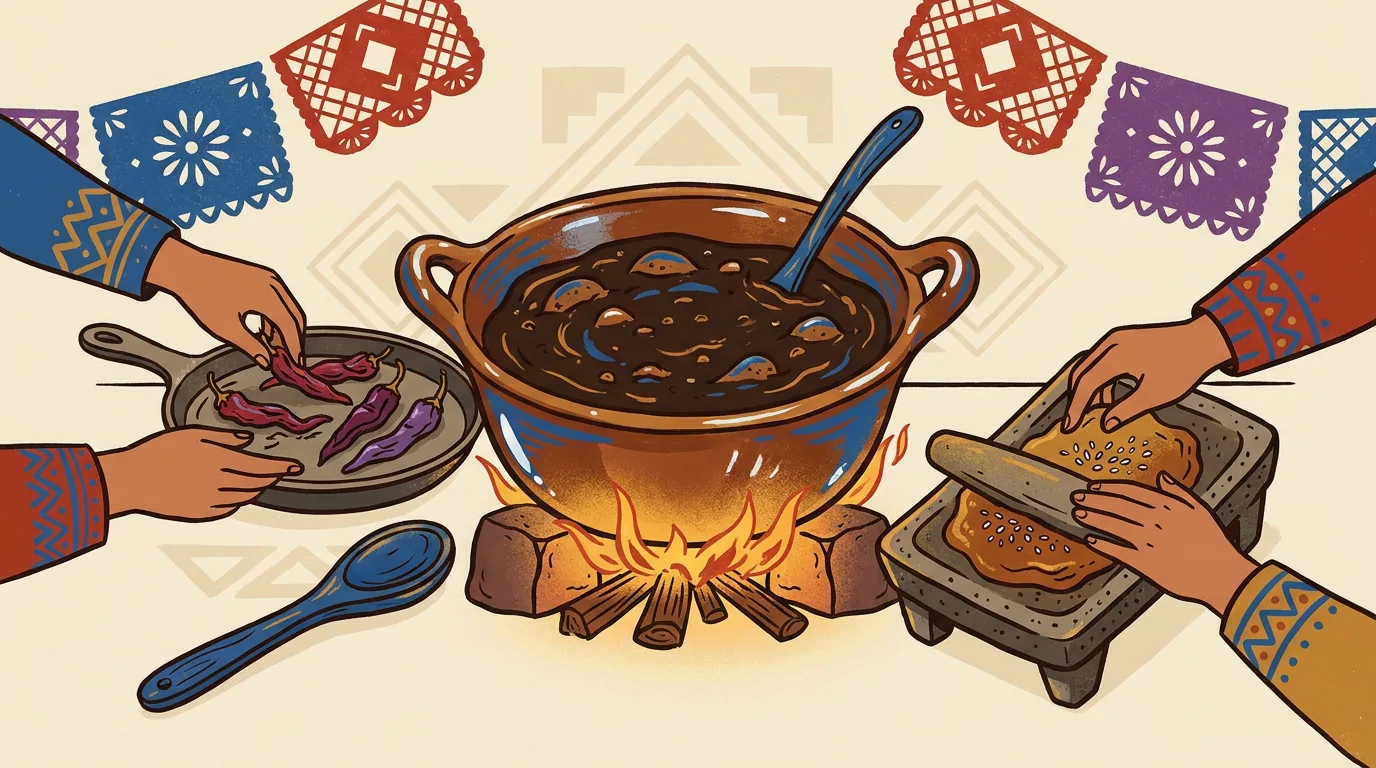
The crucial technique is to handle each ingredient separately. A chile needs seconds on the comal; an almond can take a different amount of time; a small spice can burn while you are looking for the spoon. Toasting develops aromas, but charring produces a bitterness that is hard to correct. That is why it is best to work in batches, over medium or low heat, with all the ingredients prepared before starting: mole appreciates organization, even if our aunts seem to cook it while discussing three things at once.
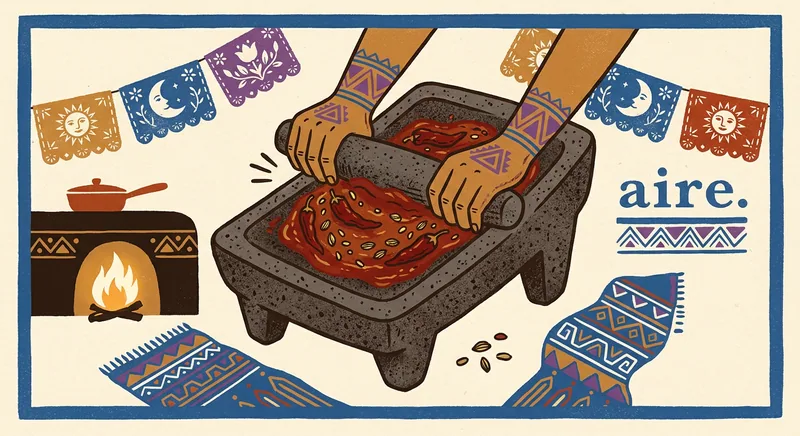
“Mole cannot be rushed: it must be accompanied.”
Grind Until Silky
After toasting, some chiles are stemmed and seeded, soaked in hot water, and drained; others are briefly fried, depending on the recipe. The seeds, spices, breads, and vegetables may also be roasted or fried before grinding. The goal is not to follow a ritual on a whim, but to extract flavors and control the texture. If the soaking water turned very bitter, there is no medal for adding it: it is better to use clean broth.
Whether using a metate, mill, or blender, grinding should produce the finest paste possible. With a blender, work in small batches, adding only the liquid needed to keep the blades moving; filling it to the brim only guarantees lumps and a lid with projectile ambitions. Straining the mixture is optional in rustic moles, but very useful when seeking a smooth sauce. If it is strained, press the solids well to extract their flavor, not merely tinted liquid.
The final texture depends on the balance among particles, fat, and water. A poorly ground paste can feel gritty; too much bread makes the mole heavy; too much broth leaves it without structure. The good news is that adjustments happen little by little. Liquid is added in batches while observing how the sauce falls from the spoon: it should coat it smoothly, not sit motionless like ceremonial cement.
Fry the Paste, Master the Flame
The ground paste is carefully poured into a wide cazuela where lard or oil has already been heated. This moment defines much of the mole’s character: the mixture splatters, thickens, and changes aroma as it loses moisture and blends with the fat. It must be stirred from the bottom with a wooden paddle to keep it from sticking. When the paste darkens slightly, smells rounded, and begins to release fat on the surface, it is ready for the broth.
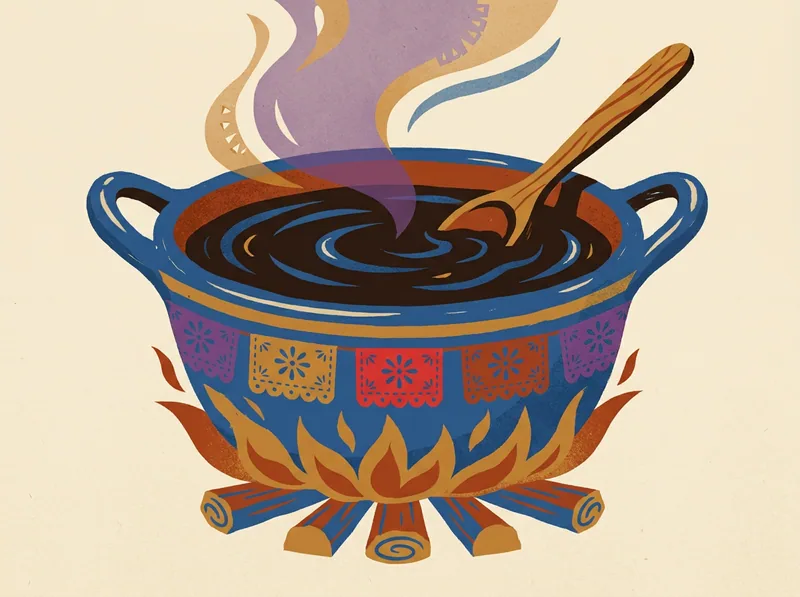
- 1Use a wide cazuela: it helps with evaporation and lets you stir without spilling over.
- 2Fry the paste over medium or low heat, and protect yourself from splatters with a partially open lid.
- 3Add hot broth little by little while stirring, until you reach the desired consistency.
- 4Cook gently for 30 to 60 minutes, or as long as the recipe calls for, checking the bottom often.
- 5Adjust the salt, sweetness, heat and acidity at the end; each correction needs a few minutes to meld.
- 6Stir in the cooked meat and let it heat through and absorb the flavors without falling apart.
Resting is also a form of cooking, even without a flame. Many moles taste better the next day because the aromas harmonize and the texture settles; to cool them safely, it is best to divide large quantities among shallow containers and refrigerate them promptly. When reheating, add a little broth or water and stir patiently. It freezes well in portions, a practical advantage for a dish that often requires half the pantry and a good part of the afternoon.
Patience, memory and the table
Learning to make mole means tasting at every stage. A burned chile can be detected before it taints the mixture; a raw paste needs more time in the fat; a flat sauce may need salt before sugar or chocolate. It is also helpful to write down weights and times, even when the family recipe speaks of handfuls and pinches. Culinary memory gains, rather than loses, when it finds a clear way to be passed down.
In many communities, preparing mole is collective work associated with weddings, patron saint festivals, mayordomías, wakes and other gatherings. Some people clean the chiles, while others toast, grind, cook or serve; the recipe lives in that coordination as much as in the list of ingredients. Making a portion at home does not recreate that entire communal dimension, but it can honor it: research the variation, buy good products and acknowledge where it comes from. No jar of “exotic sauce” can tell that story on its own.
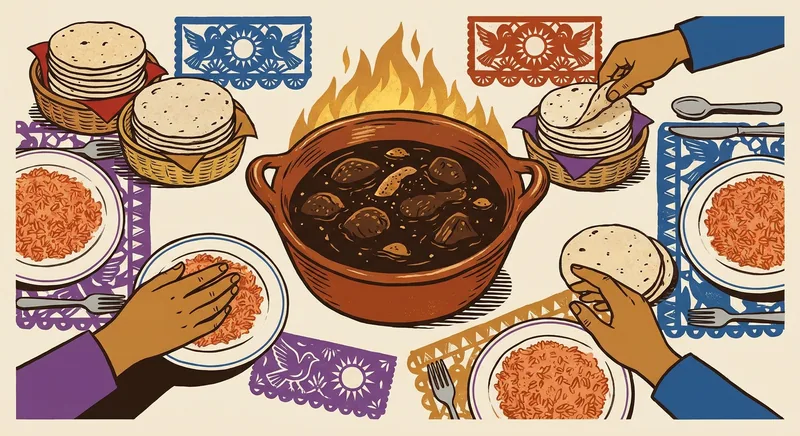
In the end, a good mole does not flaunt the number of ingredients: it lets them all work without any one shouting over the others. Its technique lies in toasting, grinding, frying, thinning and waiting; its history, in accepting that Mexico was also shaped by combining ingredients and knowledge without erasing their roots. The cazuela holds more than sauce: it preserves hours spent together, on-the-fly adjustments and ways of caring. Perhaps that is why mole is served on important occasions: because it tastes like time transformed into a shared table.
- Sahagún, Bernardino de. General History of the Things of New Spain (Florentine Codex), Book VIII.
- Pilcher, Jeffrey M. Long Live the Tamales! Food and the Making of Mexican Identity. CIESAS / Ediciones de la Reina Roja.
- Kennedy, Diana. Oaxaca al gusto: An Infinite Gastronomy. University of Texas Press, 2010.
- Muñoz Zurita, Ricardo. Encyclopedic Dictionary of Mexican Gastronomy. Larousse Cocina.
- Medina, Xavier (ed.). Intangible Heritage and Food: Traditional Mexican Cuisines. UNESCO, reference to traditional Mexican cuisine inscribed in 2010.