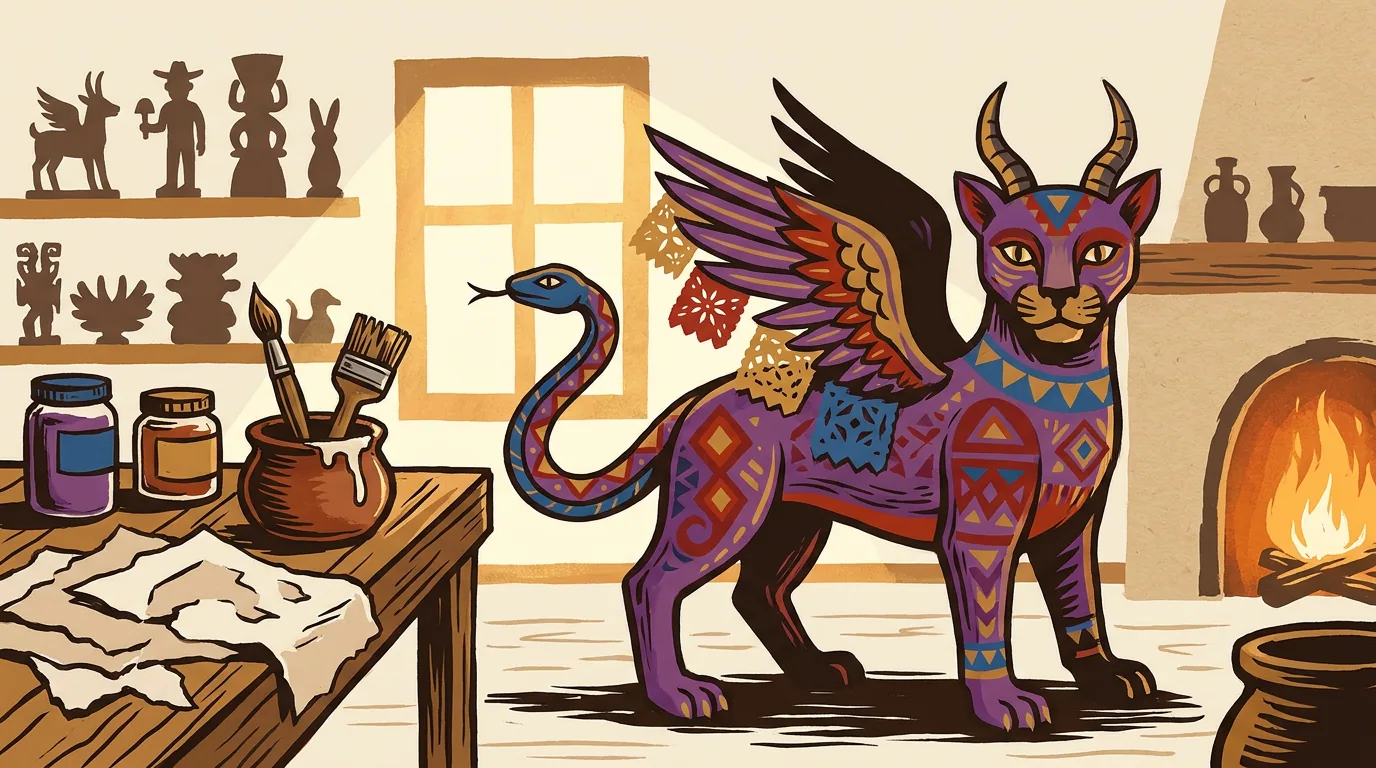
An alebrije can have crocodile teeth, rooster legs, bat wings and the disconcertingly confident gaze of someone who knows it will command the room. It looks like a creature from an ancient myth, perhaps rescued from some secret codex. But no: alebrijes are quite young, and their story begins in the 20th century, not in the pre-Hispanic world. Their documented origin lies in Mexico City, in the craft of cartonería and in the imagination of Pedro Linares López; later, Oaxaca gave the idea another material, other creators and a life of its own.
First came paper
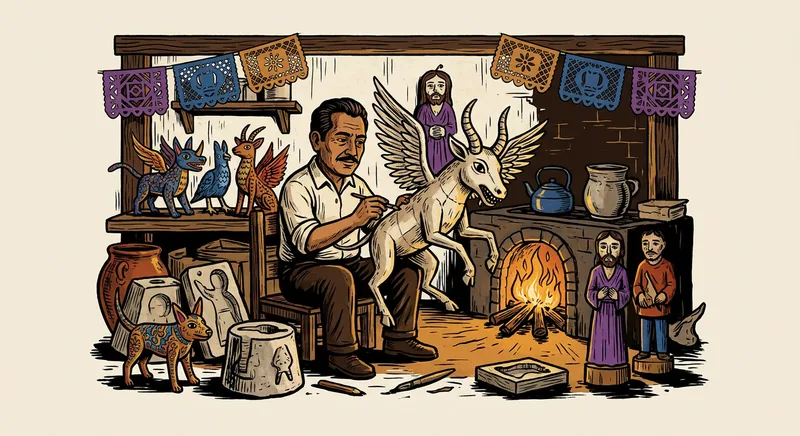
Pedro Linares López was born in 1906 in Mexico City, into a family devoted to cartonería. This craft transforms paper, cardboard, paste, wire and molds into festive or ritual objects: piñatas, masks, hobbyhorses, Judas figures and skeletons, among many others. He was not an isolated artist waiting for a romantic revelation, but an artisan trained in a family workshop and an urban tradition with its own techniques, clientele and calendar. It is worth remembering because great discoveries also happen while hands are busy.
The most widely told version says that, sometime in the 1930s, Linares fell ill and, during a feverish episode, dreamed of a strange forest populated by impossible animals. The creatures combined parts of different species and repeated a word that had never existed before: “alebrijes.” After recovering, he is said to have tried to reconstruct them using the technique he knew, shaping frames and covering them with paper before painting them in intense colors. It is a story passed down by the family and repeated by cultural institutions; it explains the invention, but its details belong to oral memory, not to a notarized record of the dream.
Legend has it that the creatures shouted a single word: “Alebrijes, alebrijes, alebrijes!”
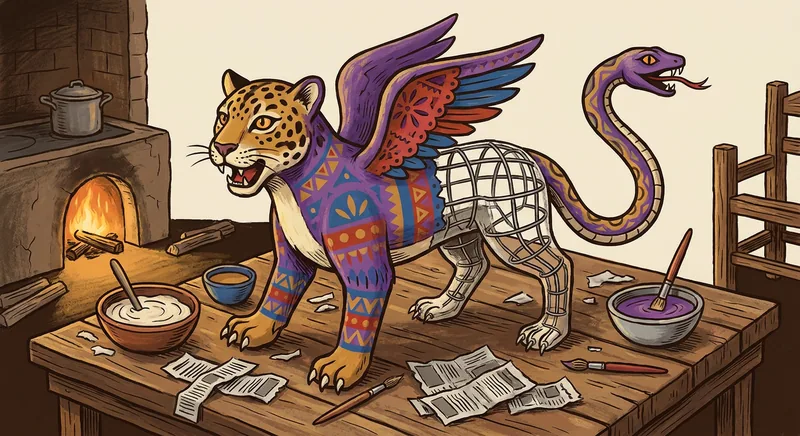
Those figures did not copy a recognizable animal: they delighted in defying zoology. Linares made cardboard creatures with jaws, scales, feathers, horns and colors that asked no permission from nature. The novelty lay not only in mixing species, something found for centuries in numerous cultures, but in giving these beings a form, a name and a visual language within modern Mexican cartonería. The original alebrije, then, was a paper sculpture born in a workshop in the capital.
An invented word finds an audience
Linares’s creatures began to circulate beyond the workshop thanks to an artistic milieu interested in folk arts. Diego Rivera and Frida Kahlo were among those who acquired work from the family, and British filmmaker Judith Bronowski made a documentary about Pedro Linares in 1975 that helped spread awareness of his work. In 1990, the artisan received the National Prize for Arts and Sciences in the Folk Arts and Traditions category. By then, the dreamed word—or the word remembered as having been dreamed—had already entered Mexico’s visual vocabulary.
That does not mean Linares invented the Mexican taste for hybrid beings out of thin air. Mesoamerican art includes animals with combined attributes, and European tradition is full of griffins, dragons and chimeras; New Spain also produced fantastical images. However, calling all those ancient figures “alebrijes” would mean placing a label made many centuries later on them. The kinship may be visual or symbolic, but the term and the specific craft genre belong to the 20th century.
- 1They are not pre-Hispanic figures, though they may be in dialogue with ancient imaginaries.
- 2The name “alebrije” is associated with Pedro Linares López and Mexico City cartonería.
- 3The dream version is part of the family story and should be told as such.
- 4Oaxacan wood carvings emerged along a different path and later adopted the name.
- 5There is no required design: transformation is an essential part of the genre.
The historical confusion has a very human explanation: successful traditions often go gray before their time. A colorful, handmade object associated with Mexico seems to immediately demand a thousand-year genealogy, as though youth diminished its value. The opposite is true: knowing that the alebrije appeared less than a century ago allows us to see a tradition being born before our eyes. It is not a relic frozen in time, but an invention that found community, craft and descendants.
Oaxaca carves another story
Oaxaca already had a tradition of carving wood to make toys, masks, saints, animals and objects for festive use. In San Antonio Arrazola, Manuel Jiménez Ramírez, born in 1919, was a pivotal figure in the development of carved animals as artistic and commercial pieces during the second half of the 20th century. His figures tended to preserve recognizable animal forms, though stylized and painted with great inventiveness. As the handicraft market grew, more families and communities developed their own styles, especially in Arrazola, San Martín Tilcajete and La Unión Tejalápam.
The wood most closely associated with these pieces is copal, a common name applied in Oaxaca to several species of the genus Bursera. The carver takes advantage of the curves, knots and forks in the branch or trunk to discover the animal’s pose; then come drying, patching, sanding and painting. For decades, aniline dyes and commercial paints were used, and different workshops have developed palettes, geometric motifs, dots and intricate patterns. What looks like a supernatural hide often conceals many hours of very down-to-earth brushwork.
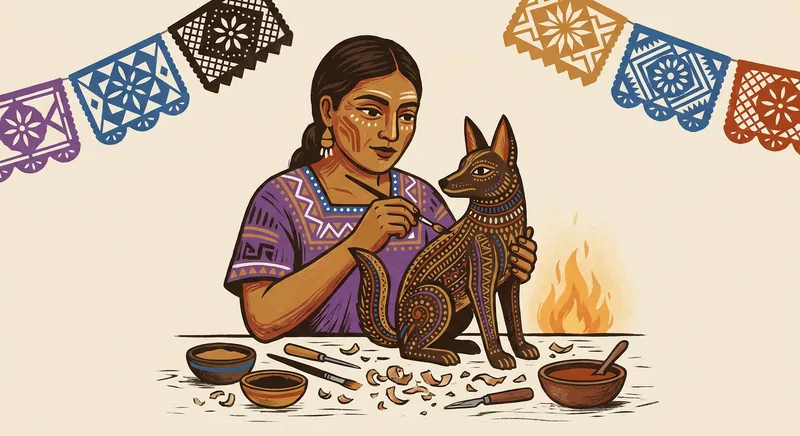
These carvings did not emerge simply as wooden copies of Linares’s figures. Research on Oaxacan folk art reveals a more complex process: a local carving tradition, artists with their own trajectories, exchanges with dealers and collectors, and changes driven by demand. Over time, the name “alebrije” spread to Oaxacan figures, especially as hybrid animals and fantastical designs began to proliferate. The word served as a commercial and cultural bridge, though it also ended up obscuring differences in origin that are worth recovering.
That is why it is more accurate to distinguish between the papier-mâché alebrijes associated with the Linares family and Oaxacan wood carvings, now widely called alebrijes. Both traditions have influenced each other and belong to Mexico’s contemporary artistic landscape, but they are not a single story, nor do they have a single creator. In Oaxaca, moreover, each family workshop organizes the carving, sanding and painting differently; sometimes the tasks are divided among several people whose names do not always appear on the label. Behind each piece is aesthetics, certainly, but also household economics, generational learning and shared work.
A young tradition, current questions
The success of alebrijes brought opportunities as well as uncomfortable questions. Who receives credit when a family design is reproduced industrially? What happens when a mass-produced figure is marketed in the same terms as a piece carved and painted over the course of weeks? How is the wood sourced, and who truly shares in the authorship? Buying thoughtfully does not require becoming a customs detective, but it does mean asking about the workshop, the community, the materials and the people who made the work.
It is also wise to be wary of explanations that turn every alebrije into a “pre-Hispanic spiritual guardian” or a direct equivalent of a nahual. Nahualism belongs to complex, diverse and documented Indigenous traditions, related in certain contexts to the ability to transform or to ties between people and animal entities. An alebrije may draw freely on those ideas, but it is not automatically a nahual or a ceremonial piece. Pairing the two terms because they involve animals and mystery makes for a highly marketable story, though one that is historically a little weak in the knees.
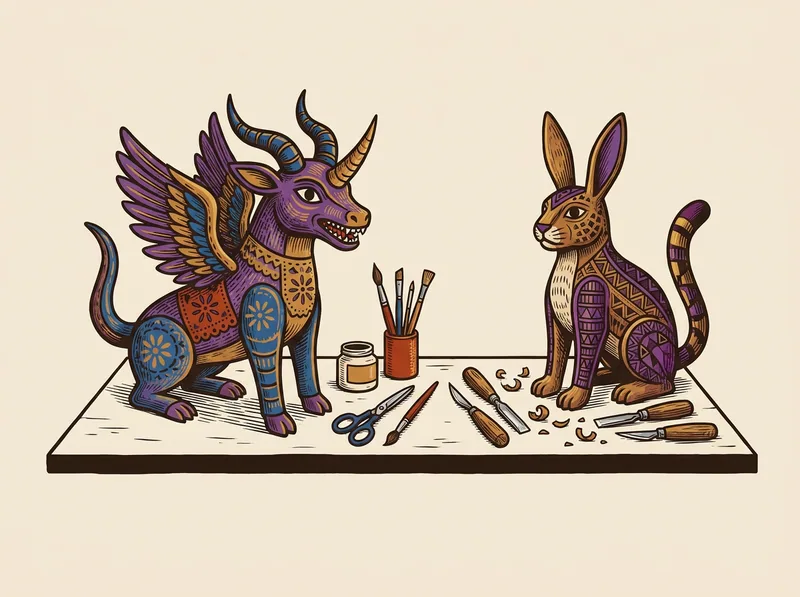
Today, the Linares family continues to work in papier-mâché, while numerous Oaxacan workshops sustain and reinvent wood carving. At the same time, artists from other regions create creatures in ceramics, textiles, metal, print and digital media. This expansion confirms the power of the idea, but it makes naming origins and creators essential. “Mexican” should not be such a large blanket that it covers up the actual people.
Perhaps that is where the alebrije’s deepest charm lies: it seems ancestral because it touches an ancient impulse—the urge to combine animals to imagine what does not exist—but its biography is modern and recognizable. It was born from Pedro Linares’s craft, grew amid paper and paste, and found in Oaxaca a powerful parallel life of wood, color and family organization. It does not need an invented antiquity to be living heritage; something harder to come by is enough: creators, memory, transformation and hands that still wrestle with the material. The alebrije did not emerge intact from the past: freshly painted, it continues to enter the future.
- Museo de Arte Popular (Mexico City), institutional materials on Pedro Linares and the alebrije tradition.
- Smithsonian American Art Museum, biographical and collection entry on Manuel Jiménez Ramírez.
- Michael Chibnik, Crafting Tradition: The Making and Marketing of Oaxacan Wood Carvings, University of Texas Press, 2003.
- Judith Bronowski, Pedro Linares: Artisan of Papier-Mâché, documentary, 1975.
- Secretaría de Cultura del Gobierno de México, Sistema de Información Cultural and materials on papier-mâché and folk arts.