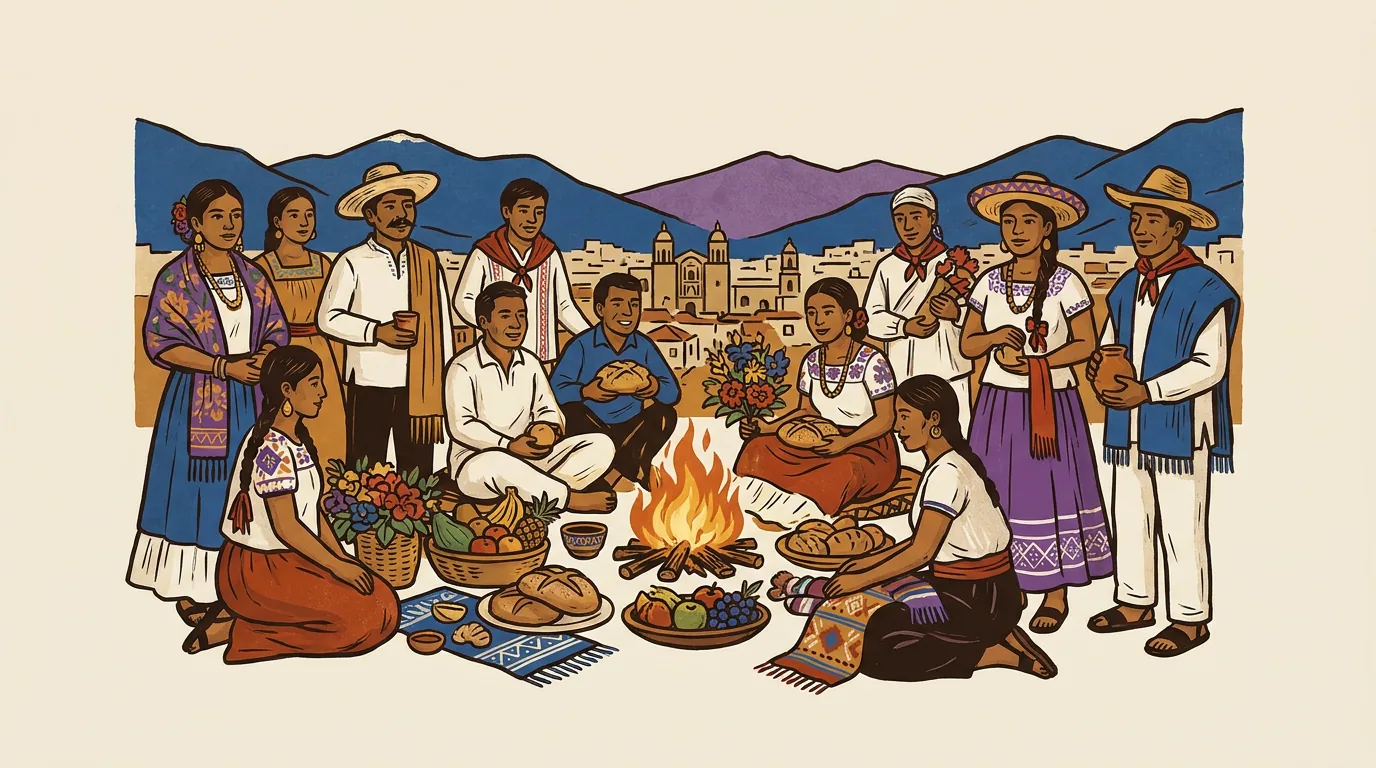
In Oaxaca, a single word can mean help with a wedding, a basket of fruit tossed to the crowd, an affectionate debt between neighbors, and a massive celebration atop a hill. That word is guelaguetza. Today it is commonly associated with the Lunes del Cerro, regional dances, and an auditorium packed to the very last hat; but its history cannot be contained entirely onstage. To understand it, you have to look less at the program and more at the gesture: someone gives because they belong, and whoever receives becomes part of a network of reciprocity.
Giving is not casting a gift to the wind
The term guelaguetza comes from Zapotec and is often translated as offering, cooperation, assistance, or reciprocal exchange. No Spanish rendering can fully encompass it, because it describes not only an object that is given, but a social relationship. A family contributes corn, mezcal, money, or labor for a celebration; later on, that help may be reciprocated when another household needs it. It is not a bank account in a huipil, though it does retain a memory: the gift creates obligation, gratitude, and belonging.
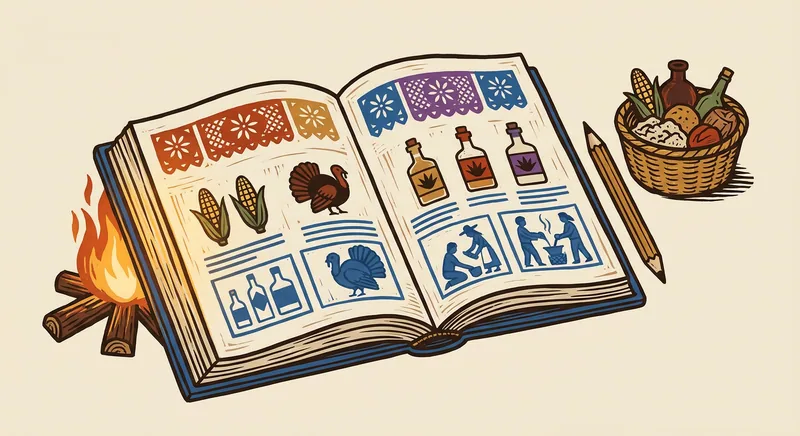
This practice has been part of community organization in various towns across Oaxaca, although it does not work the same way everywhere, nor does it belong exclusively to any one era. It may appear at weddings, funerals, mayordomías, patron saint festivals, and collective work projects. It should not automatically be confused with tequio: both express cooperation, but tequio is generally mandatory or agreed-upon community labor for the common good, while guelaguetza emphasizes exchange and reciprocity between individuals or families. In real life, of course, the boundaries may be less tidy than they are in a dictionary.
Guelaguetza is not only what is offered: it is the bond that remains after the offering is made.
Before the auditorium
It is often claimed that the Guelaguetza descends directly from pre-Hispanic ceremonies dedicated to Centéotl, the Mesoamerican deity of corn, held on Cerro del Fortín. The connection between July, the rains, corn, and ancient ritual practices is plausible in a region with a long agricultural history; there are also colonial references to Indigenous celebrations that evangelizers sought to suppress or redirect. However, presenting today's spectacle as a ceremony preserved intact since Zapotec times erases centuries of change and oversimplifies a complex history. There are cultural continuities, yes, but not a straight, seamless line from an ancient rite to today's grandstands.
During the viceregal period, Catholic festivals coexisted and became intertwined with Indigenous practices. In Oaxaca, the celebration of Our Lady of Mount Carmel, whose feast day is July 16, gained importance; the following Mondays became associated with outings and celebrations on Cerro del Fortín. Popular tradition explains the one-week skip through the anniversary of Benito Juárez's death, which occurred on July 18, but that explanation does not account for every historical calendar and should be treated with caution. What is certain is that the so-called Lunes del Cerro existed before the festival took on its official twentieth-century form.
A modern festival with deep roots
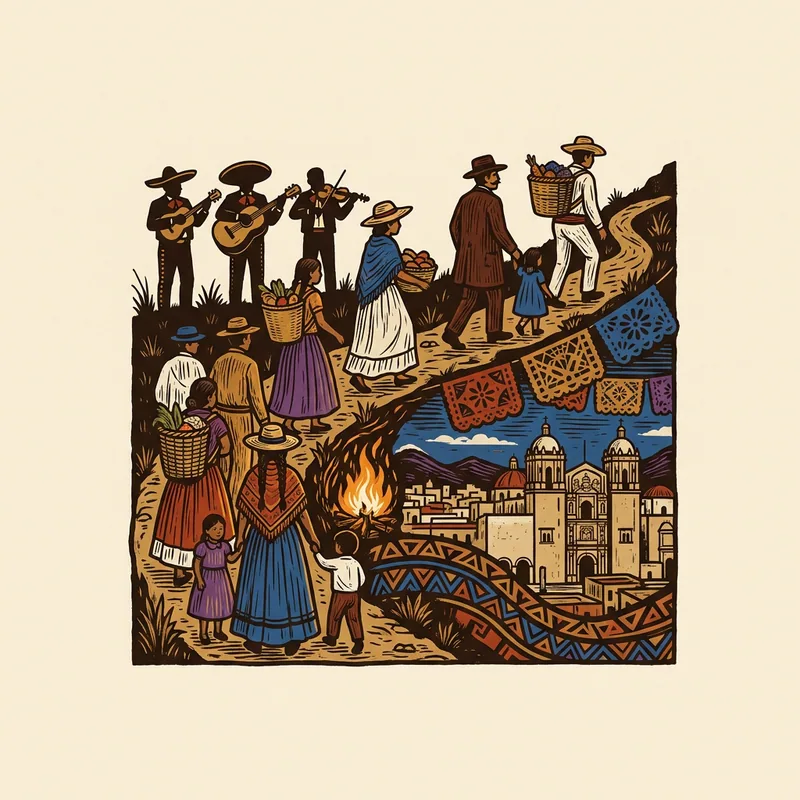
The Guelaguetza as a major regional showcase has a pivotal date: 1932. That year, after the 1931 earthquake and as part of the four-hundredth anniversary of Oaxaca's elevation to city status—then called Oaxaca de Juárez—the Homenaje Racial was organized. Delegations from different regions presented dances, music, traditional dress, and products at the Rotonda de las Azucenas on Cerro del Fortín. The event sought unity and recovery, but it also reflected postrevolutionary cultural policy, which was intent on constructing an orderly, picturesque image of the nation.
That staging did not invent the dances or the communities, but it did select, arrange, and turn local expressions into a mosaic visible from the state capital. Over the years, the Homenaje Racial became institutionalized and eventually came to be known as the Guelaguetza. The Rotonda was replaced by an auditorium inaugurated in 1974, later renovated and named the Auditorio Guelaguetza. Thus, a word associated with community reciprocity also came to name an official, tourist-oriented, media-driven spectacle.
- 1Community guelaguetza: an exchange of goods, support, or labor within relationships of reciprocity.
- 2The Lunes del Cerro: a festive tradition celebrated on the two Mondays following July 16, except when the calendar is adjusted.
- 3The official Guelaguetza: a presentation of regional delegations organized by the state government at the Auditorio Guelaguetza.
- 4Local and alternative festivals: community, neighborhood, or critical celebrations that also lay claim to the word and its meaning.
Eight regions take the stage
In its best-known format, the festival brings together delegations from the regions historically presented as Cañada, Costa, Istmo, Mixteca, Papaloapan, Sierra Norte, Sierra Sur and Valles Centrales. Since 2019, the state’s administrative division has also recognized Sierra de Flores Magón as a region, formerly called Cañada; the program and the festival’s collective imagery do not always change at the same pace as official maps. Each delegation brings selected and rehearsed repertoires: sones, jarabes, chilenas, dances, bands, clothing and objects that evoke its community. At the end of some performances, fruit, bread, hats or regional products are tossed to the audience: a stage interpretation of the act of sharing.
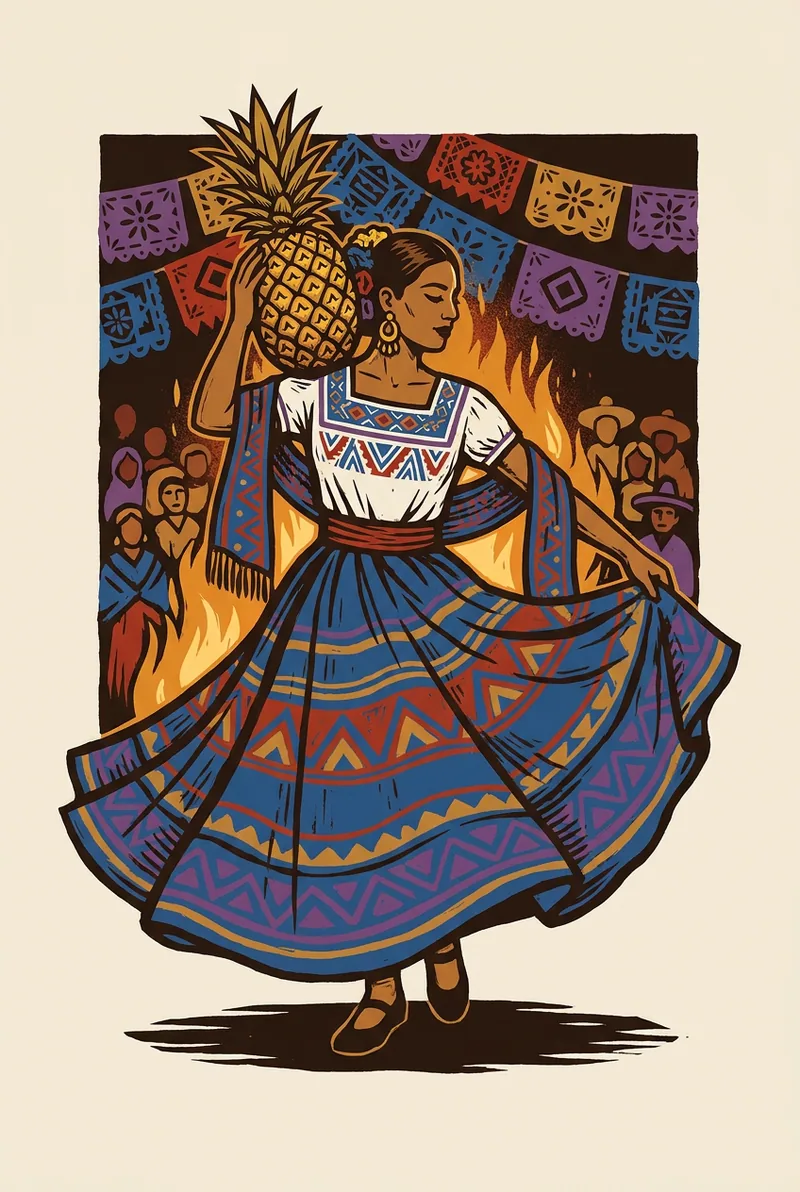
Not everything that appears onstage is an ancestral survival. One famous example is Flor de Piña, a choreography created in 1958 by Paulina Solís Ocampo to represent Tuxtepec, accompanied by the melody of the same name by Samuel Mondragón. Its relatively recent history does not make it false: traditions, too, are created, adopted and imbued with meaning over time. What matters is not selling as a thousand-year-old relic something that has an author, a date and a context, because truth usually dances better without a costume.
The selection of delegations sparks inevitable debates: who represents whom, what clothing is considered authentic, which dances are left out and how much weight the tourist gaze carries. People also debate ticket prices, government control and the distance between the community-based notion of the gift and a large-scale spectacle. At the same time, for many participants, attending means pride, discipline, family memory and an opportunity to showcase a living culture. Both things can be true: a festival can be deeply cherished and also shaped by power, commerce and institutional decisions.
What is given comes back
Asking what the Guelaguetza is, then, requires answers in the plural. It is an ethic of reciprocity with Zapotec roots; it is a custom of cooperation that remains alive; it is the modern name of the Lunes del Cerro; and it is a stage where Oaxaca represents and celebrates itself, and also debates itself. Reducing it to “the greatest festival of the people of Oaxaca” works for the poster, but leaves out the most interesting questions. Nor is there just one Oaxaca: the state is home to Zapotec, Mixtec, Mixe, Mazatec, Chinantec, Chatino, Triqui, Ikoots, Afro-Mexican and many other peoples, each with histories that cannot fit into a ten-minute choreography.
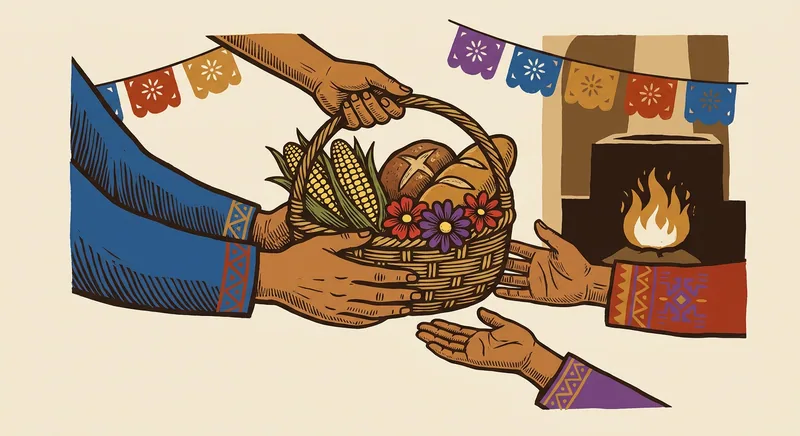
Perhaps that is why it is worth viewing the festival with both joy and attentiveness. Enjoying the band, the movement of the textiles and the shower of fruit does not prevent us from asking who arranged the image we see or listening to the communities outside the auditorium. The history of the Guelaguetza is not that of an archaeological artifact, but that of a practice transformed by time, religion, the State, tourism and the will of the peoples. When the music ends, its most fertile idea remains: a community is sustained not by what it keeps, but by what it knows how to put into circulation.
- Lizama Quijano, Jesús. The Guelaguetza in Oaxaca: Festival, Interethnic Relations and Processes of Symbolic Construction in the Urban Context. CIESAS, 2006.
- National Institute of Indigenous Peoples (INPI), outreach materials on the Guelaguetza and the Indigenous peoples of Oaxaca.
- Oaxaca Ministry of Cultures and Arts, Historical Archive of the Guelaguetza.
- National Institute of Anthropology and History (INAH), public outreach articles on the Lunes del Cerro and the history of the Guelaguetza.