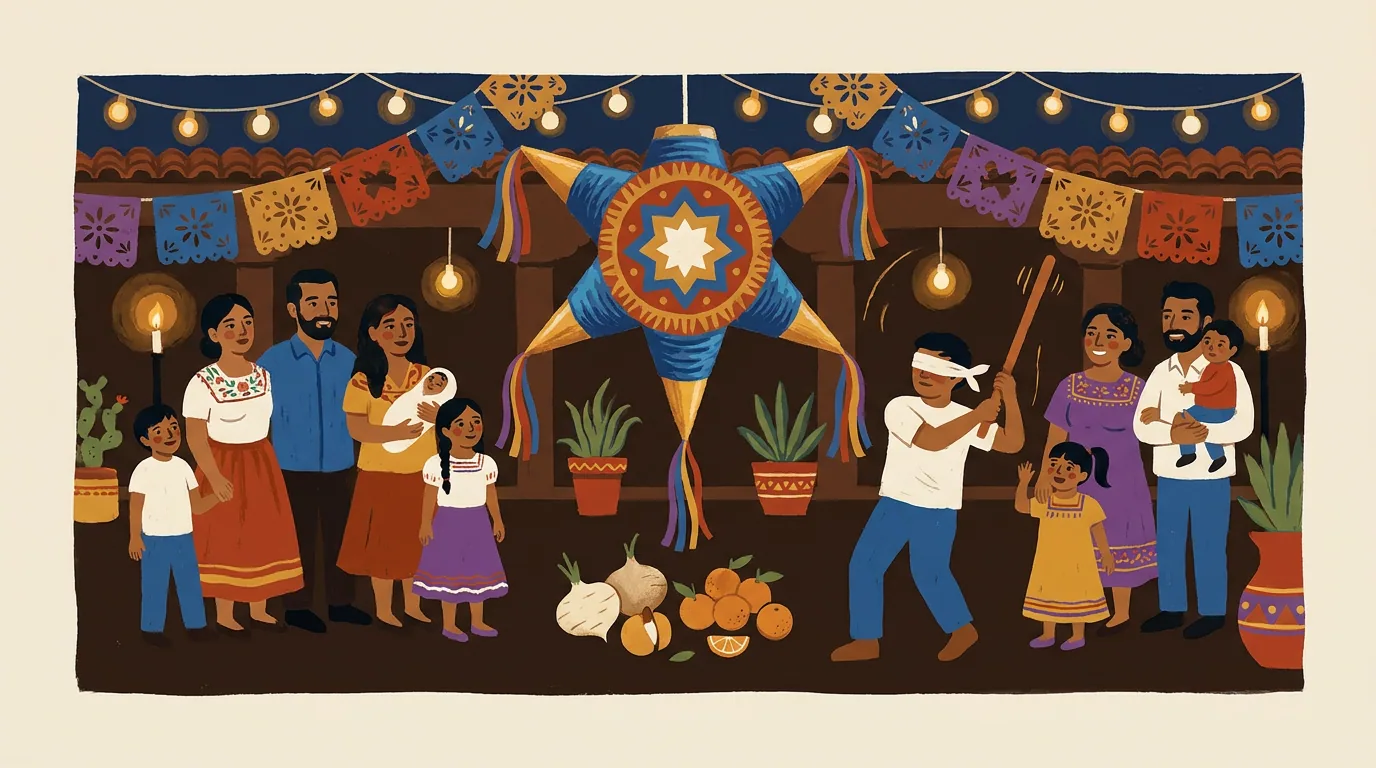
Before it becomes a shower of candy, the piñata is a small ceremony of noise, anticipation and chaos. It is hung up, spins above people’s heads and forces you to put your trust in a stick while someone yanks the rope with less-than-kind intentions. In Mexico, it appears at posadas, birthdays and public celebrations, so familiar that it seems to have been here forever. But its history does not follow a straight line: it crosses Asia and Europe, enters New Spain as a tool of evangelization and ends up transformed into one of our most joyful ephemeral arts.
A vessel that traveled far
The best-documented antecedent is in Europe. During medieval Lent, people in Italy would break a clay pot called a pignatta—a word related to “pot”—that contained gifts or food; from there, the custom spread to Spain. Some popular versions claim that Marco Polo brought the idea of striking hollow figures back from China, but the story is difficult to verify and should be treated as tradition, not as a birth certificate. What is certain is that European celebrations involving breakable containers already existed before the piñata took on its New Spanish form.
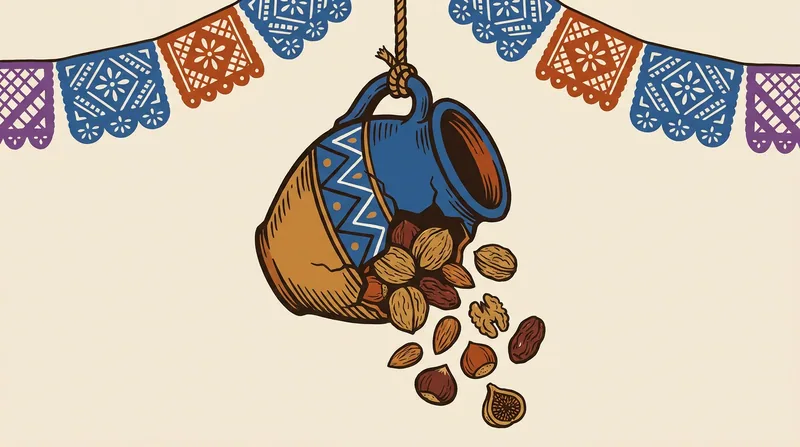
It is also wise to resist the temptation to identify a universal “first piñata.” Many cultures have broken vessels, struck ritual objects or distributed goods during celebrations, without all those practices belonging to a single genealogy. In Mesoamerica, there were ceremonies involving vessels and offerings, but claiming they were piñatas identical to those of today oversimplifies very different ritual worlds. The Mexican piñata arose, rather, from contact and adaptation: a European form that changed its calendar, materials, meanings and audience here.
Acolman: doctrine with a stick and rope
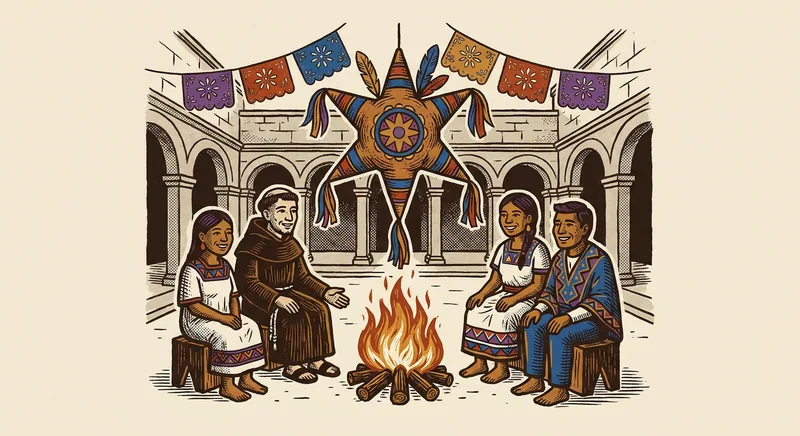
Mexican tradition places a pivotal moment in Acolman, now in the State of Mexico. In 1587, the Augustinian friar Diego de Soria, prior of the San Agustín monastery, obtained authorization from Pope Sixtus V to celebrate misas de aguinaldo from December 16 to 24. These ceremonies included songs, religious instruction and gifts; over time, they became linked to the posadas. For that reason, Acolman holds a central place in the historical memory of the piñata, even though no precise day can be identified when someone attached the first cone and declared the custom officially inaugurated.
The friars used theatrical devices to explain Christian doctrine to Indigenous peoples. The seven-pointed piñata was interpreted as representing the seven deadly sins; its colors and decorations symbolized temptation, the blindfold was faith, the stick embodied virtue and the falling fruit served as a reward. It is a widely known catechetical interpretation consistent with New Spanish teaching methods, though its details were not fixed once and for all. As often happens with effective symbols, each era adjusts their hat a little.
“I don’t want gold and I don’t want silver, what I want is to break the piñata!”
- 1The seven-pointed star: associated in catechesis with the deadly sins.
- 2The blindfold: understood as faith that guides without sight.
- 3The stick: presented as the virtue that overcomes temptation.
- 4The fruit and candy: a material reward and symbol of grace or abundance.
The celebration becomes Mexican
Beyond religious discourse, the piñata found something more enduring than any sermon: the communal love of throwing a party. The posadas reenacted Mary and Joseph’s pilgrimage during the nine nights before Christmas, but songs, lights, food and games grew up around the prayers. The piñata stopped being merely a visual lesson and became a moment of collective participation. No one needs a treatise on theology to understand the thrill of hearing the paste crackle overhead.
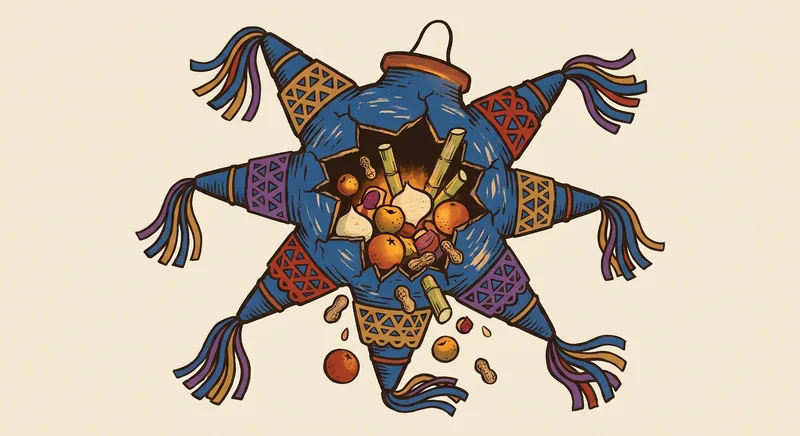
The traditional pot was covered with paper, paste and cardboard cones, and filled with seasonal fruit: tejocotes, sugarcane, jícamas, oranges, peanuts and colaciones. The contents varied by region and budget; abundance has always known how to negotiate with the pantry. In the 20th century, mass-produced candy and small toys gained ground, while cardboard and wire frames often replaced clay. The change prevented some memorable bumps on the head, though it did not put an end to the national sport of diving for the last piece of candy.
The songs also regulate the game. “Dale, dale, dale, no pierdas el tino” keeps time for the person swinging the stick; “de la colación” accompanies the distribution and the promise that something will hit the ground. These verses have been passed down in countless variations, closer to oral tradition than to official lyrics. Each family shortens, lengthens or improvises them according to the piñata’s resilience and the patience of whoever is holding the rope.
From star to superhero
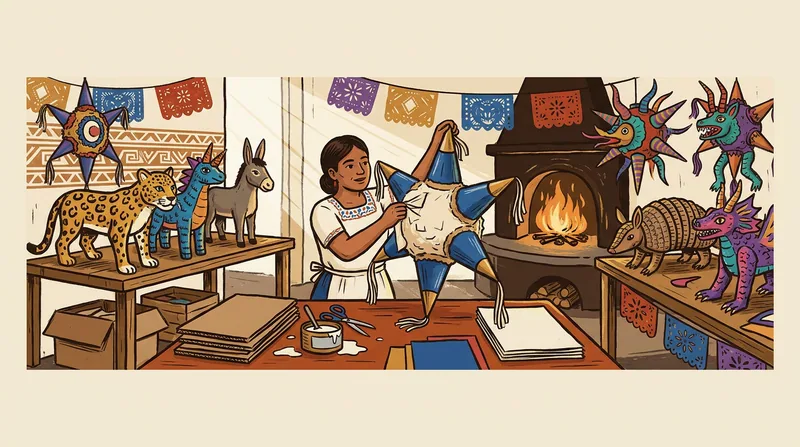
The piñata moved beyond the Christmas season and found a place at birthdays, fairs, baptisms, school parties and civic celebrations. Its range of forms became inexhaustible: stars, bulls, donkeys, fruit, popular characters, politicians and creatures whose fame lasts less time than the latest song. In family workshops, especially in central Mexico, making them brings together cartonería skills: shaping paper, cardboard, paste, wire and color. It is popular sculpture destined to disappear, a work that fulfills its purpose when it is reduced to confetti.
Its spread to the United States and other countries accompanied Mexican and Latin American communities, but also transformed the object into a commercial emblem. Today, piñatas appear in advertising campaigns, art installations and political protests; striking a cardboard figure of a public figure offers a catharsis so clear that it needs no subtitles. At the same time, artisans have responded with monumental pieces, miniatures and custom designs. Tradition stays alive not by standing still, but by knowing how to change without losing the shared game.
What Falls When It Breaks
Seen up close, the piñata encapsulates several centuries of cultural translation. It preserves the memory of the European clay pot, the religious teachings of New Spain, community celebrations and the inventiveness of Mexican cartonería. It also shows that traditions are not fossils: they adapt to new materials, urban rhythms and characters, without asking permission from a committee on authenticity. Its history matters precisely because it does not belong to one single, pure origin, but to the many hands that hung it in different ways.
When the piñata breaks open, no one gathers only candy. Fragments of a shared history come tumbling down: clay turned into paper, doctrine turned into song and a solemn symbol transformed into laughter. Afterward, the ground is covered in color, and there is a brief negotiation over who took too much. Perhaps that is its most enduring lesson: some things are made to be broken, because only by breaking can they share what they carry inside.
- National Institute of Anthropology and History (INAH), outreach materials on the origins of posadas and the piñata in Mexico.
- Government of the State of Mexico, historical and cultural information about the municipality of Acolman and its piñata-making tradition.
- Royal Spanish Academy, Dictionary of the Spanish Language, entry “piñata”.
- Frances Toor, A Treasury of Mexican Folkways, Crown Publishers, 1947.
- Octavio Hernández, Las piñatas, General Directorate of Popular Cultures, Secretariat of Public Education, Mexico.