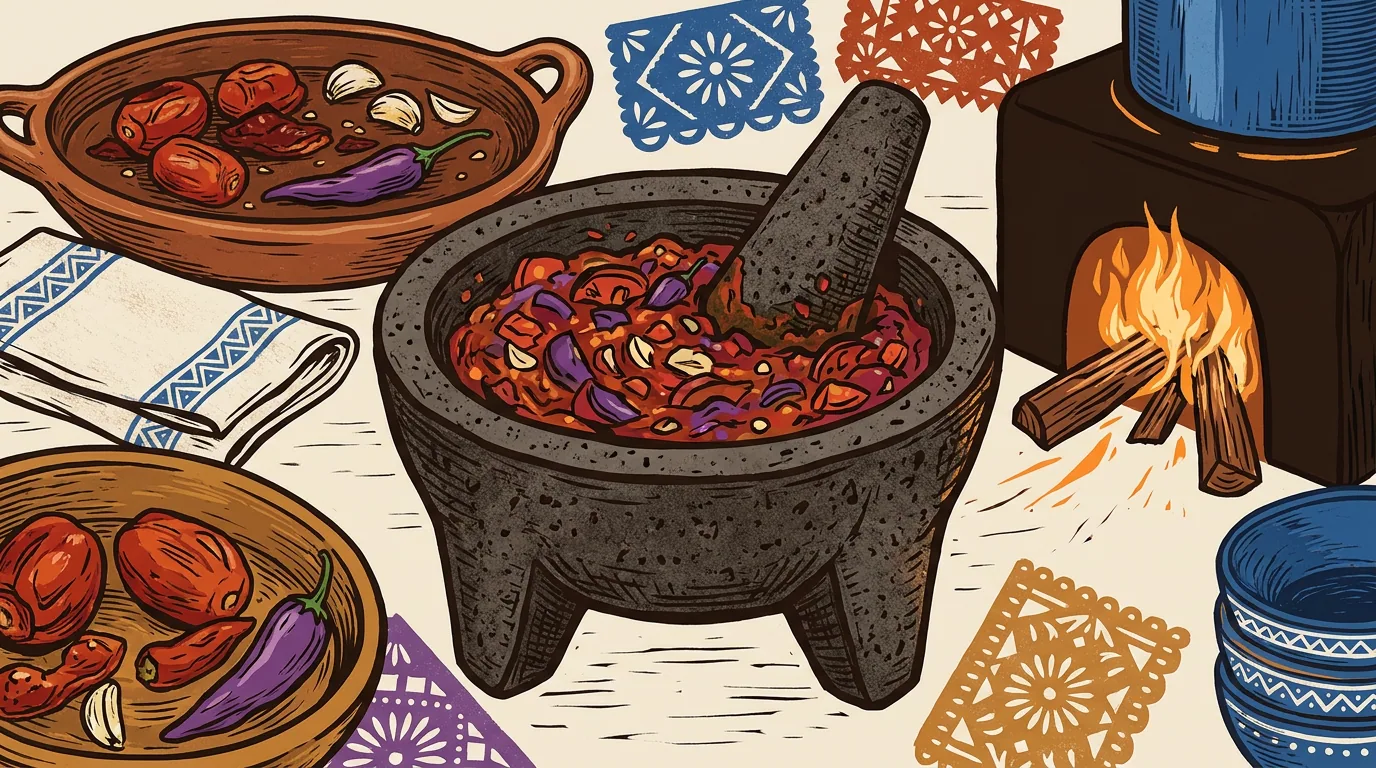
Before a salsa reaches the table, the molcajete has already made quite a racket. The tejolote pounds, turns and drags; the chile gives way, the garlic disappears and the tomato ends up transformed into a mixture that is not entirely smooth, nor does it aim to be. That irregular, juicy texture holds a history thousands of years old: that of a stone technology created to transform food with strength, patience and a steady hand. Calling it a “prehispanic blender” is convenient, but also unfair: the molcajete does not imitate any modern machine; it does something else, and does it in its own way.
Before the name, there was the stone
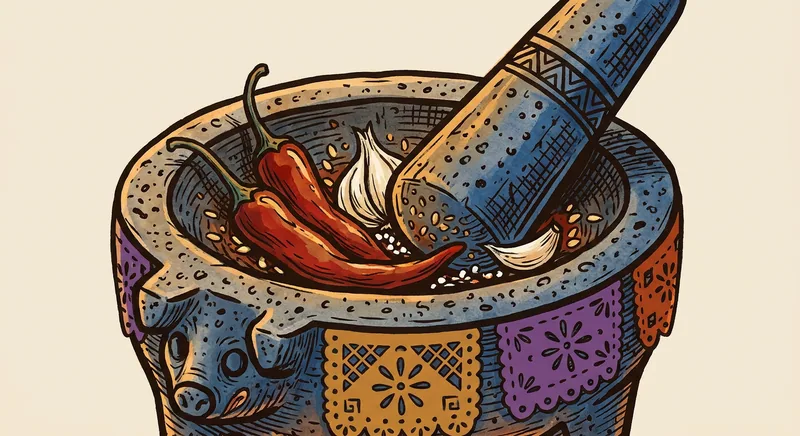
Grinding is one of the oldest operations in cooking. In Mesoamerica, farming communities needed sturdy tools to crack seeds, pulverize pigments and process corn, chile and other plants. Archaeological remains include grinding stones, handstones, mortars and metates of various shapes; not all were molcajetes in the present-day sense, but they belong to a long technological family. Over time, concave vessels and their pounders became specialized, and some three-legged models became familiar across broad regions of Mexico.
The word “molcajete” comes from Nahuatl and is usually traced to molcaxitl: a vessel for salsa or for grinding. “Tejolote,” the name of the stone pestle, derives from texolotl. As with many words that passed from Nahuatl into Mexican Spanish, pronunciation and spelling adapted over centuries of everyday use. The result lives not only in dictionaries: it lives in markets, kitchens and phrases like “pass me the tejolote,” which can sound alarming if you do not know dinner is underway.
In prehispanic Mexico, grinding tools played a role in domestic, productive and ritual tasks. The metate was central to nixtamalized corn, while stone mortars were used to process seasonings, seeds, remedies and pigments. Early colonial codices and written sources from the 16th century document ground foods and Indigenous utensils, though they do not always offer an exact snapshot of every kitchen. Archaeology fills in part of the picture through traces of use, residues and archaeological contexts; stone, though discreet, often speaks up under scientific questioning.
“In molcaxitl”: the grinding vessel was named in Nahuatl long before it became a restaurant emblem.
A technology on three legs
The traditional molcajete is made from volcanic rock, a material abundant in different areas of central Mexico. Not every dark stone will do: it must withstand pounding, provide an abrasive surface and shed as little material as possible once conditioned. Its cavity helps contain ingredients and liquids, while its three legs give it stability on the floor, a table or a work surface. The shape is simple, but it answers a very serious design question: how to concentrate force without sending the salsa onto the walls.
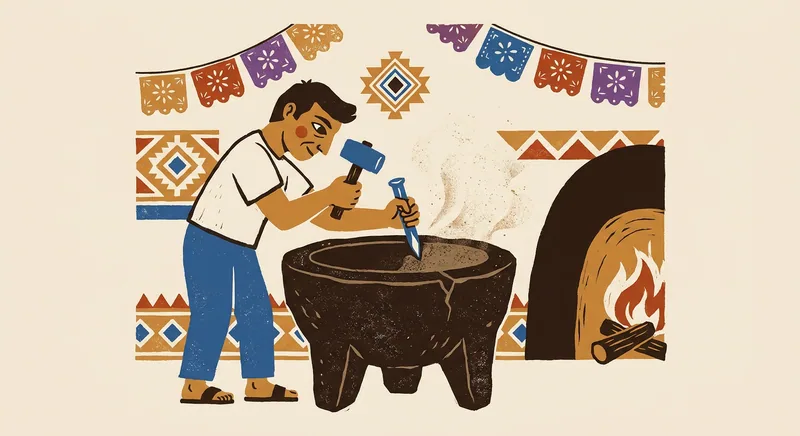
The craft begins long before the chisel. You have to know the quarry or the terrain, select the rock and recognize fractures that could ruin hours of work. Then come rough shaping, defining the cavity, the legs, the rim and a surface rough enough to grind without behaving like sandpaper gone wild. In places with a stone-carving tradition, knowledge passes between generations and adapts to new tools without abandoning the reading of the material. A machine can speed up certain cuts; deciding where to strike remains a matter of ear, eye and experience.
San Lucas Evangelista, in Tlajomulco de Zúñiga, Jalisco, is a community known for making basalt-stone molcajetes. There are also workshops and production centers in the State of Mexico, Puebla, Guanajuato and other volcanic regions. Each area develops its own sizes, finishes and profiles, from understated pieces for daily use to examples carved with animal heads or ornamental motifs. It is best not to imagine a single tradition frozen since Mexica times: the molcajete has changed with markets, tastes and tools, like any object that refuses to become a fossil.
- 1Selection of a compact rock, with no visible cracks or fragile areas.
- 2Rough shaping of the exterior to obtain the vessel’s overall form.
- 3Hollowing and pecking out the cavity where grinding will take place.
- 4Carving the legs, rim and, when applicable, decorative elements.
- 5Checking the balance and finishing the work surface.
- 6Curing at home before first use to remove dust and loose particles.
From Stone to Salsa
Grinding in a molcajete is not the same as chopping with blades. The tejolote crushes and tears plant tissues against a rough surface, releasing juices, oils and aromas while preserving particles of different sizes. In a blender, speed produces more uniform mixtures and can incorporate air; with a molcajete, the person decides when to leave a chile just barely broken up or turn the garlic into a paste. This is not about declaring an absurd war between stone and electricity: each tool produces different results, and dinner is better off when we do not turn everything into a crusade.
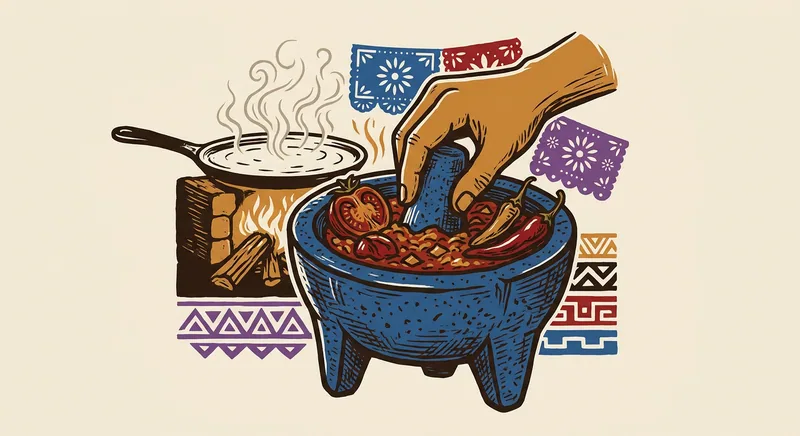
The order of grinding matters. It often begins with coarse salt, garlic or dried spices, which help form a paste; roasted chiles are added next, followed by tomatoes or tomatillos, whose liquid loosens the mixture. But there is no universal sequence: it changes depending on the salsa, the region and the hand doing the cooking. Some preparations call for a thick emulsion; others, visible chunks and whole seeds. The molcajete makes it possible to adjust as you go with a precision measured not in buttons, but in turns.
Seasoning also reveals the quality of the piece. An excessively sandy molcajete that continues to shed particles after several grindings may be poorly finished or made from unsuitable stone. To care for it, water, a stiff brush and thorough drying are usually enough; heavily scented detergents can linger on the porous surface and show up, uninvited, in the next salsa. Nor is it wise to subject a cold piece to sudden temperature changes. Stone is durable, not immortal: even objects with an ancient reputation appreciate not being tossed into the sink.
Surviving Modernity
During the colonial centuries, the molcajete did not disappear with the introduction of metals, glazed ceramics and new ingredients. On the contrary, it found additional work: pepper, cloves, cinnamon, cumin and products brought from Europe, Asia and Africa entered kitchens where Indigenous techniques remained active. The cuisine of New Spain was not an orderly replacement, but a daily negotiation among ingredients, utensils and knowledge. In that conversation, the molcajete spoke with a stone accent and welcomed guests without giving up the house.
Later, it coexisted with hand-cranked mills, food processors and blenders, appliances that reduced the time and effort required for many household tasks. Its staying power should not be explained by some supposed romantic resistance to progress, but by concrete reasons: it produces prized textures, works for both preparing and serving, lasts for decades and can be repaired or retextured. It is also tied to family memories and embodied knowledge that is difficult to put into a recipe. “Until it looks right,” “until it smells right” or “until it comes together” are imprecise instructions on paper, but perfectly clear to a trained hand.
In recent years, the molcajete has also become a design object, a souvenir, dramatic tableware and the star of cooking videos. That popularity is a double-edged sword. It can strengthen workshops and renew interest in the craft, but it also encourages industrial imitations made of cement or low-quality stone, as well as pieces bought based on price without asking who made them. Identifying a good molcajete requires looking at the carving, weight, porosity and origin; buying directly from producers or retailers that identify the workshop is a simple way to acknowledge that behind the stone is human labor.
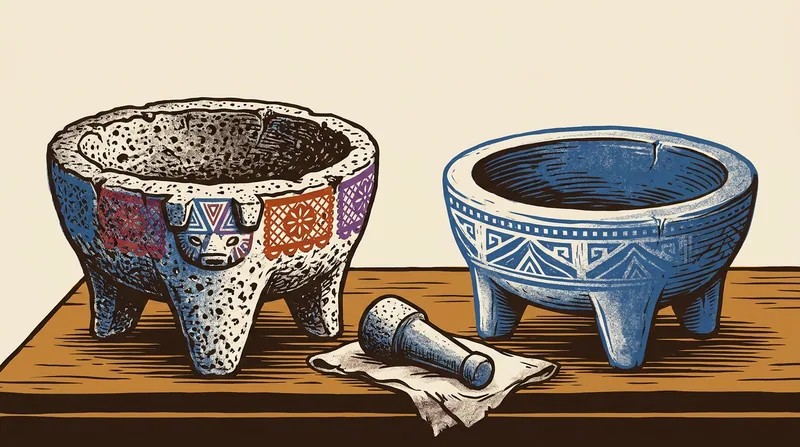
Its presence today does not prove that all molcajetes are identical to pre-Hispanic ones, or that every salsa prepared in them preserves a thousand-year-old recipe. Cuisines change, and tomatoes, chiles, onions and garlic have formed different combinations throughout history depending on the era and region. True continuity lies not in an impossible purity, but in passing down a material logic: choosing, roasting, grinding, tasting and adjusting. Seen up close, tradition looks less like a display case and more like a worktable.
The history of the molcajete fits inside a stone, but it is not a static history. It brings together geology, agriculture, the Nahuatl language, colonial exchange, artisanal labor and household decisions that rarely make it into grand national narratives. Each strike of the tejolote repeats an ancient gesture without copying it exactly: the recipe changes, the hand changes, the table changes. Perhaps that is why the molcajete is still there, heavy and battery-free, reminding us that some technologies survive not because of nostalgia, but because they still have something to do.
- Sahagún, Bernardino de. General History of the Things of New Spain (Florentine Codex), edition by Alfredo López Austin and Josefina García Quintana, National Council for Culture and the Arts.
- National Museum of Anthropology, National Institute of Anthropology and History (INAH): archaeological and ethnographic collections on food and grinding in Mesoamerica.
- Long-Solís, Janet, and Luis Alberto Vargas. Food Culture in Mexico. Greenwood Press, 2005.
- Coe, Sophie D. America’s First Cuisines. Fondo de Cultura Económica, 2004.
- Royal Spanish Academy and Association of Academies of the Spanish Language. Dictionary of the Spanish Language, entries “molcajete” and “tejolote.”