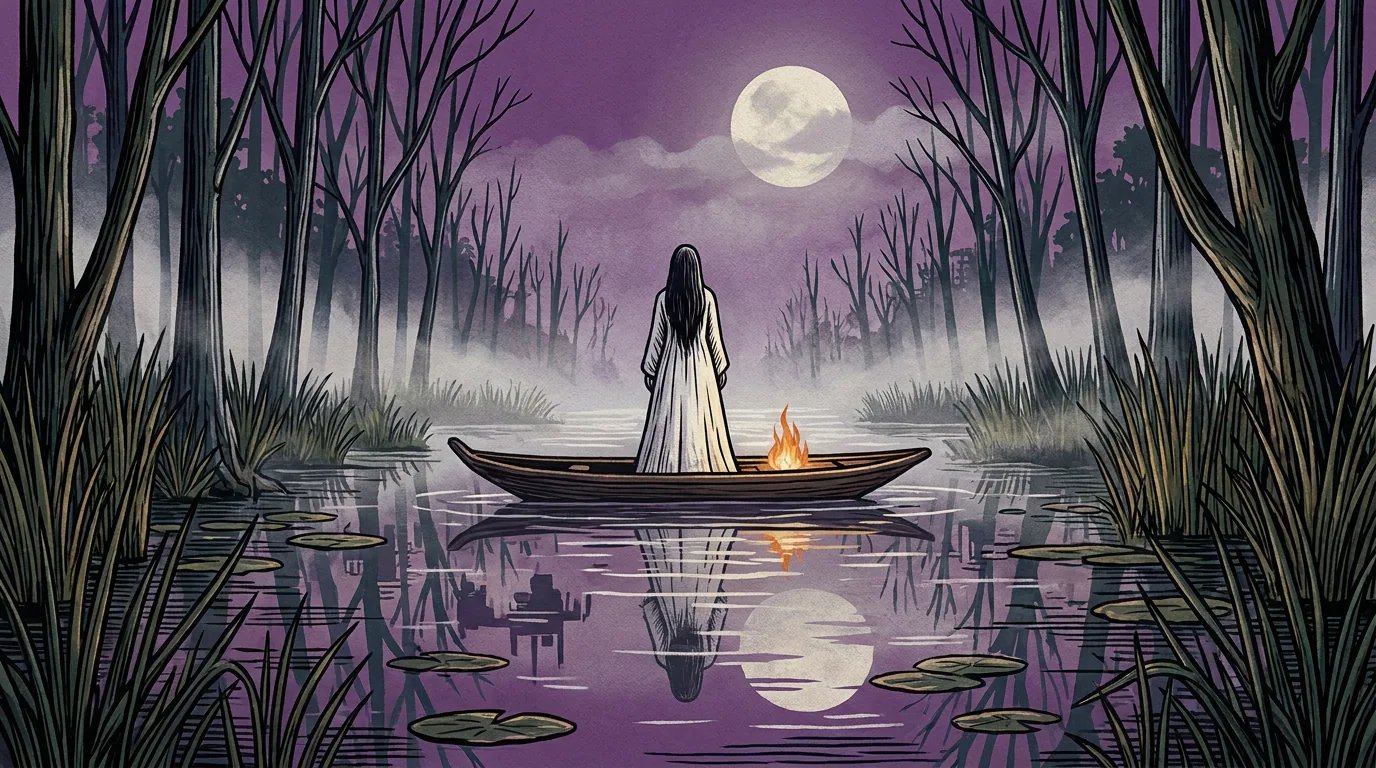
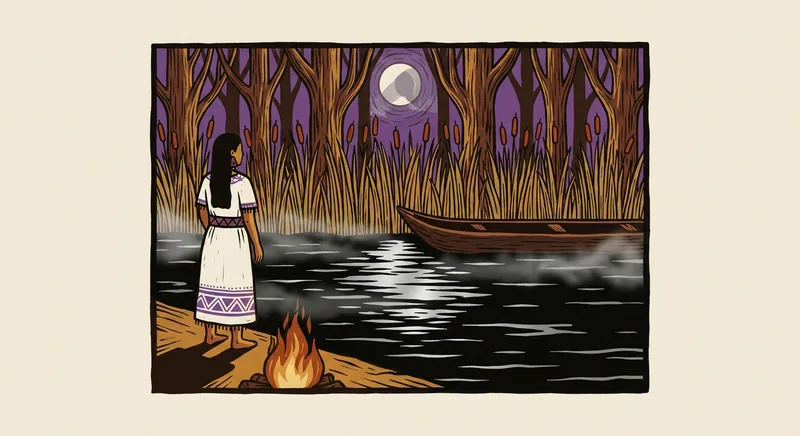
La Llorona does not need to knock on the door: one untimely wail is enough for half of Mexico to recognize her name. She is said to wander near rivers, irrigation ditches, and lakes, dressed in white, searching for the children she lost or killed; anyone who hears her cry should be wary of the distance, since tradition holds that if it sounds far away, she is near. But there is no single version, nor any birth certificate for this specter. The figure we now call La Llorona is a tapestry of ancient Indigenous imagery, colonial tales, sermons, ballads, plays, and family memories.
A Legend with Many Mothers
In its most widespread form, the story tells of a woman who falls in love with a man who later abandons her, scorns her, or marries someone of his own social standing. Desperate, she drowns her children in a river and, when she realizes what she has done, takes her own life or dies consumed by grief. From then on, her soul roams the riverbanks crying, “Oh, my children!”, condemned to search for them without ever finding them. It is a simple and brutal plot, but each region shifts the pieces: the motive for the crime, the number of children, the place where she appears, and even the fate of whoever hears her weeping all change.
- 1In some tales, she is an Indigenous woman abandoned by a Spaniard.
- 2In others, she is a poor mother scorned by a rich man.
- 3Sometimes she does not kill her children: she loses them in a flood, or they are taken from her.
- 4She may appear faceless, veiled, with long hair, or with a skull beneath her rebozo.
- 5In certain versions, she foretells misfortune; in others, she punishes men who are drunk, unfaithful, or out late at night.
Before the Woman in White
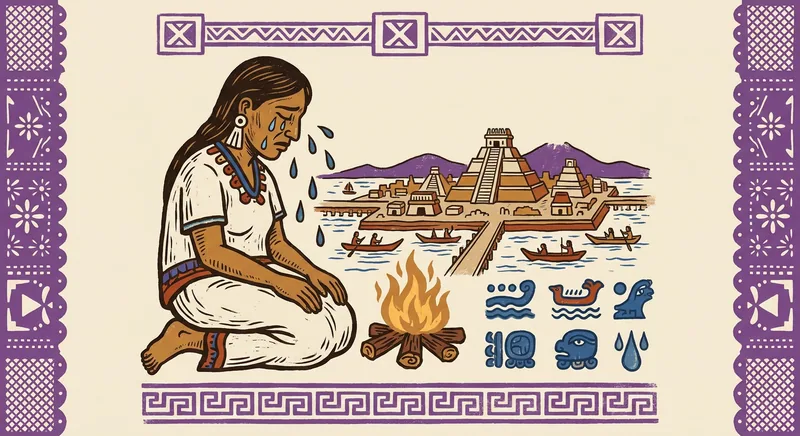
Searching for a single origin often yields answers that are far too convenient. One of the most frequently cited connections points to the omens preceding the conquest of Mexico-Tenochtitlan, recorded decades later by Fray Bernardino de Sahagún and his Nahua informants. In the Spanish-language version of the General History of the Things of New Spain, a woman appears who wept at night and said: “Oh, my children, we are already lost!” and “Where shall I take you?” The passage is colonial and retrospective: it preserves Indigenous voices, but it was compiled after the fall of Tenochtitlan, as part of a Franciscan project.
That woman has also been linked to Cihuacóatl, a Mexica deity associated with motherhood, war, childbirth, and death, whose presence could be understood as an omen. In Nahua sources, Cihuacóatl has fearsome and maternal traits, but simply equating her with the modern La Llorona erases centuries of transformations. We do not have a straight documentary line running from a pre-Hispanic goddess to the white-rebozo apparition people describe today. It is wiser to speak of echoes and reinterpretations, not an unchanged identity that crossed five centuries without changing her dress.
“Oh, my children, we are already lost!”
Another popular interpretation identifies La Llorona with Malintzin, or Doña Marina, Hernán Cortés’s interpreter. That association is late and symbolic, not a biographical fact: no early source claims that Malintzin drowned her children or wandered about mourning them. The image arose from later interpretations that made her an emblem of the conquest, cultural mixing, or supposed “betrayal,” a word that often judges, with harsh hindsight, an enslaved woman who acted under extreme conditions. Confusing the symbol with the historical person may make for good melodrama, but it makes for bad history.
The Blending of the Specter
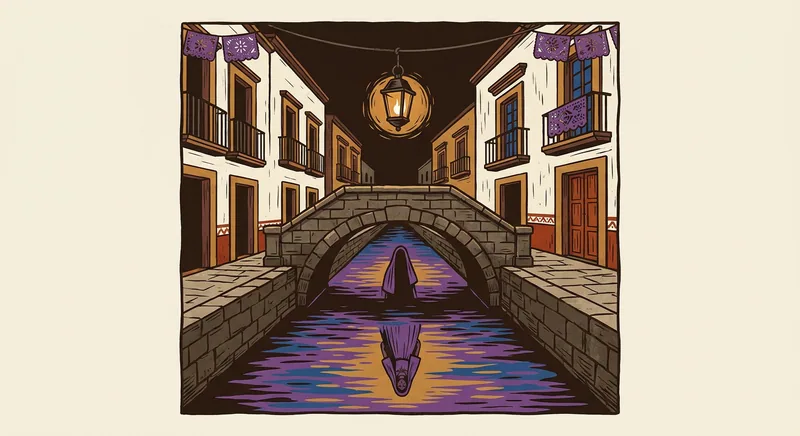
During the viceroyalty, Indigenous traditions coexisted and mingled with European figures: restless souls, white ladies, punished mothers, and women who return from the beyond because of a grave transgression. Catholic culture offered a powerful vocabulary of guilt, sin, penance, and purgatory. At the same time, New Spain’s cities had irrigation ditches, lakes, dark bridges, and streets where night transformed every silhouette; Mexico City, still surrounded by water, was a setting tailor-made for rumors. La Llorona thus gradually took on a colonial and, later, nineteenth-century appearance: a white dress, a veil, a hidden face, and a nocturnal walk.
In 1809, the Dominican friar Mier published La Llorona in Valencia, a poem on a New Spanish subject that attests to the name’s circulation in writing at the beginning of the 19th century. Later, newspapers, collections of legends and costumbrista writers helped establish scenes that had previously changed as they passed from mouth to mouth. The tale remained alive precisely because it was never sealed by a definitive edition. Each storyteller could move it to their own bridge, river or neighborhood and swear, with the seriousness reserved for excellent gossip, that it had happened “right around here.”
The legend also served as a form of nighttime discipline. “Don’t go out, or La Llorona will take you” kept children away from the water and the street; in tales for adults, the apparition might teach drunkards, womanizers or reckless travelers a lesson. Yet reducing her to a bogeywoman would be to see only the rebozo. Her sorrow speaks of abandonment, inequality, forced motherhood, violence against women and the collective fear of a mother who breaks with the protective role society imposes on her.
From Theater to Film and the Canals
In the 20th century, La Llorona moved from oral tradition into theater, radio, comics and film without ceasing to haunt courtyards and linger over after-dinner conversations. The Mexican film La Llorona, directed by Ramón Peón and released in 1933, was one of the first sound horror productions made in the country. Its plot combined a family curse, the colonial past and modern science, a sign that the legend could already be adapted to new genres. More films, songs, stage productions and television versions followed, some somber and others downright gleeful in their excess.
The stage production La Llorona has been performed since 1993 in the Cuemanco area of Xochimilco, with music, dance, canoes and a chinampa landscape that serves as more than a mere backdrop. The show reinterprets episodes from the conquest and elements of the Nahua worldview, and it has helped forge a contemporary connection between the character and the canals. The production should not be mistaken for an unchanged pre-Hispanic survival: it is a modern artistic creation rooted in a historic territory. That distinction does not diminish its power; on the contrary, it allows us to appreciate how a community retells the past from its own waters.
What Is She Weeping for When She Weeps?
La Llorona’s enduring presence can be explained by her ability to hold different fears without losing her cry. She can be the guilty mother, the betrayed woman, the soul that foretells a catastrophe, the memory of a destroyed city or an image of colonial violence. She can also be read as the flip side of idealized motherhood: not the serene mother of a holy card, but a figure overwhelmed by pain and turned into a threat. Therein lies the discomfort that makes her so fruitful for artists, writers and filmmakers: her crime cannot be justified, but neither can her suffering fit into a simple moral.
Her settings matter as much as the character. Rivers, lakes, ravines and irrigation canals are borders between communities, between the visible surface and what the water keeps hidden. In a country where many bodies of water have been channeled underground, drained or polluted, the lament even takes on an environmental resonance that older versions did not express in those terms. La Llorona reminds us that canals once lay beneath the capital’s asphalt and that the landscape, even when we cover it with concrete, retains memory and moisture.
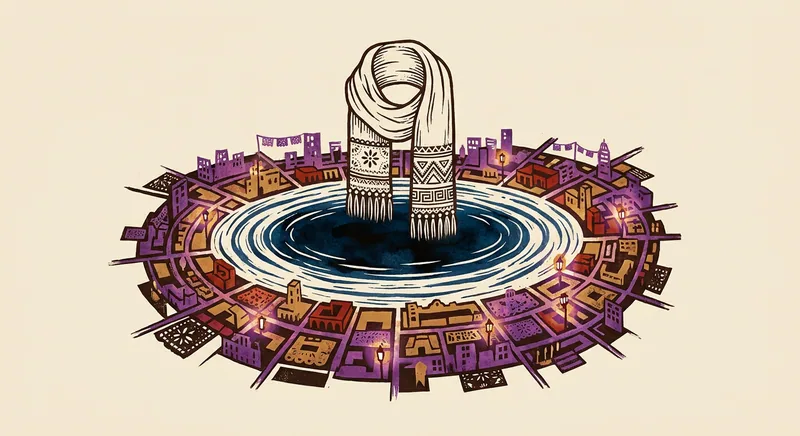
Asking whether La Llorona “existed” may be less interesting than finding out who tells her story, where they place her and what they fear losing. She was not a single historical woman, nor can she be attributed with certainty to any one deity: she is a collective figure, remade by generations. On some nights she bears traces of Cihuacóatl; on others, of European sorrowing ladies, colonial Catholicism, melodrama or a grandmother who knew how to build suspense. The legend lives because it changes, and it changes because every era finds something of its own in that “Ay, my children!” that travels across the water.
Perhaps that is why the cry never quite fades into the distance. It does not call only to lost children: it calls to erased cities, wounded languages, judged women and waters that once lay open to the sky. La Llorona is neither a pre-Hispanic relic nor a perfectly preserved colonial ghost, but a memory in motion. When we think we have left her behind, the echo plays its old trick: it sounds far away and, suddenly, it is here.
- Fray Bernardino de Sahagún, General History of the Things of New Spain, Book XII (World Digital Library and UNAM editions).
- Alfredo López Austin, The Myths of the Opossum: Paths of Mesoamerican Mythology, UNAM, Institute of Anthropological Research, 1990.
- Luis González Obregón, The Streets of Mexico: Legends and Happenings, Ediciones Botas, 1922.
- UNAM Film Archive, catalog entry and research materials on La Llorona (Ramón Peón, 1933).
- National Institute of Anthropology and History, INAH Media Library and educational materials on Cihuacóatl and the traditions of La Llorona.