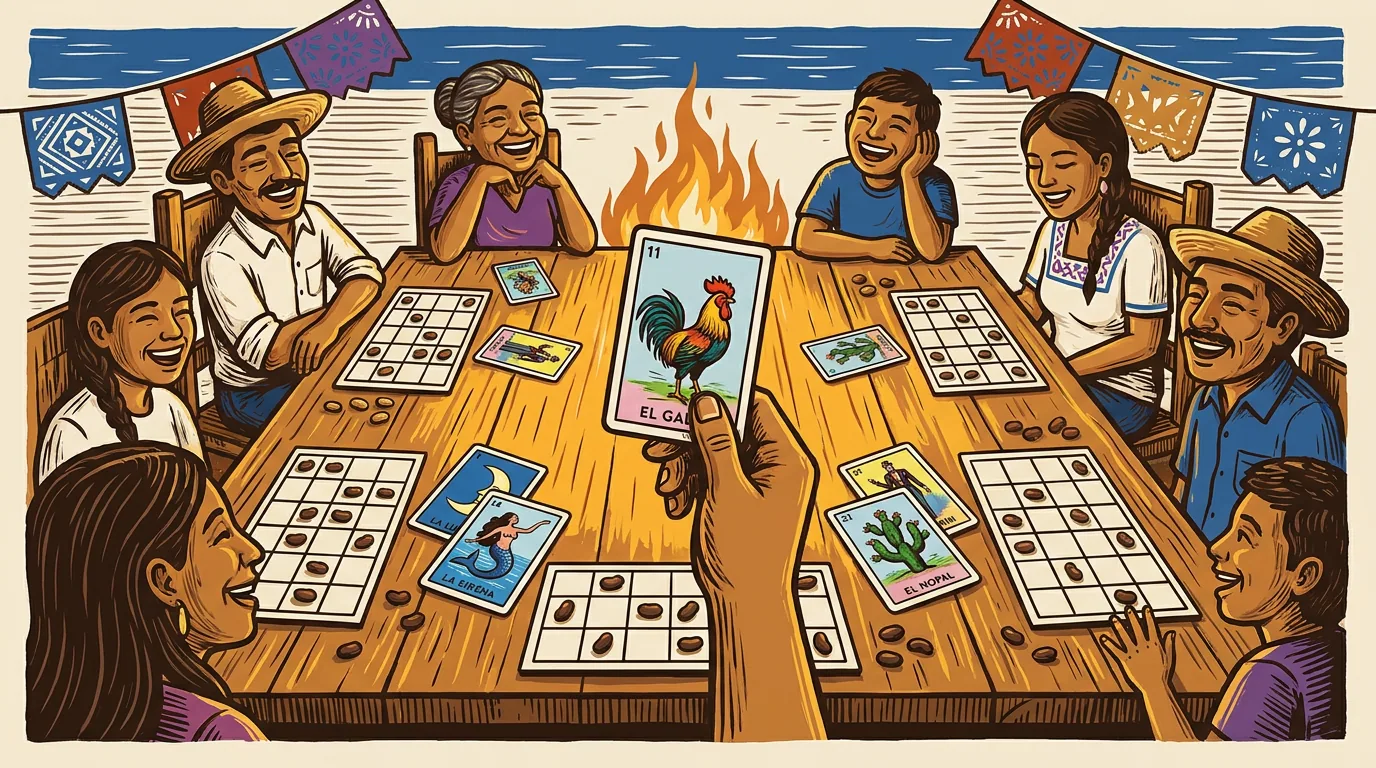
Someone holds up a card and calls: “The one who sang to Saint Peter!” On the table, beans hop from one square to another; a girl looks for the bell, the grandmother keeps an eye on the cheater, and sooner or later, someone shouts “Lotería!” with a joy no modest prize can explain. Few images seem as Mexican as that rectangle populated by the mermaid, the dandy, the little devil, and the cactus. Yet lotería did not spring fully formed or appear through spontaneous generation amid papel picado and little clay jugs: it is the result of centuries of travel, commercial adaptations, and popular appropriation.
From Italy to New Spain
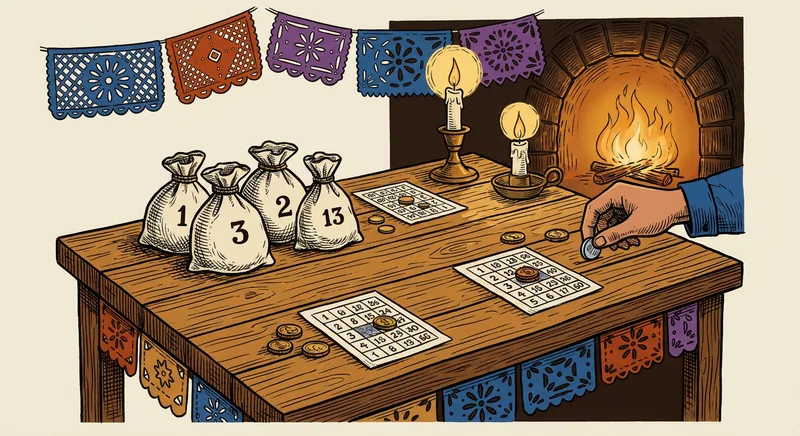
The roots of Mexican lotería lie in European games of chance and wagering. In 16th-century Italy, lotto became popular, emerging from practices in which numbers were drawn to determine winners; later, different variants circulated through France, Spain, and other European territories. Some used numbers, others words or images, but they shared a simple mechanism: one person drew pieces at random, and participants marked matches on their boards. Bingo also comes from that family, the parish-hall cousin who usually shows up dressed in numbers.
It is worth distinguishing the table game from public lotteries organized to raise funds. In New Spain, the Real Lotería General began operating in 1771, during the reign of Carlos III, and allocated part of its proceeds to public works and institutions. That institution sold numbered tickets and awarded cash prizes; it was not yet the illustrated deck of 54 cards we recognize today. Both forms belong to a shared history of chance and drawings, but confusing them would be like claiming that a Spanish deck of cards and a sports pool are the same animal because both fit in your pocket.
- 116th century: Italian lotto establishes a form of drawing with numbers and prizes.
- 217th and 18th centuries: related games circulate through Europe and adopt various rules and formats.
- 31771: the Real Lotería General of New Spain begins operating, an institution based on tickets and cash prizes.
- 419th century: illustrated lotería decks circulate in Mexico and find an audience at fairs, in homes, and at gatherings.
- 51887: Clemente Jacques registers his commercial activity in Mexico; his name will become linked to the most widely distributed version of the deck.
When Images Took Over the Table
The exact date when illustrated lotería arrived in Mexico is not documented with the precision of a birth certificate. Its introduction is generally placed in the colonial era, and it is said to have first been entertainment for well-to-do groups before spreading throughout the population; the idea is plausible, although many popular accounts repeat it without providing concrete documents. What can be verified is that by the 19th century, lotería games with images were already circulating in Mexico, aided by the expansion of printing and by social spaces such as fairs, plazas, barracks, and homes. Their success depended on something very practical: players did not need to read fluently; they only had to recognize the figures and follow the call.
The mechanism remains enviably elegant. Each player receives a board with a selection of images; the caller shuffles the cards, reveals them one by one, and announces each figure; whoever completes the agreed-upon pattern—a line, four corners, or the entire board—wins. Tokens, coins, pebbles, and often kernels of corn or beans are used to mark the squares. It is a portable, inexpensive, and adaptable design: a small print shop could produce it, and a family could play it with no electricity beyond the spark of gossip.
Illustrated lotería also has very visible European kinships. Some figures in Mexican decks recall the imagery of Italian pictorial lotto and French games: the sun, the moon, death, the mermaid, the world, and the hand are part of a long tradition of emblems. But once established in Mexico, that vocabulary blended with local characters, objects, and sensibilities. The cactus, the brave man, the dandy, the canoe, and the Apache do not constitute a neutral mirror of the country: they are a historical selection, sometimes picturesque, sometimes uncomfortable, shaped by the perspective of their time.
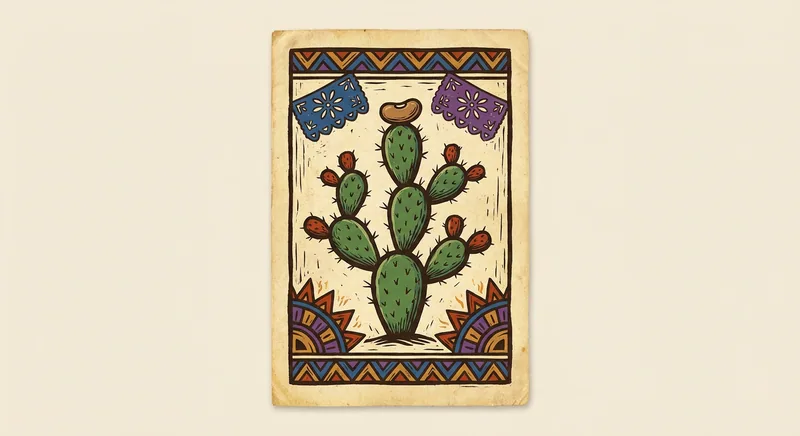
“Lotería!” does more than announce a victory: for an instant, it puts the conversation, the suspicion, and the pending rematch on hold.
Clemente Jacques and an Unforgettable Deck
If one version defined the modern imagery of the game, it was the one associated with Clemente Jacques’s company. Jacques, a French-born businessman established in Mexico, registered his commercial activity in 1887 and produced canned foods, as well as playing cards and printed games. His company did not invent Mexican lotería or all of its figures, but it succeeded in printing, distributing and establishing a deck whose appearance became dominant. The brand became so firmly attached to the memory of the game that the story is sometimes told backward, with the company credited for creating it entirely.
The so-called Clemente Jacques lotería established a series of 54 cards and boards with 16 squares. Its repertoire combines celestial bodies, animals, instruments, plants, everyday objects, social types and allegorical figures: the rooster often opens the list and the frog closes it, while in between the umbrella, the bottle, the lady, the drunk, the musician and the heart coexist. It is not a scientific catalog of Mexico, but a heterogeneous collection designed to be recognized immediately. Much of its power lies there: each image is simple, but together they form a multitude.
That multitude bears the marks of the late 19th and early 20th centuries. The catrín embodies the excessively elegant man; the lady reflects conventions of gender and class; the drunk turns a social condition into a character; the Apache uses a generic, stereotyped term to represent a North American Indigenous person. Looking at them today calls for something more interesting than canceling or venerating them: it allows us to ask who was drawing whom, which differences were considered funny and which hierarchies seemed natural. A deck of cards is also an archive, even if it comes stained with beans.
The art of calling the cards
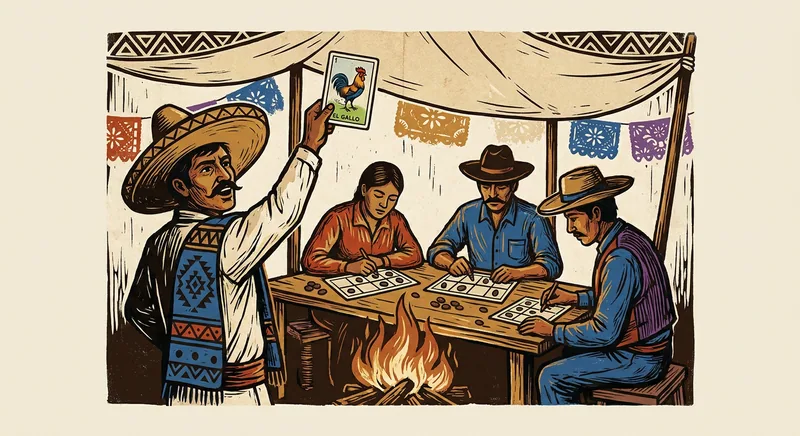
Lotería is not complete with images alone: it needs a voice. The caller may simply name the card, but the Mexican game developed verses, riddles, allusions and double entendres to announce it. “The one who sang to Saint Peter” leads to the rooster; “the poor man’s blanket” usually introduces the sun; “the pitcher goes to the well so often…” lets the audience mentally complete the phrase. There is no single, unchanging songbook: the calls vary by region, family, era and flair for mischief.
In the hands of a good caller, each game becomes a miniature oral performance. The caller must give clues without revealing the answer too soon, keep the rhythm going and allow players to check their boards. There is also room to comment on neighborhood life: the lady may resemble a neighbor, the brave man a politician and the drunk someone whose name, out of courtesy, everyone knows. That flexibility explains why the game survives its own iconography: the cards are fixed, but the conversation never is.
- 1The rooster: “The one who sang to Saint Peter.”
- 2The sun: “The poor man’s blanket.”
- 3The pitcher: “The pitcher goes to the well so often…”.
- 4The ladder: “Take me up step by step, don’t go trying to skip.”
- 5The heart: “Don’t miss me, sweetheart, I’ll be back on the bus.”
These formulas belong to oral tradition and allow for countless variations; searching for an “authentic” and definitive version would be like asking an albúr for a notarized certificate. Some rhymes are relatively recent, others have circulated for decades and many were born at one particular table before traveling to another. Their authorship is usually anonymous because the caller adapts, combines and improvises. The value lies not only in how old a phrase is, but in the immediate sense of complicity it creates when someone recognizes the card before seeing it.
A country fits—and changes—within 54 cards
During the 20th century, lotería took firm root at school fairs, patron saint festivals, trade fairs, family gatherings and charity drives. The prizes might be money, pantry staples, a set of dishes or the glorious right to brag for a week. It also became visual material for advertising, design and folk art, and its figures spread to tablecloths, posters, ceramics, clothing and murals. The deck came to resemble a kind of national alphabet, though no alphabet is innocent or ever finished.
In recent decades, loterías have appeared devoted to neighborhoods, Indigenous languages, trades, plants, feminist struggles, sexual diversity, migration, regional cuisines and contemporary figures. Some preserve the grid, the caller and the bean; others take the game to screens or use it as an educational resource. These versions do not betray some ancient essence: they continue the adaptation that made the game possible from its European origins. Lotería has always survived by changing its images without giving up the pleasure of recognizing them together.
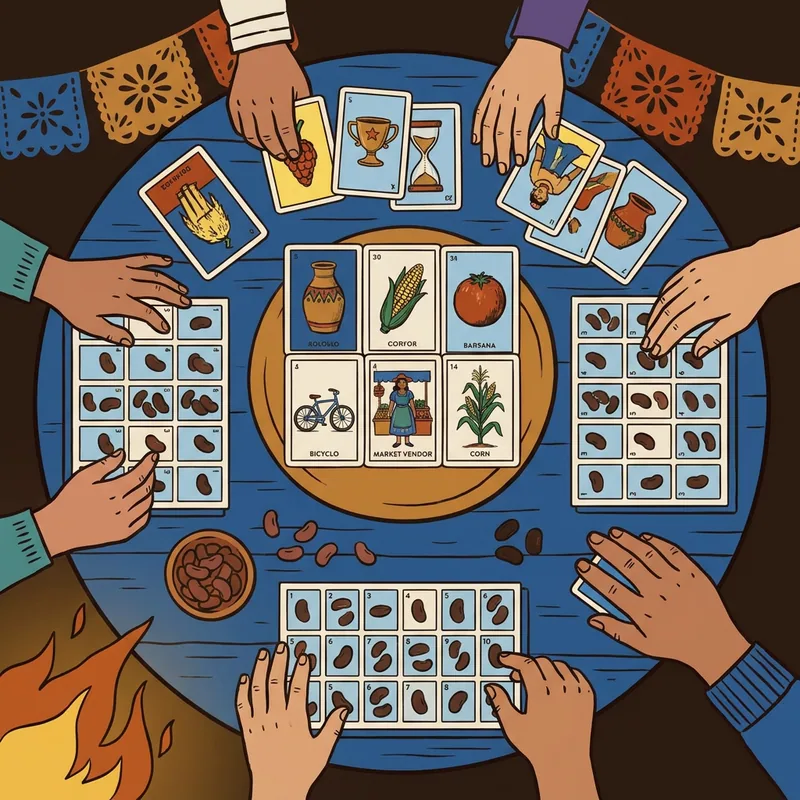
It is also worth resisting the temptation to present it as an eternal portrait of “Mexicanness.” The game came from Europe, took on modern commercial forms and constructed a partial selection of the country; precisely for that reason, it is profoundly Mexican: not because of purity, but because of mixture, use and everyday invention. Its history speaks of printing presses, commerce, oral tradition and gathering, but also of the people’s capacity to appropriate an object and turn it into ritual. All of Mexico cannot fit into 54 cards; fortunately, each generation can shuffle in others.
At the end of the game, the beans are gathered, suspicions are counted and the deck goes back into its box. Yet the images remain: the moon, death, the heart and the world, four matters too vast for a piece of cardboard. Perhaps that is the secret of lotería: making chance become a story and allowing any ordinary table, for a few minutes, to hold an entire community. The next card is face down; the rest depends on who calls it.
- María José Garrido Asperó, Fiesta y nación en México: notas sobre el juego de la lotería, Instituto Mora.
- General Archive of the Nation, Mexico, educational materials and documents on the Royal General Lottery of New Spain.
- National Lottery for Public Assistance, institutional history of the lottery in Mexico.
- Mexican Institute of Industrial Property, Historical Trademark Archive: Clemente Jacques commercial registrations.
- Encyclopaedia Britannica, “lottery” entry, a historical overview of European lotto and public lotteries.