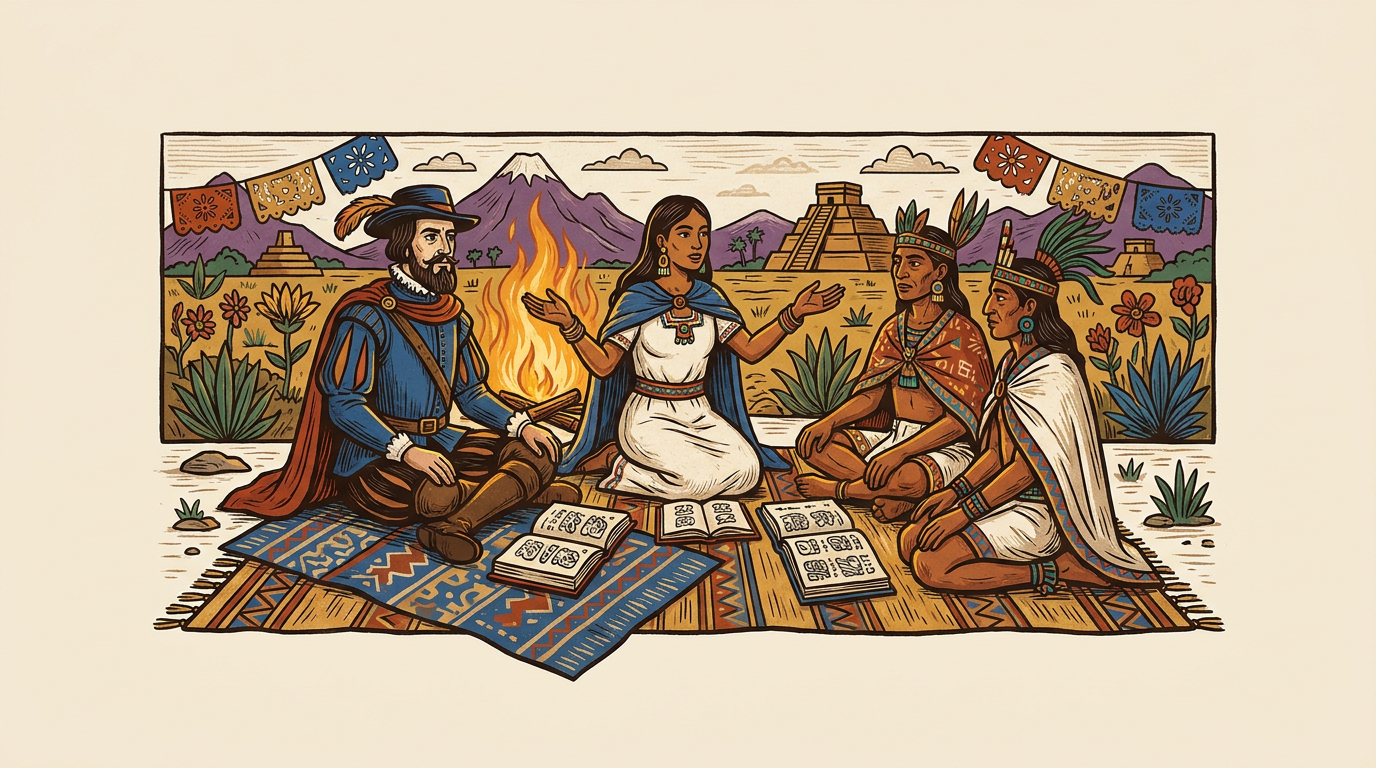
Malintzin has been given so many names and burdens of blame that sometimes the woman disappears beneath the persona. She was called Malinalli, doña Marina, Malintzin and, much later, “La Malinche”: interpreter, mediator, symbolic mother of mestizaje, and supposed traitor to the nation. The problem is that she lived before Mexico existed as a nation and left behind very few traces of her own voice. To find her, we must read documents written by others, set legends aside, and be wary of judgments made several centuries after the fact.
A Life Between Names
We do not know for certain her birth name, the exact year she was born, or all the details of her childhood. Early sources place her in the region of what is now southern Veracruz or Tabasco and indicate that she belonged to a family of some standing. Bernal Díaz del Castillo recounts that, after her father’s death and her mother’s remarriage, she was handed over to merchants from Xicalango; the account is valuable, but it was written decades later and cannot be treated as a notarized record of her childhood. What can be confirmed is that, before 1519, she had moved from a Nahuatl-speaking community to another where she learned Chontal Maya.
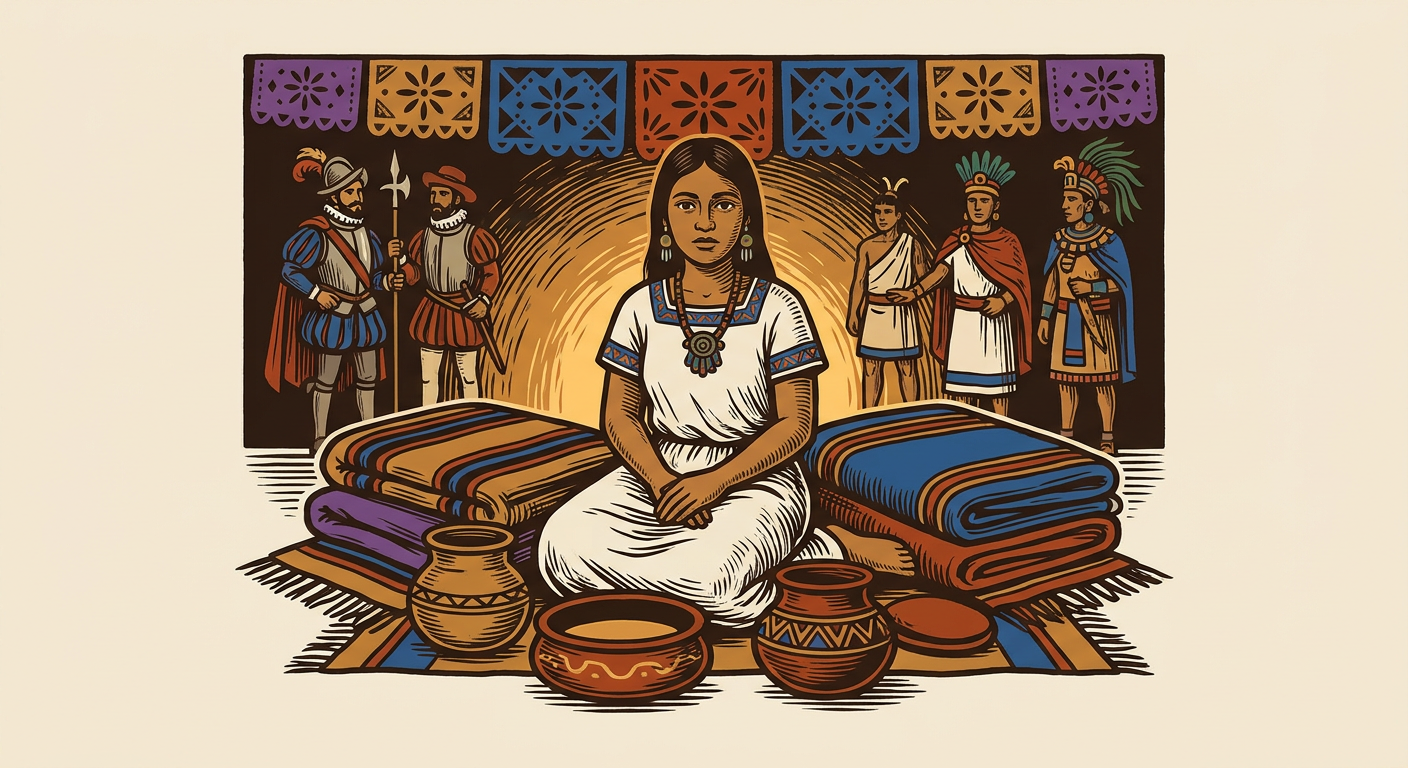
In March 1519, after the defeat of Potonchán, authorities in Tabasco gave the Spaniards food, textiles, and twenty enslaved women. Among them was Malintzin, who was baptized as Marina and initially assigned to Alonso Hernández Portocarrero. She did not freely “join” a European expedition out of curiosity, nor did she leave home with a translator’s résumé tucked under her arm. Her entry into colonial history came as a captive in a political exchange, in a world where women could be used to seal alliances, provide services, and bear children.
The Voice That Crossed Borders
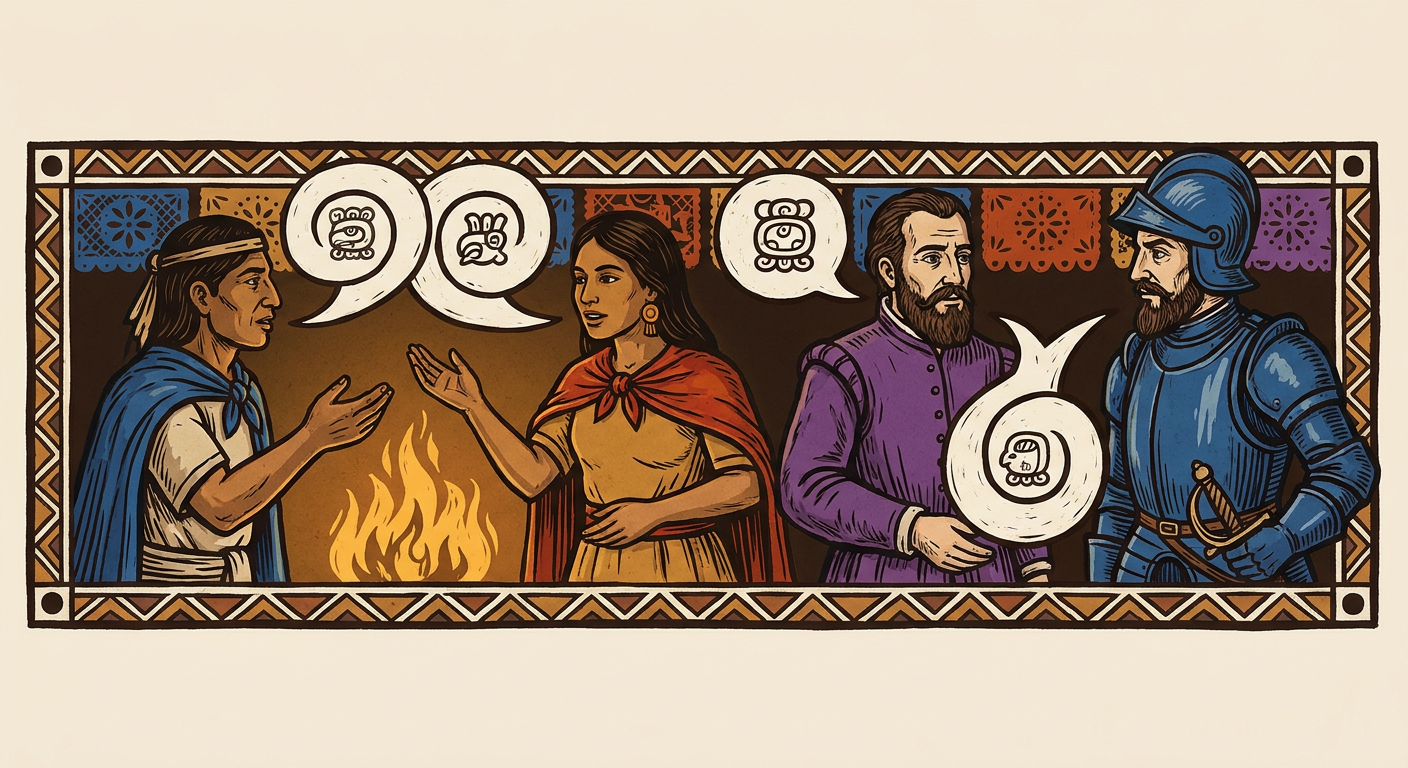
Cortés already had Jerónimo de Aguilar, a Spaniard who had lived among the Maya for years and spoke a Mayan language. When the expedition entered Nahuatl-speaking territories, Malintzin made a chain of interpretation possible: she translated from Nahuatl into Maya, and Aguilar from Maya into Spanish. She soon learned Spanish, and the chain grew shorter. Translating, however, was not a matter of swapping words as though moving beans from one pot to another: it required explaining hierarchies, protocols, threats, kinship ties, and political concepts that did not correspond from one society to another.
“Without the tongue doña Marina, we could not understand the language of New Spain and Mexico.” —Bernal Díaz del Castillo, True History of the Conquest of New Spain
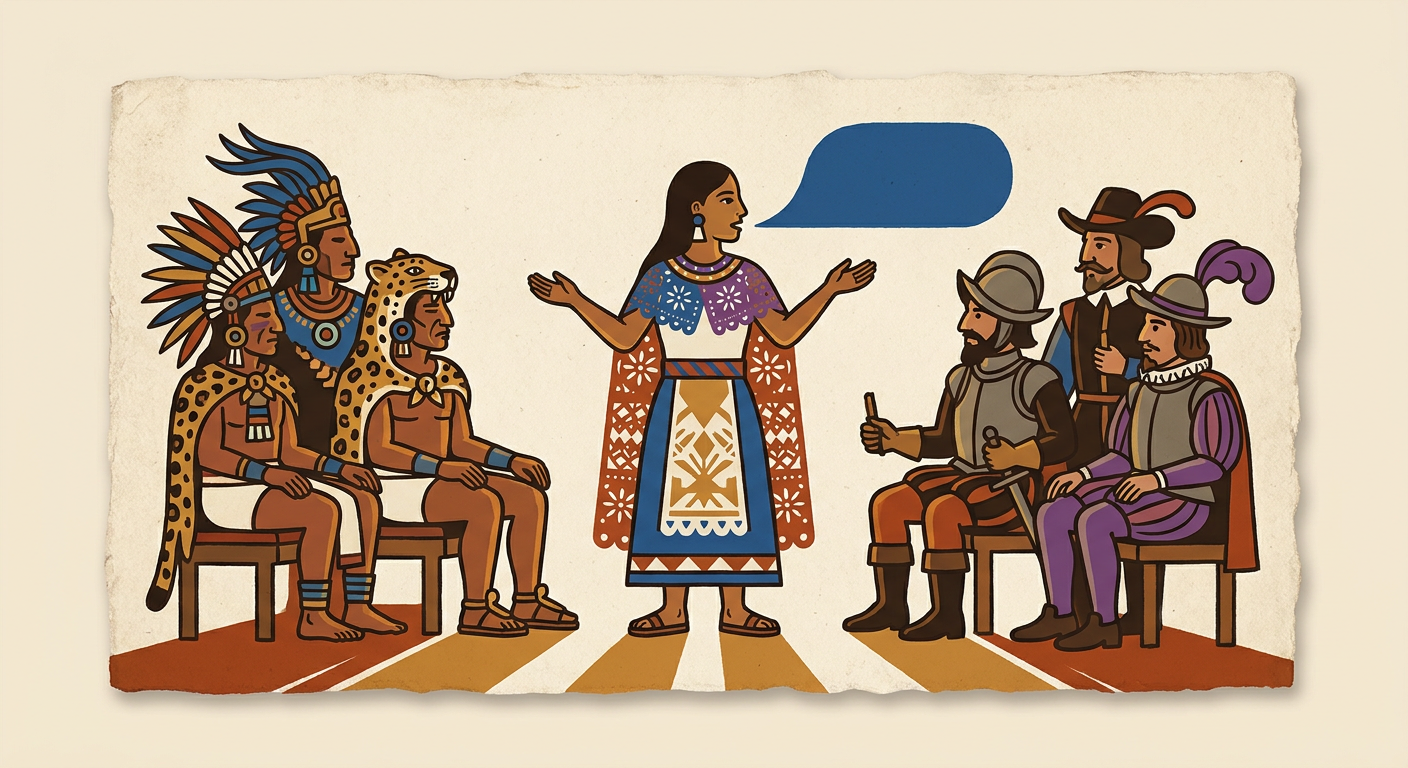
Images in the Florentine Codex and the Lienzo de Tlaxcala often show her standing and speaking between Cortés and various Indigenous rulers. Her visual presence is exceptional: she does not appear as decoration, but as a central figure in the negotiations. She took part in meetings with Totonacs, Tlaxcalans, and Mexica; she conveyed speeches and, in all likelihood, helped read intentions and adapt messages. Some sources also attribute intelligence-gathering and advisory roles to her, though it is difficult to separate what she did on her own initiative from what she carried out under Cortés’s authority.
Nor was the conquest a simple fight between “Spaniards” and “Indigenous people.” Thousands of Tlaxcalan, Totonac, and other warriors allied with Cortés for their own reasons: rivalries, tribute, survival, and political calculation. On that chessboard, Malintzin was an Indigenous woman of enormous value, but her power was constrained by the violence that had brought her there. Recognizing her abilities does not require inventing total freedom for her; recognizing her captivity does not require denying her intelligence or room to maneuver.
- 1She spoke Nahuatl and Chontal Maya; later she learned Spanish.
- 2She interpreted words, diplomatic formulas, and cultural references.
- 3She appears in Indigenous and Spanish sources as a visible figure in the negotiations.
- 4Her actions took place within a military expedition she did not control.
- 5She left no written testimony of her own that would allow us to know her motives directly.
Cholula and the Weight of the Narrative
One of the most debated episodes took place in Cholula, in October 1519. According to Cortés and Bernal Díaz, a noblewoman warned Malintzin of an ambush; she reportedly pretended to accept a marriage proposal to obtain more information and then informed the Spaniards. Cortés then ordered the massacre of Cholula’s inhabitants and leaders, carried out with the participation of his allies. The sources disagree on the existence and scope of the plot, so portraying Malintzin as the mastermind behind the massacre turns a self-serving account into a definitive verdict.
She also served as interpreter at the meeting between Cortés and Motecuhzoma, on November 8, 1519, and during the turbulent months that followed in Mexico-Tenochtitlan. She survived the Spanish retreat of June 1520, the war, the siege, and the epidemics that transformed the heart of Mesoamerica. She later had a son with Cortés, Martín, born around 1522, but that motherhood was no romantic scene of reconciliation between two worlds. The relationship began within a radical imbalance of power: he was a military commander, and she had been handed over as a slave.
From historical woman to national insult
After the conquest, Cortés arranged her marriage to Juan Jaramillo, a Spanish conquistador and official, during the expedition to Honduras of 1524-1526. They had a daughter named María. Documents show that doña Marina received recognition within the colonial order, though that does not erase her experience of slavery or the violence of the process. She probably died before 1529, perhaps in Mexico City, but the date and cause remain uncertain; the oft-repeated claim that she died of smallpox is possible, but unproven.
The name “Malinche” followed a curious path. The Nahuas called Marina Malintzin and, by association, Cortés himself “Malinche,” as though he were the man connected to her. Over time, the term became attached primarily to the interpreter. In the 20th century, “malinchismo” became synonymous with a preference for foreign things, and essays such as Octavio Paz’s The Labyrinth of Solitude cemented a sexual and national reading of her figure: the open, violated, or treacherous woman through whom Mexico’s mestizo origins could be explained.
That metaphor has been challenged by historians, writers, and Chicana and feminist thinkers. They point out something fundamental that the myth often forgets: one cannot betray a nation that does not yet exist, much less blame a captive woman for the decisions of captains, monarchs, and armies. Nor is it necessary to turn her into a flawless heroine to right the injustice. Malintzin could have been indispensable to Cortés’s enterprise, acted to survive, and exercised extraordinary political skills all at the same time; history, fortunately, cannot be reduced to a little picture of a good or bad person.
Malintzin was not the mother of a national betrayal: she was a woman positioned on the dangerous frontier between languages, powers, and memories.
Looking at her carefully does not mean absolving the conquest or denying that her voice aided the Spanish advance. It means assigning responsibility according to each actor’s actual power and accepting the limits of the sources. We know that she was enslaved, multilingual, an interpreter, a mediator, and a mother; we do not know what she thought as she translated or what future she was trying to protect. Perhaps therein lies her most uncomfortable lesson: for centuries, Mexico called the skill with which a woman without an army managed not to disappear a betrayal.
- Bernal Díaz del Castillo, The True History of the Conquest of New Spain, edited by Guillermo Serés, Royal Spanish Academy, 2011.
- Hernán Cortés, Letters from Mexico, edition by Ángel Delgado Gómez, Castalia, 1993.
- Fray Bernardino de Sahagún, General History of the Things of New Spain (Florentine Codex), World Digital Library / Biblioteca Medicea Laurenziana.
- Camilla Townsend, Malintzin's Choices: An Indian Woman in the Conquest of Mexico, University of New Mexico Press, 2006.
- Matthew Restall, Seven Myths of the Spanish Conquest, Oxford University Press, 2003.