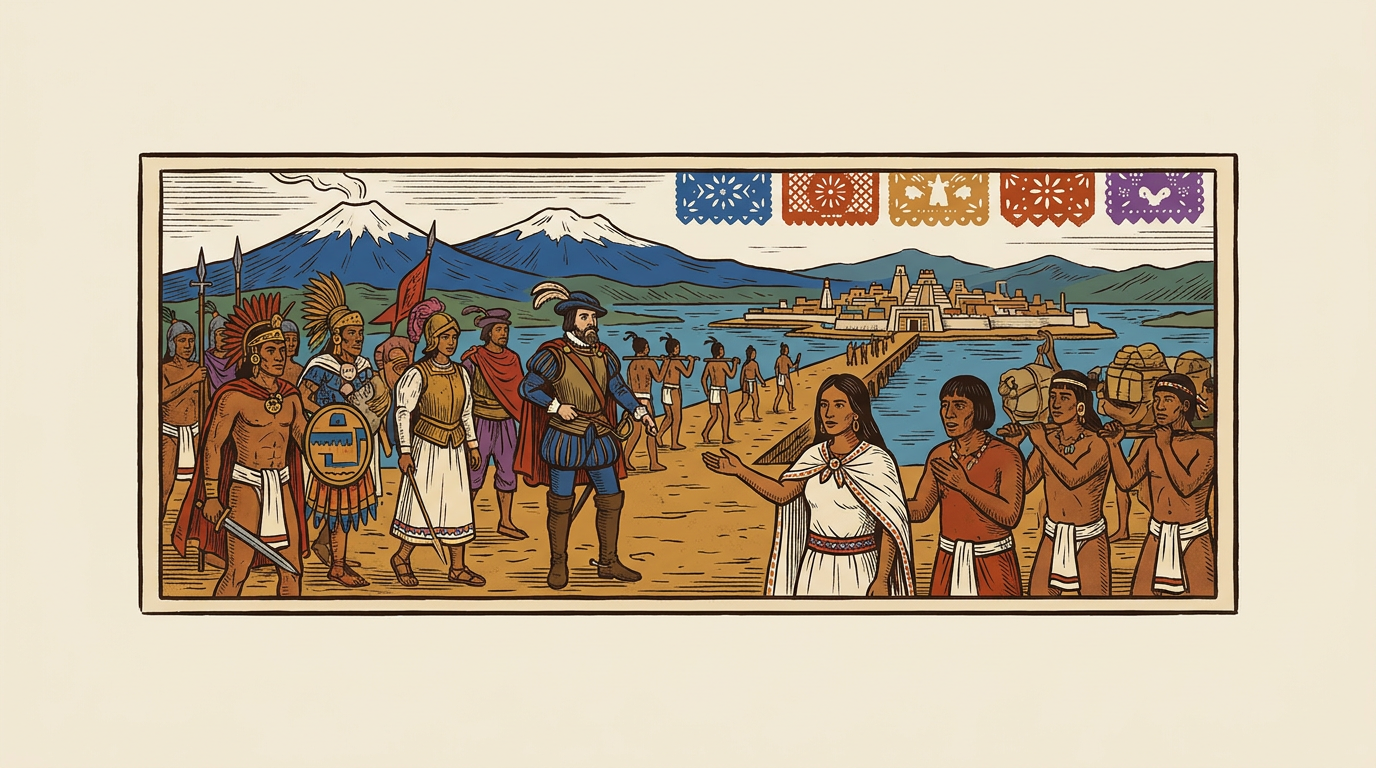
Hernán Cortés did not enter history walking alone, sword raised and a route laid out to Mexico-Tenochtitlan. He arrived on a coast he barely understood, disobeyed orders, lost men, negotiated with the enemies of his future enemies, and depended on Indigenous interpreters to know where he stood. His journey was less an arrow aimed at the heart of an empire than a chain of dangerous gambles. If it ended with the fall of a city, it was not because the outcome had been written, but because thousands of people—Spaniards, Maya, Totonacs, Tlaxcalans, Mexica, and many more—pushed history in different directions.
An Expedition Off Script
Cortés was born in Medellín, Extremadura, around 1485, and went to the Antilles in 1504. By then, Castilian expansion in the Caribbean had already produced encomiendas, military campaigns, epidemics, and brutal exploitation of Indigenous populations. He took part in the conquest of Cuba under Diego Velázquez and accumulated land, prestige, and administrative experience. He was no naive newcomer: he understood the workings of colonial power and also knew that a successful venture could turn a minor hidalgo into a wealthy man.
In 1518, Velázquez entrusted him with an expedition to the mainland coast, following the voyages of Francisco Hernández de Córdoba and Juan de Grijalva. Their relationship deteriorated before they set sail, and the governor tried to revoke the appointment; Cortés left Cuba in February 1519 without waiting for politics to close the port to him. He had around 500 soldiers, sailors, horses, artillery, and enough ambition to fill several caravels. It is best not to imagine a modern army: this was a private, motley force, sustained by credit, promises of plunder, and a discipline that sometimes frayed.
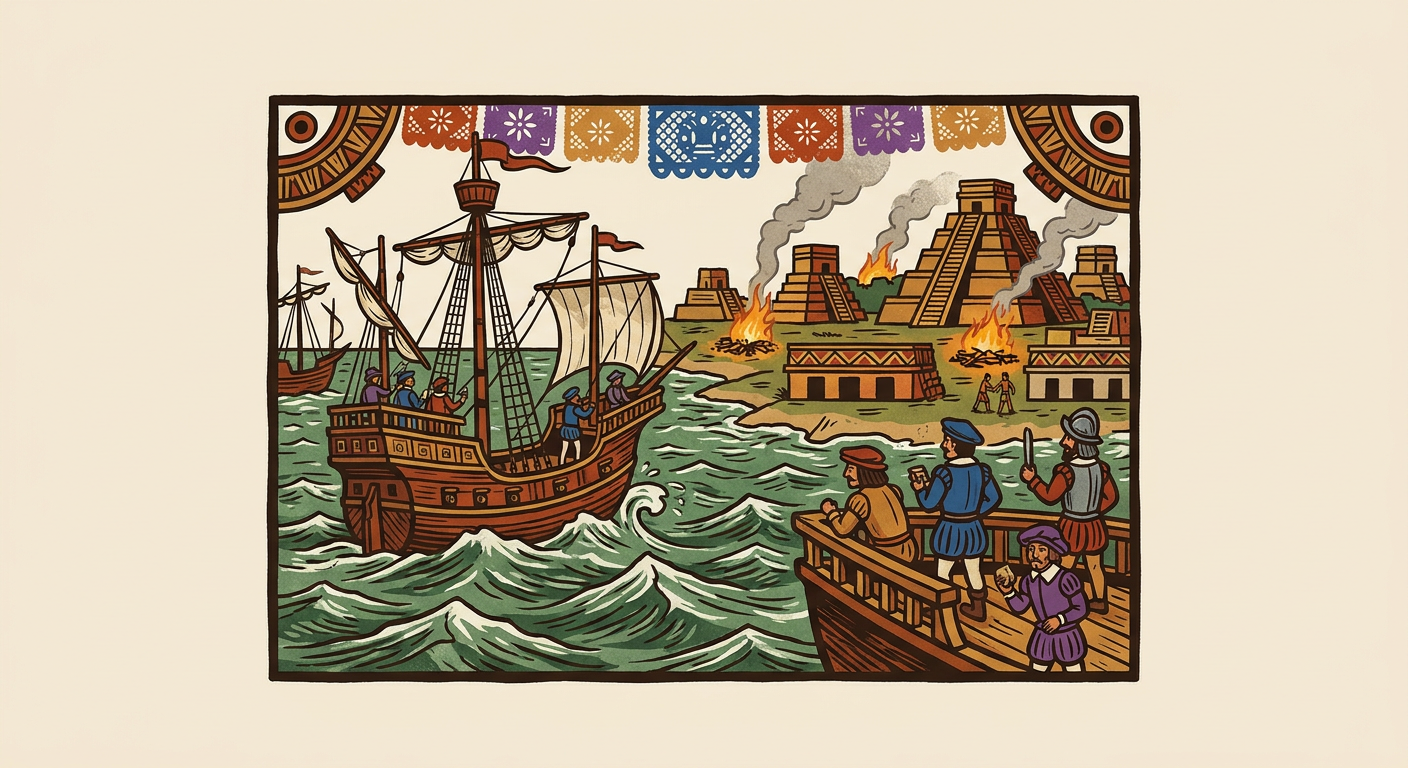
The first decisive stop was Cozumel, where Cortés learned of Spaniards who had been shipwrecked years earlier. Jerónimo de Aguilar, one of the survivors, joined the expedition and was able to translate between Maya and Castilian Spanish. Gonzalo Guerrero, the other famous castaway, chose to remain with his Maya family and community; his refusal is a reminder that contact did not automatically mean returning to the Europeans. Soon afterward, in Potonchán, Tabasco, the newcomers fought Maya-Chontal forces and, after peace was made, received food, textiles, and twenty enslaved women.
Words Opened the Way
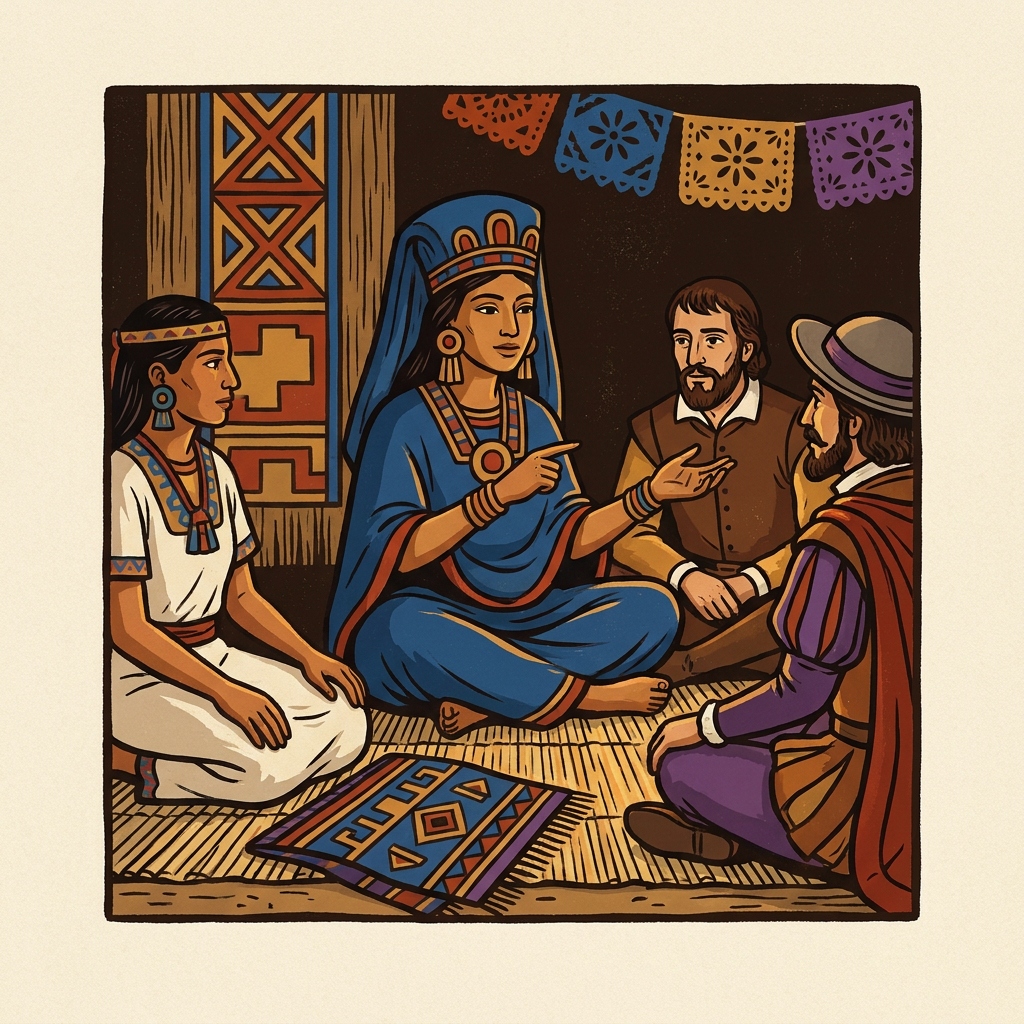
Among those women was Malintzin, also called Marina by the Spaniards and later known as la Malinche. She spoke Nahuatl and a Maya language, so at first conversations passed through a chain: Malintzin translated from Nahuatl into Maya, and Aguilar from Maya into Castilian Spanish. She soon learned Spanish and became the chief interpreter, a political mediator, and an expert in diplomatic codes that Cortés did not understand. Calling her simply a “translator” is like calling the person holding up the bridge while everyone crosses an “assistant.”
Malintzin appears in Indigenous and Spanish sources alongside Cortés, sometimes even speaking while he stands behind her. Her participation was not a colorful detail, but a condition that made it possible to forge pacts, gather information, issue threats, and understand—if only partially—the political geography of Mesoamerica. She began as an enslaved woman, and that makes it impossible to cast her story as a free choice between “betrayal” and “loyalty.” The label of traitor, coined centuries later from an idea of Mexico that did not yet exist, says more about modern national anxieties than about 1519.
“Without the interpreter, we could do nothing”: that was how Bernal Díaz del Castillo summed up Malintzin's importance to the expedition.
On the coast of what is now Veracruz, Cortés received emissaries from Moctezuma Xocoyotzin and established a town council called Villa Rica de la Vera Cruz. The act involved considerable legal cunning: his supporters elected him captain general and chief justice, in an attempt to sever the expedition from Velázquez's authority and place it under the Crown. He then disabled the ships—the sources speak of sinking, boring holes into, or running them aground, depending on the account—to prevent desertions and ensure that no one returned to Cuba too quickly. The famous phrase “burn the ships” belongs to legend; the real gesture was less theatrical, but just as final.
A March Built on Alliances
The advance into the highlands was not a campaign by a few hundred Spaniards against a united Indigenous mass. Mexica rule rested on tribute, conquests, and unequal relationships that had created powerful enemies. In Cempoala, Totonac leaders saw the newcomers as an opportunity to challenge Mexico-Tenochtitlan, although the alliance also exposed them to enormous risks. The Europeans brought steel, horses, firearms, and aggressive resolve; their allies brought knowledge of the terrain, food, porters, and most of the combatants.
Tlaxcala was the turning point. Its city-states resisted through several clashes before negotiating an alliance with Cortés in September 1519; they did not meekly “surrender,” nor did they act as a bloc without disagreements. Tlaxcala had been at odds with the Triple Alliance for decades and maintained a beleaguered independence, so the arrival of the Spaniards opened up a strategic possibility. From then on, thousands of Tlaxcalan warriors joined the march, and without them the expedition would hardly have reached Mexico-Tenochtitlan, much less returned after the defeat.
- 1There was no single “Indigenous side”: the cities and city-states had interests of their own.
- 2Alliances shifted quickly and combined political calculation, coercion, and survival.
- 3Interpreters were as crucial as weapons in coordinating armies and negotiating passage.
- 4Women prepared food, transported goods, tended wounds, and took part in diplomatic networks.
- 5The victory of 1521 cannot be explained without tens of thousands of Mesoamerican allies.
Then came Cholula, a sacred city and commercial center where one of the expedition’s most debated massacres took place. Cortés claimed to have uncovered a conspiracy and ordered a preemptive attack; Tlaxcalan and Spanish sources offered accounts supporting that justification, while other traditions emphasized the violence against unarmed inhabitants. It is impossible to reconstruct every detail with certainty, but the outcome is clear: thousands of Cholulans died, according to figures that vary and were probably exaggerated by the chroniclers. The massacre also served as a political message: those advancing were not coming merely to talk.
The city on the lake and the edge of disaster
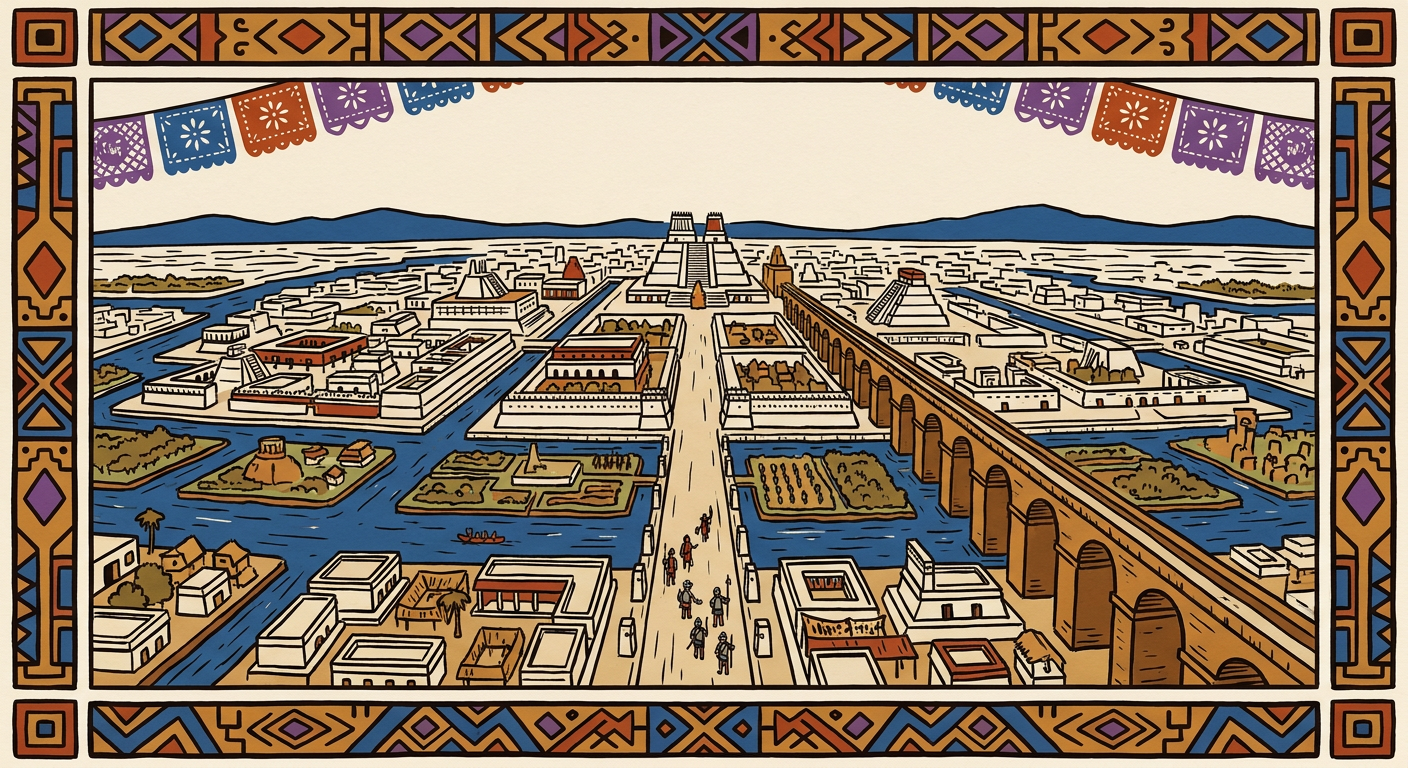
On November 8, 1519, Cortés and his companions entered Mexico-Tenochtitlan along the Iztapalapa causeway. The city, built amid the lake, its canals, and chinampas, impressed the Europeans with its markets, temples, plazas, aqueducts, and cleanliness; Bernal Díaz wrote that it seemed like something out of an enchantment. Moctezuma received Cortés in a ceremony whose meaning remains debated. The idea that the tlatoani believed Cortés was the god Quetzalcóatl lacks solid support in the earliest sources and was developed or amplified after the Conquest.
Within a few weeks, Cortés took Moctezuma prisoner in his own palace. The abduction allowed the Spaniards to govern precariously through the tlatoani, but it heightened tensions in the city. In the spring of 1520, Cortés left to confront Pánfilo de Narváez, who had been sent by Velázquez to arrest him, and managed to defeat him and bring many of his men into his own ranks. Meanwhile, Pedro de Alvarado ordered a massacre during the festival of Tóxcatl at the Templo Mayor, and by the time Cortés returned, the rebellion was already raging.
Moctezuma died under uncertain circumstances: the Spaniards said he was wounded by stones thrown by his own people, while Indigenous accounts attributed his death to his captors. On the night of June 30 to July 1, 1520, the Spaniards and their allies attempted to flee along the Tlacopan causeway in the rain, laden with gold. They were discovered and suffered devastating losses in fighting, drownings, and the collapse of portable bridges. Tradition called it the Noche Triste; for the Mexica, it was, with every justification, a night of victory.
The survivors reached Tlaxcala after fighting at Otumba. There they were able to rest, regroup, and prepare to return because their allies upheld the pact even when the venture seemed doomed. Cortés ordered thirteen brigantines built to control the lake, cut off the aqueducts, and coordinated the siege with ever larger Indigenous armies. Meanwhile, smallpox—introduced from the Atlantic world—spread among a population with no prior immunity and caused enormous loss of life, including the death of the tlatoani Cuitláhuac.
After the collapse
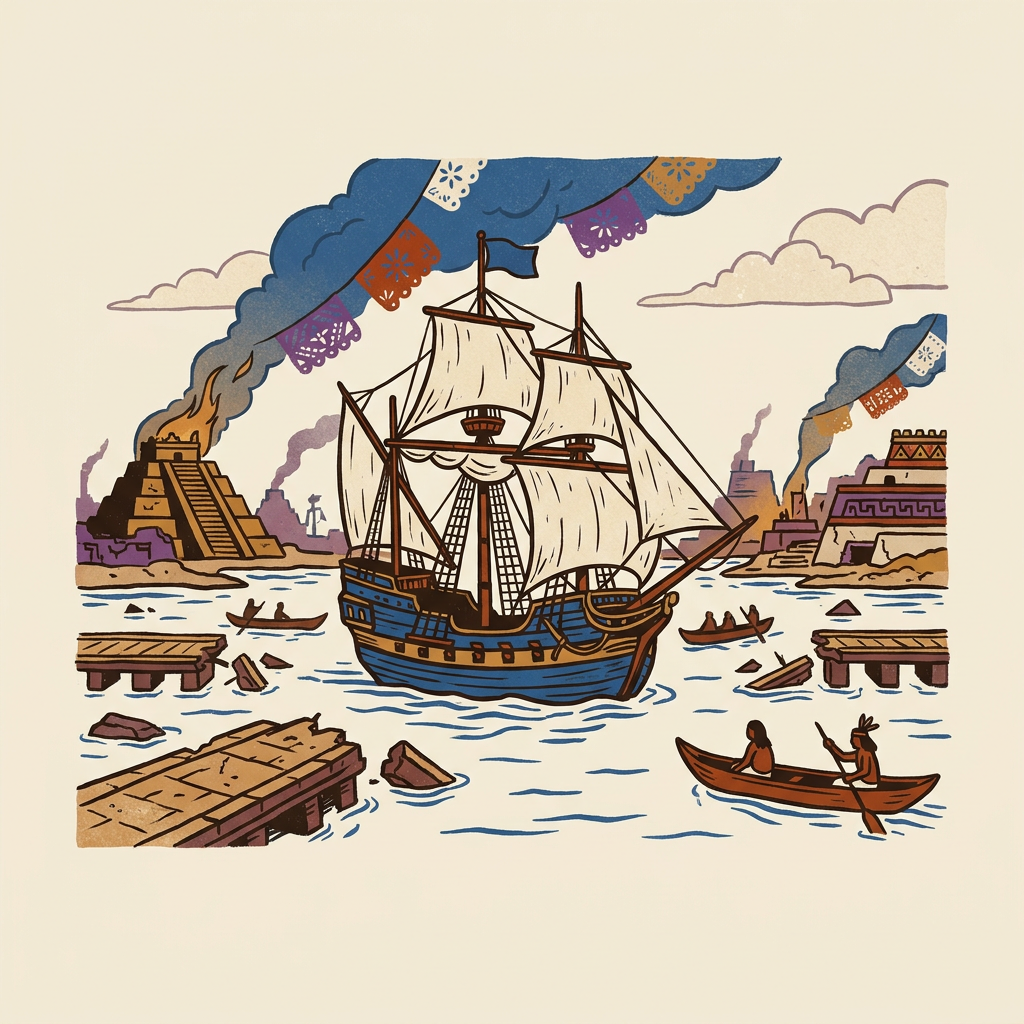
The siege of 1521 was a prolonged catastrophe. The attackers advanced along the causeways, destroyed houses to fill in canals, and choked off supplies, while the defenders resisted amid hunger, disease, and contaminated water. Cuauhtémoc, the last Mexica tlatoani, was captured on August 13, the date that commonly marks the fall of Mexico-Tenochtitlan. It was not the end of the conquest of what we now call Mexico: for decades, campaigns, rebellions, and negotiations continued in regions that had never submitted to the Mexica.
Cortés received titles, lands, and the marquisate of the Valley of Oaxaca, but his political power was limited by the Crown. He led later expeditions, including the disastrous march to Las Hibueras between 1524 and 1526, during which he ordered Cuauhtémoc executed on charges of conspiracy. He also promoted voyages in the Pacific and reached the peninsula that would later be called California. He died in Castilleja de la Cuesta, near Seville, in 1547, still litigating over honors and rewards; even conquistadors discover that bureaucracy can be more resilient than a wall.
Telling the story of this journey beyond the framework of “the Conquest” does not mean absolving Cortés or replacing one statue with another. It means looking at colonial violence, but also recognizing the agency of the peoples who negotiated, fought, resisted, or sought to take advantage of a crisis without knowing how it would end. The fall of Mexico-Tenochtitlan was the work of a broad coalition, shaped by epidemics and Mesoamerican conflicts, whose victory ultimately benefited an imperial order that none of its Indigenous allies would fully control. Cortés traveled the road, yes; but the road was filled with voices, and history changes when we finally stop listening only to his.
- Hernán Cortés, Letters from Mexico, various critical editions.
- Bernal Díaz del Castillo, The True History of the Conquest of New Spain, various critical editions.
- Matthew Restall, When Montezuma Met Cortés: The True Story of the Meeting That Changed History, Taurus, 2019.
- Federico Navarrete, Who Conquered Mexico?, Debate, 2019.
- National Institute of Anthropology and History (INAH), materials from the Mexico 500 project.