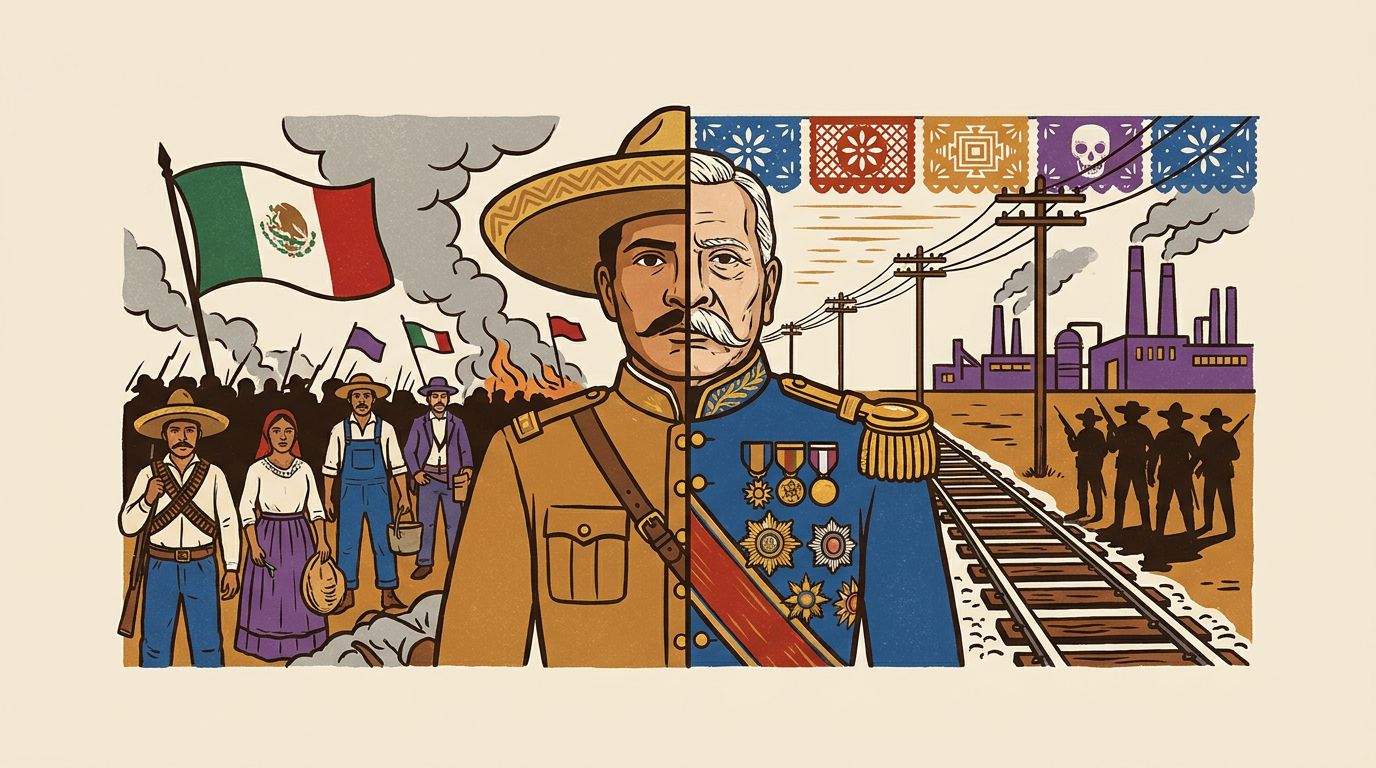
Before he became the old man with a chest covered in medals who gazed out from official portraits, Porfirio Díaz was a young liberal who took up arms against conservatives and foreign invaders. He fought for the Republic, earned military renown, and opposed presidential reelection with a vehemence that would later prove, shall we say, uncomfortably prophetic. He came to power in 1876 promising that no man should perpetuate himself in the presidency and ended up ruling, with one carefully managed pause, until 1911. The question is not only how a hero became a dictator, but why much of the country accepted, celebrated, or endured that transformation for so many years.
The General of the Republic
José de la Cruz Porfirio Díaz Mori was born in Oaxaca in 1830, into a mestizo family of modest means. He attended seminary, studied law at the Institute of Sciences and Arts of Oaxaca, and came under the political influence of the liberals, including Benito Juárez. His decisive career, however, did not unfold behind a desk: it began during the Revolution of Ayutla and continued in the Reform War. By the 1860s, he was already one of the country’s most capable and ambitious republican military leaders.
During the French Intervention, he fought the army that supported Maximilian’s Empire. He took part in the battle of May 5, 1862, under the command of Ignacio Zaragoza, although his prestige grew above all in later campaigns, such as the recapture of Oaxaca and the capture of Puebla on April 2, 1867. Those victories helped tighten the noose around the imperial regime and turned Díaz into a national figure. He was not a hero invented by later propaganda: his military merits were real, although he knew how to polish them until they gleamed like the buttons on a uniform.
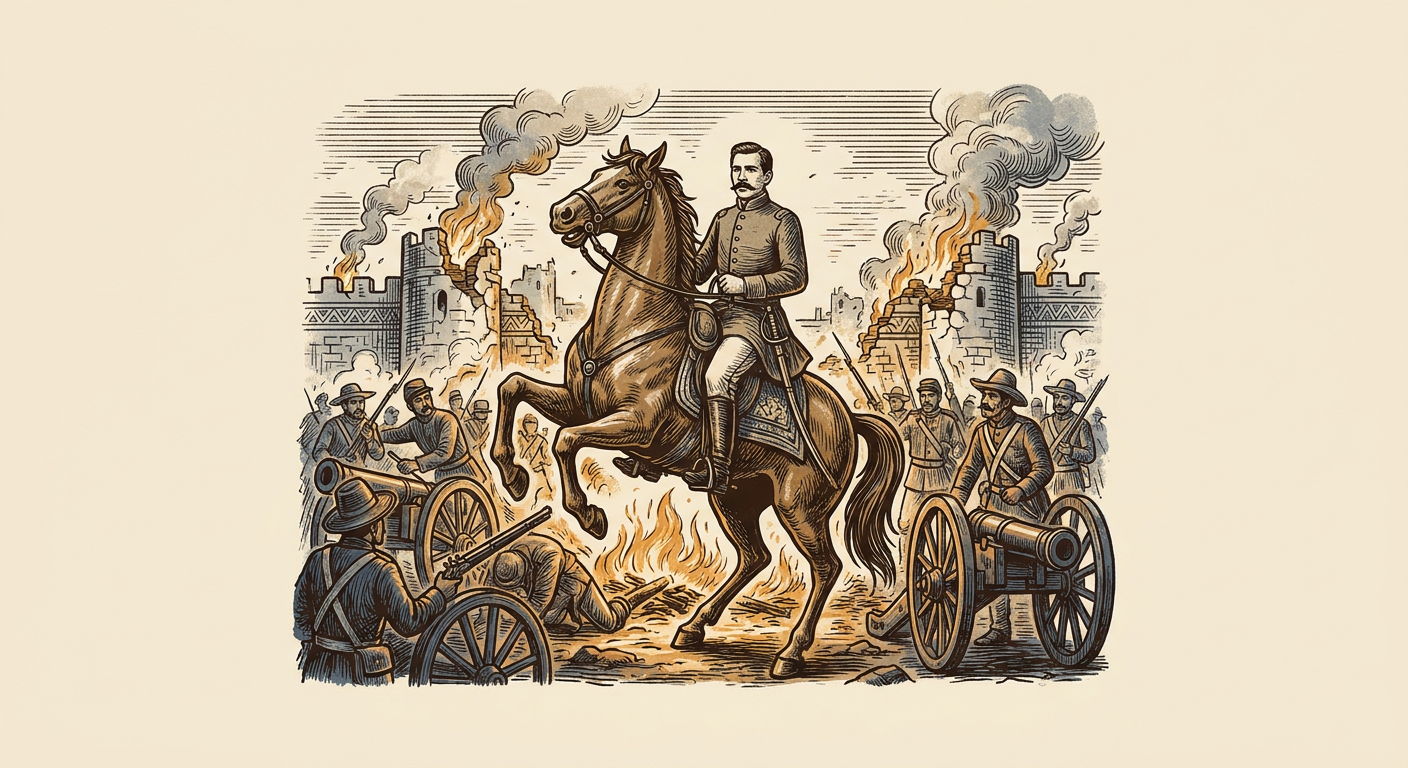
With the Republic restored, weapons yielded the stage to the ballot box, but Díaz was unwilling to play a supporting role. He rebelled against Juárez through the Plan of La Noria in 1871, raising the banner of “no reelection”; he was defeated. After Juárez’s death, Sebastián Lerdo de Tejada assumed the presidency and sought reelection, giving Díaz a second opportunity. The Plan of Tuxtepec of 1876 once again raised the anti-reelection banner and, this time, the rebellion succeeded.
“Let no citizen impose himself and perpetuate himself in the exercise of power, and this will be the last revolution.” —Plan of Tuxtepec, 1876
Order, Progress, and a Very Comfortable Chair
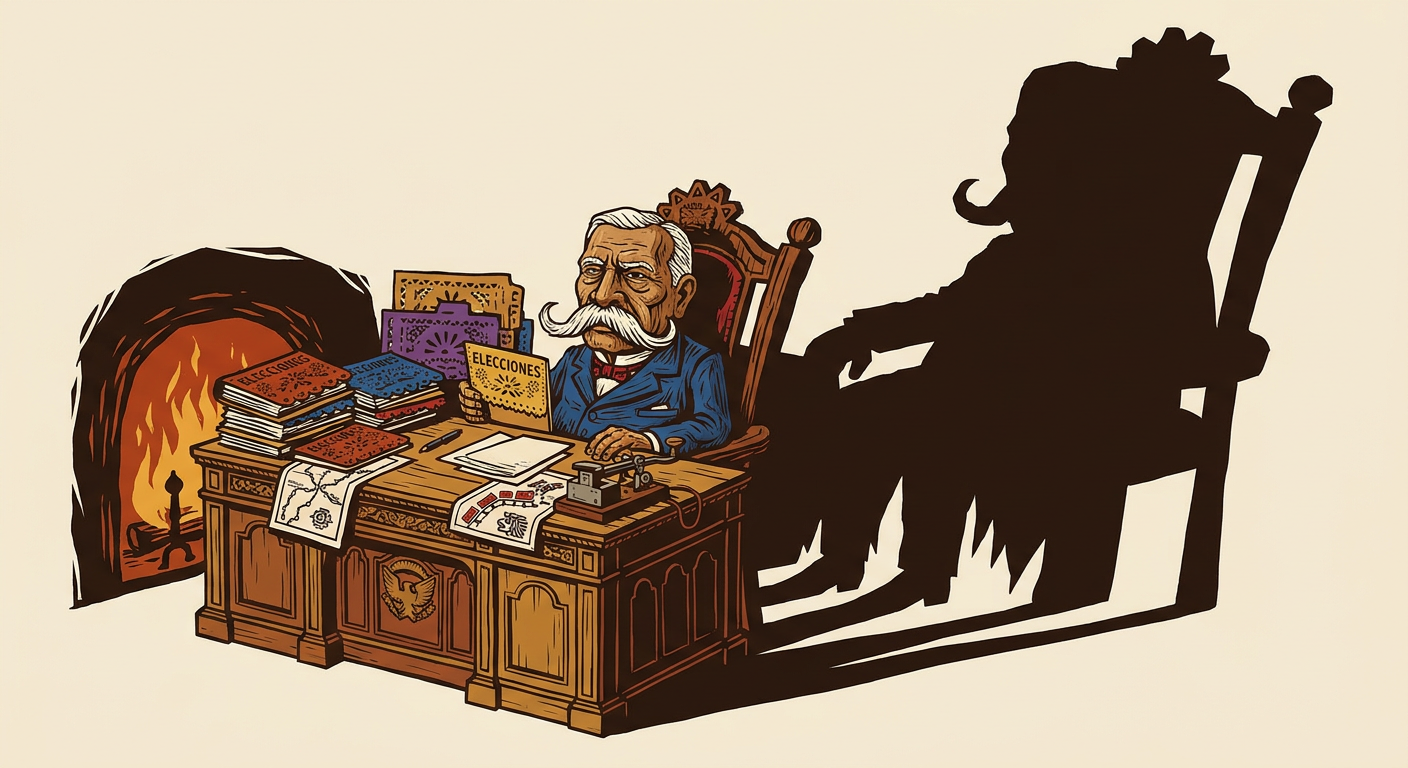
Díaz assumed the presidency in 1877 and governed until 1880. Because immediate reelection was prohibited, he handed the office to his ally Manuel González, who served as president from 1880 to 1884; Díaz then returned and did not relinquish power until May 1911. To make that possible, the Constitution was amended: first to allow reelection after an interval, and later to allow continuous reelection. Republican forms remained—Congress, elections, governors, courts—but the president learned to arrange them like pieces in a parlor before receiving guests.
The new regime answered an understandable desire: after decades of civil wars, invasions, uprisings, and bankruptcies, many Mexicans wanted stability. Díaz offered it through a mixture of negotiation, distribution of offices, budgetary discipline, electoral control, and force. He brought old adversaries into the fold or neutralized them, kept governors close, and cultivated relationships with business leaders, hacienda owners, and military commanders. The famous formula “bread or the stick,” though it neatly sums up the method, should not be taken as a verified quote from Díaz: it is an expression later attributed to the logic of his government.
Nor did his authority depend on fear alone. Díaz was skilled at reading ambitions, reconciling factions, and presenting himself as the indispensable arbiter, while the official press constructed the image of the patriarch who had pacified Mexico. The so-called científicos, a group of politicians and intellectuals associated with positivist ideas, championed technical administration, investment, and order as paths to progress. They were not a perfectly uniform secret cabinet, but they were an influential current linked to figures such as José Yves Limantour and Justo Sierra.
Rails, Cables, and Storefronts
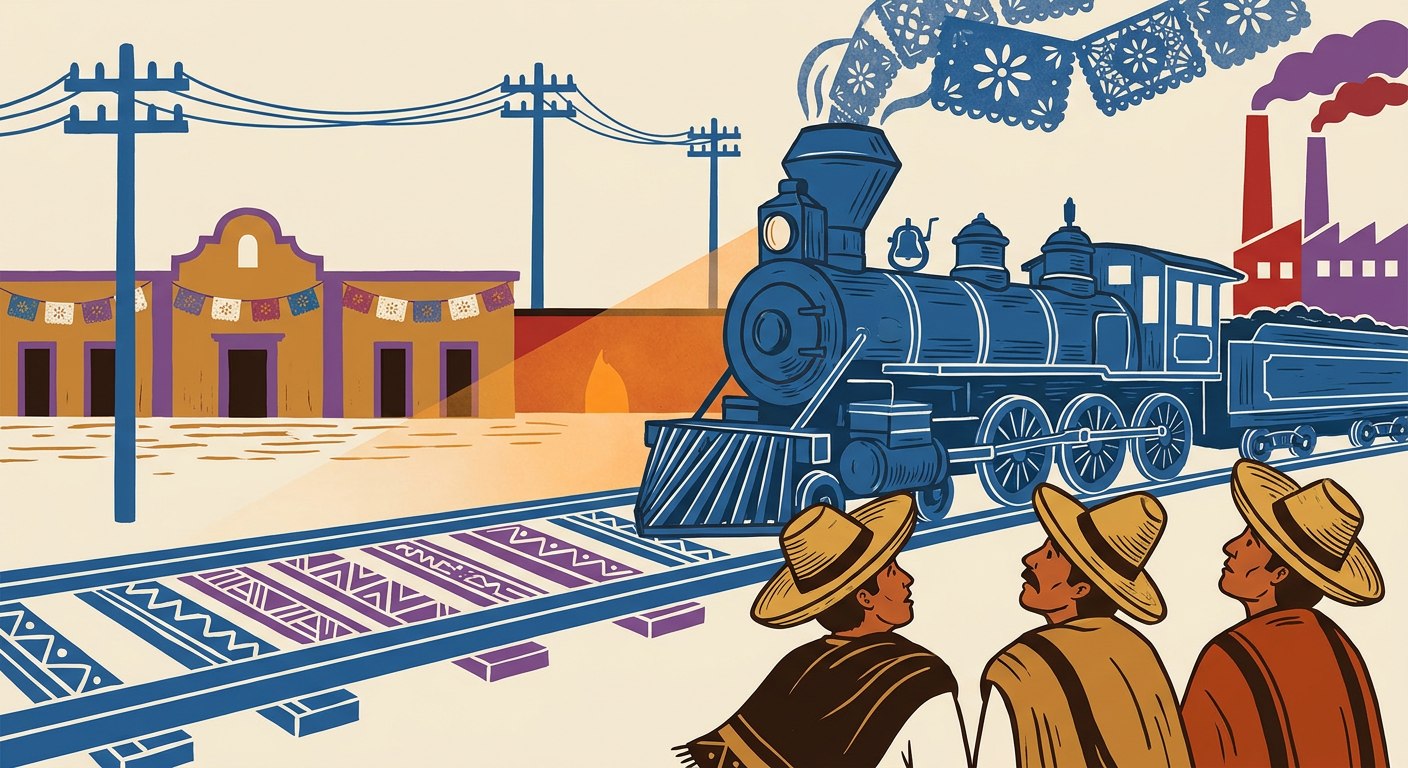
The Porfiriato transformed the country’s infrastructure. The railroad network grew from fewer than seven hundred kilometers at the start of Díaz’s rise to nearly twenty thousand by 1910, linking producing regions with cities, ports, and the U.S. border. The telegraph expanded the communication capacity of the state and businesses; mining, banking, henequen production, the textile industry, and oil extraction all grew. Mexico City gained electric lighting, streetcars, and European-style buildings, because modernity had a wardrobe too and preferred to pose in French profile.
Stability made it possible to put public finances in order, renegotiate the debt, and attract capital, especially from the United States, Great Britain, and France. Limantour’s administration achieved budget surpluses and an international reputation the country had not enjoyed for much of the 19th century. Education and certain scientific and cultural institutions also expanded, although illiteracy remained very high and the benefits were far from reaching everyone. Progress existed; the problem was who could board the train and who had to step away from the tracks.
- 1Material modernization: railroads, telegraphs, ports, electricity, and new industries.
- 2Political concentration: manipulated elections, subordinate governors, and little room for the opposition.
- 3Uneven growth: great fortunes and foreign capital alongside low wages, labor debts, and rural poverty.
- 4Coercive peace: negotiation for allies and repression for communities, journalists, workers, and rebels.
In the countryside, land survey and colonization laws favored the surveying and allocation of lands considered vacant, often to land-surveying companies and large landowners. Processes begun by previous liberal governments accelerated under Díaz and affected communal and Indigenous lands, although the experience varied from region to region. Market-oriented haciendas and plantations expanded, while many peons were bound by miserable wages, debts, and company stores. Reducing the entire Porfirian countryside to a single image would be inaccurate; denying the concentration of land and dispossession would be far worse.
The peace had bayonets
The so-called Porfirian peace was real insofar as major national conflicts declined, but it was not peaceful for everyone. The regime censored or bought off newspapers, jailed opponents, and used the army, state forces, and the Rural Guard to pursue dissidents and protect roads and property. Local autonomy diminished as political bosses and governors guaranteed predictable election results. In that system, an election might have ballot boxes, ballots, and even a brass band; what it rarely had was uncertainty.
The repression took especially brutal forms against Indigenous peoples. The Yaquis of Sonora resisted the invasion of their territory and government policies for decades; thousands were deported to Yucatán and other regions, where many died under extreme working conditions. In the Yucatán Peninsula, campaigns against Maya rebels continued, and in 1901 federal troops occupied Chan Santa Cruz, now Felipe Carrillo Puerto. These events were not accidents on the margins of progress, but part of the cost imposed to open up lands, secure investments, and assert central authority.
There were also episodes whose precise attribution of responsibility must be recounted carefully. In Veracruz, the massacre of Lerdo supporters in June 1879 became associated with the phrase “kill them on the spot,” supposedly sent by Díaz to Governor Luis Mier y Terán. The repression is documented, but the authenticity of the telegram and the phrase remains disputed by historians. The legend survived because it encapsulated a broader political truth: the regime was willing to kill when conciliation no longer served its purposes.
At the beginning of the 20th century, discontent also surfaced in factories and mining regions. During the Cananea strike in Sonora in 1906, workers demanded better wages and equal treatment with American employees; the conflict ended in deaths and the irregular intervention of armed men from Arizona, permitted by Sonoran authorities. A year later, the textile workers’ protest in Río Blanco, Veracruz, was repressed by government forces and left a death toll that sources estimate differently. Both crises showed that beneath the veneer of order, the floorboards were creaking.
The last reelection
The regime aged along with its founder. In 1910 Díaz was eighty years old, had not established an acceptable succession, and the elites debated who would inherit a system designed so that no one could replace him. Francisco I. Madero, a Coahuila landowner and advocate of effective suffrage, traveled across the country, organized the National Anti-Reelection Party, and ran for president. Díaz had him jailed during the campaign and was declared the winner of an election without free competition.
Madero escaped and issued the Plan of San Luis, dated October 5, 1910, which rejected the reelection and called for an armed uprising on November 20. The rebellion did not erupt as a single national blaze, but as multiple regional fires fueled by different grievances. Pascual Orozco and Francisco Villa advanced in Chihuahua, while Emiliano Zapata led a peasant struggle in Morelos focused on recovering land. When Ciudad Juárez fell in May 1911, the regime lost its main argument: it could no longer guarantee the order that justified its existence.
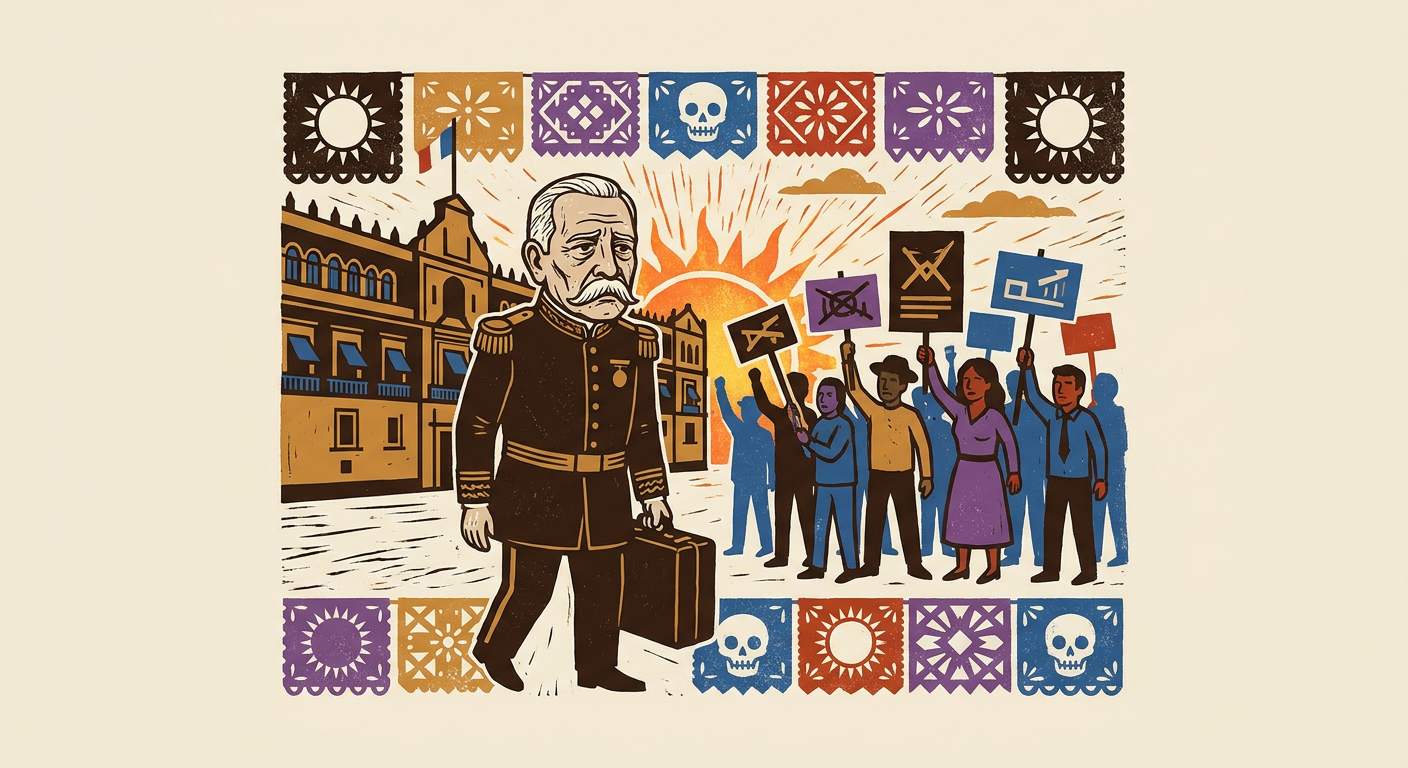
Díaz resigned on May 25, 1911, and went into exile in France. He died in Paris in 1915 and was buried in Montparnasse Cemetery. He did not live to see the outcome of the Revolution that his downfall had unleashed, but he did witness the collapse of the political architecture built over more than three decades. The republican hero ended up driven out by a revolution that, with biting irony, took up his old banner against reelection.
Judging the Porfiriato requires holding two truths at once: Mexico underwent profound modernization, and that modernization was built on restricted citizenship, enormous inequality, and the systematic use of coercion. Díaz did not begin his public life as an inevitable tyrant, nor did he govern alone in a room full of levers; he was sustained by institutions, economic interests, regional allies, and sectors that preferred stability to democracy. His trajectory reminds us that heroes are not granted historical immunity and that progress, when it requires silence to function, eventually hears the din of its own reckoning. A victor’s uniform may open the door to power; what reveals the measure of a ruler is whether he ever agrees to walk back out through it.
- Paul Garner, Porfirio Díaz: From Hero to Dictator. A Political Biography, Editorial Planeta, 2003.
- Daniel Cosío Villegas (ed.), Modern History of Mexico. The Porfiriato, Editorial Hermes.
- Friedrich Katz, Agrarian Servitude in Mexico during the Porfirian Era, Ediciones Era.
- El Colegio de México, Nueva historia general de México, 2010.
- National Institute for Historical Studies of the Revolutions of Mexico (INEHRM), historical materials on Porfirio Díaz, the Porfiriato, and the Mexican Revolution.