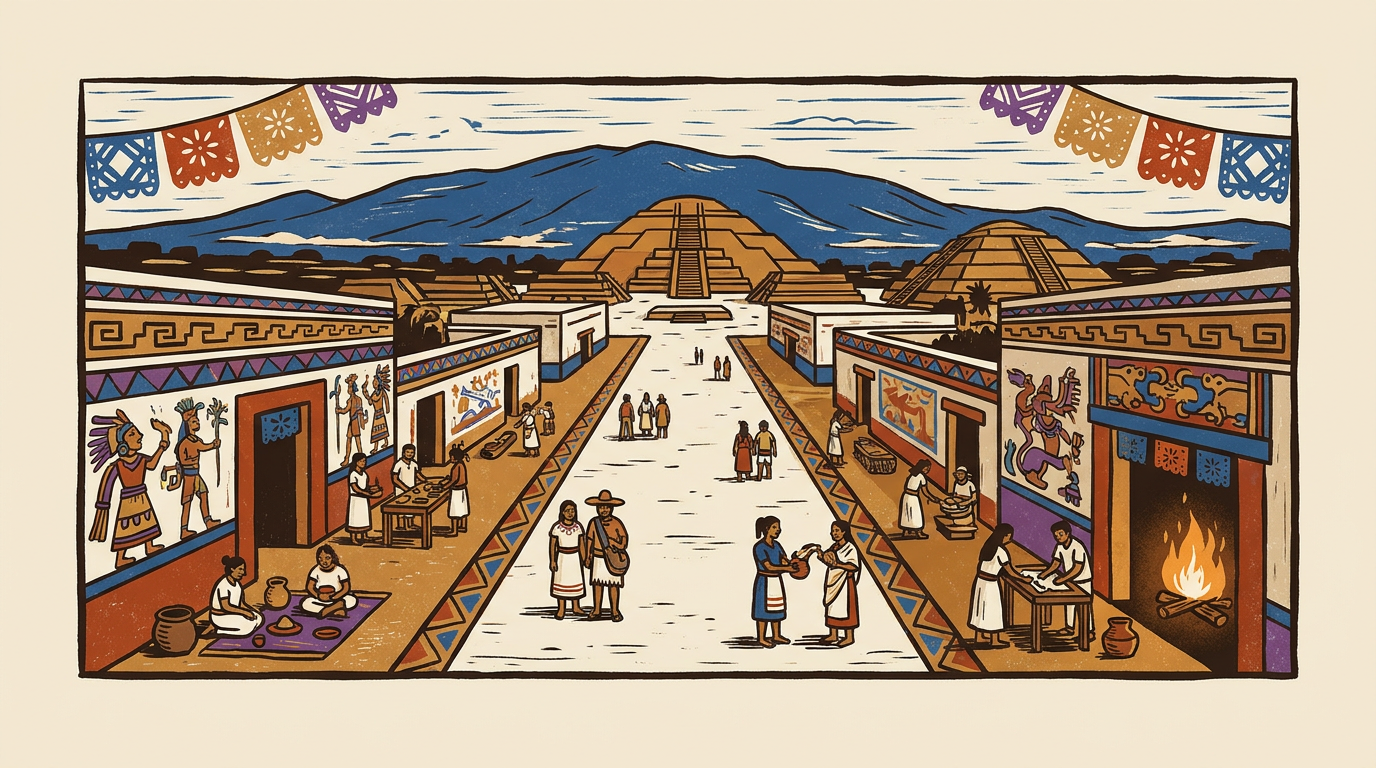
Teotihuacán needs no extraterrestrials, secret energies, or crowded equinox celebrations to be astonishing. We need only imagine it around the year 500 of the Common Era: a rigorously planned metropolis, with painted buildings, ceremonial plazas, obsidian workshops, and neighborhoods where people from different regions of Mesoamerica lived side by side. It covered around 20 square kilometers and, according to varying archaeological estimates, its population may have exceeded 100 thousand. It was an immense city for its time; the true mystery is human, and therefore all the more interesting.
The name came later
We do not know what its inhabitants called the city or what language predominated in its streets. The name Teotihuacán comes from Nahuatl and was used centuries later by the Mexica, when the great urban center had long been abandoned. It is usually translated as “place where the gods were made” or “place where the gods were born,” though the linguistic interpretation has been debated. “City of the Gods” is a beautiful and useful phrase, as long as we remember that it did not come from the mouths of its founders.
Teotihuacán’s first secret is simple: we know the name given to it by those who came later, not the one used by those who built it.
Its urban origins date back to the last centuries before the Common Era, in the Basin of Mexico, where several populations reorganized after volcanic eruptions and political changes. Between the 1st and 3rd centuries CE, the main monuments and a remarkably consistent urban grid took shape. The Pyramid of the Sun, the Pyramid of the Moon, and the complex known as the Ciudadela were not isolated whims: they structured routes, ceremonies, and hierarchies. The city was oriented approximately 15.5 degrees east of north, a deliberate deviation that has been linked to calendrical and astronomical observations as well as to the landscape, though there is no single accepted explanation.
A metropolis shaped by many places
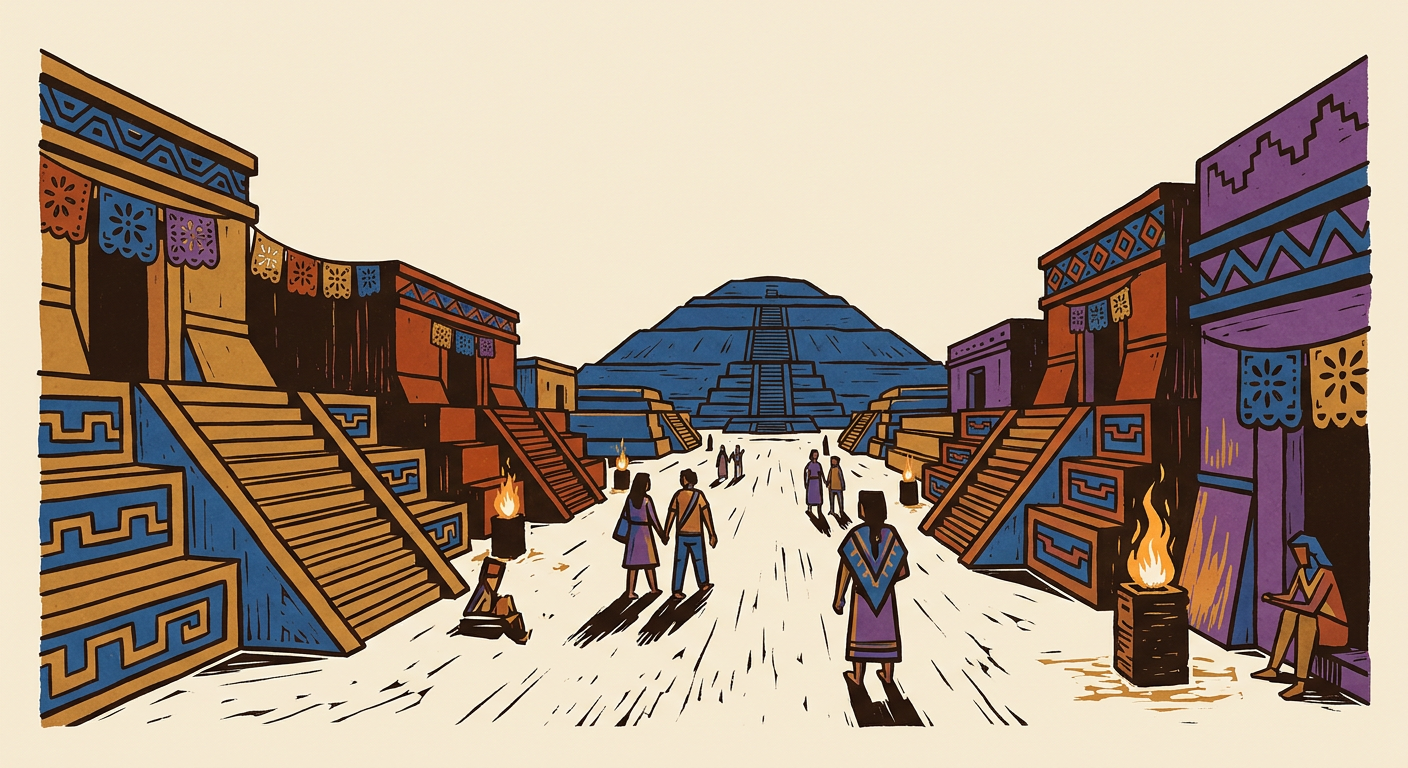
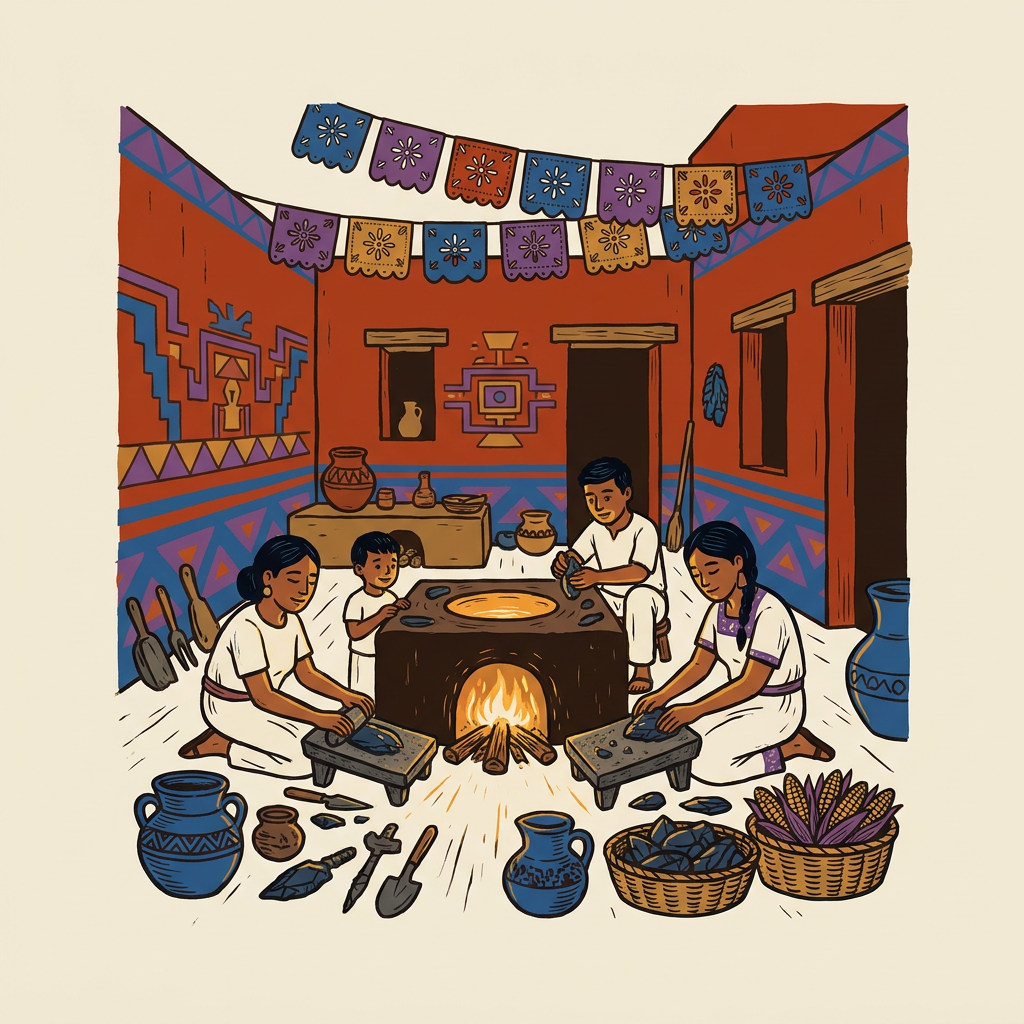
Teotihuacán was far more than its monumental corridor. Many of its inhabitants lived in masonry apartment compounds, organized around interconnected patios and rooms; for the ancient world, this represented an exceptional urban form. There were spaces to prepare food, work, worship, and bury relatives beneath the floors. These were not identical homes: their size, decoration, and materials reveal considerable social differences, because even the most carefully planned cities find ways to distribute comfort unequally.
The neighborhoods let us see diversity without turning it into a folkloric tableau. In Tlailotlacan, the so-called Oaxacan Barrio, funerary customs and ceramics linked to Oaxaca have been identified; in the Merchants’ Barrio, materials and practices related to the Gulf Coast were found. Isotopes, human remains, objects, and artistic styles point to a mobile, multiethnic population. Teotihuacán attracted artisans, merchants, religious specialists, and entire families: a cosmopolitan capital where origins mattered, but could also be negotiated.
- 1Green obsidian from Pachuca, fashioned into blades, points, and ritual objects.
- 2Ceramics from different regions, useful for tracing trade and migration.
- 3Seashells, pigments, and greenstones brought from great distances.
- 4Murals depicting birds, felines, plants, flowing water, and supernatural beings.
- 5Remains of corn, beans, amaranth, chile, squash, and maguey, the foundation of daily life.
Power painted and power armed
Teotihuacán authority left no gallery of easily recognizable kings, as was the case among the Maya. Its murals favor processions, animals, deities, offerings, and richly dressed figures, but they rarely identify individual rulers through names and biographies. This difference has fueled debate: was there one supreme king, several lineages, councils, or some shifting combination? The question remains open, and it is best not to cover it up with a stage-prop certainty.
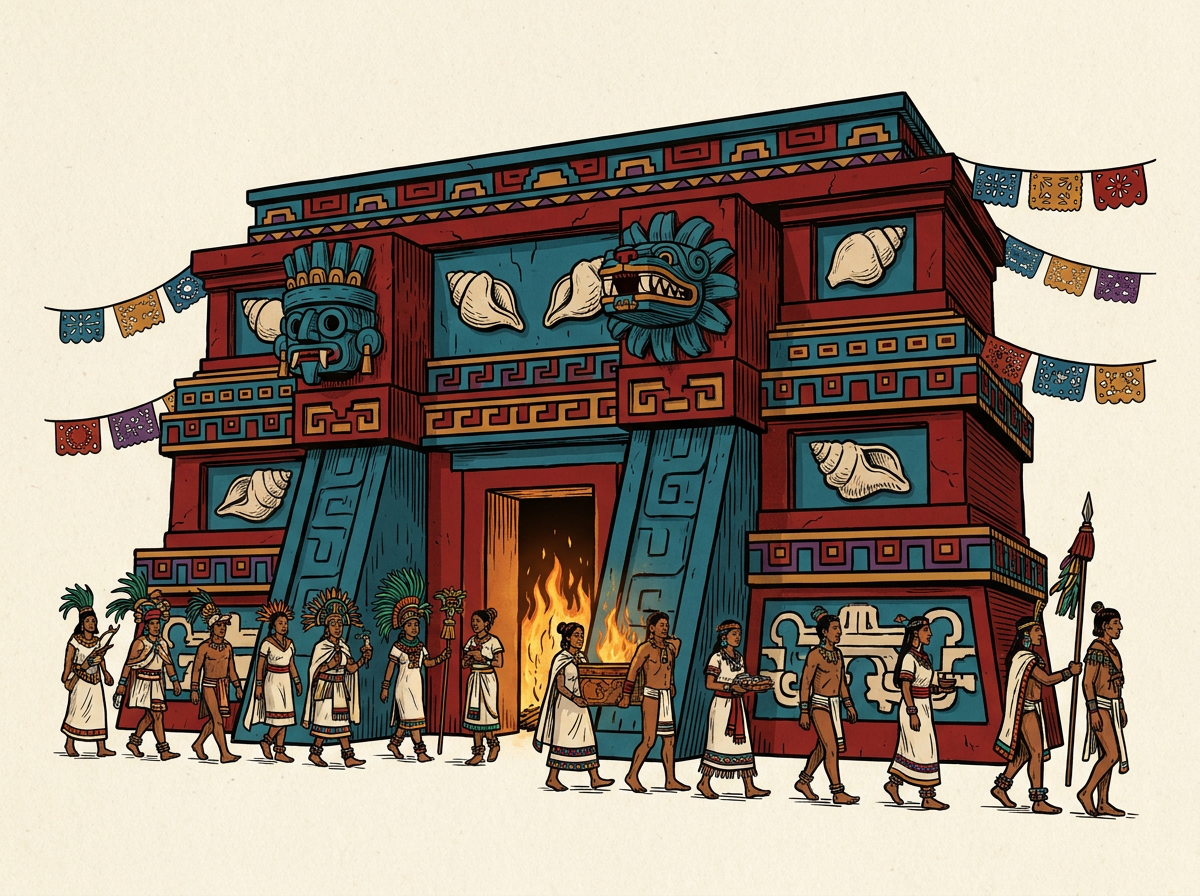
We do know the power of its public rituals. At the Temple of the Feathered Serpent, collective burials of sacrificed people were found, many accompanied by weapons and ornaments, as part of a program tied to the building’s consecration. More than a hundred individuals have been recovered over different field seasons, evidence that monumentality was also sustained through organized violence. The temple’s sculptures—heads of feathered serpents alternating with another figure whose interpretation remains debated—were not innocent decoration: they proclaimed cosmic order, wealth and the ability to command.
Beyond the valley, Teotihuacan influence reached regions of Puebla, Veracruz, Oaxaca, western Mexico and the Maya area. In Tikal, for example, Maya inscriptions record the arrival, in 378 AD, of figures associated with a powerful foreign intervention that many researchers link to Teotihuacan. However, not every Teotihuacan-style object proves direct conquest: there was also trade, alliances, prestigious imitation and migrant communities. Mesoamerica was a complex political network, not a game board where a single city moved all the pieces.
Fire, departure and memory
The great city did not end on a single dramatic day. Around the 6th and 7th centuries, several buildings in the civic-ceremonial center were selectively burned and damaged, while economic networks and the regional political balance shifted. Internal conflicts, a crisis of government, inequality, droughts and environmental changes have all been proposed; several factors were probably involved, rather than one catastrophe with movie-style theatrics. The population declined, some areas were abandoned and others remained occupied for a time.
Centuries later, the Mexica visited and revered the ruins, incorporating them into stories about the creation of the Sun and the Moon. Several names used today come from that later perspective: Avenue of the Dead, Pyramid of the Sun and Pyramid of the Moon are not verified Teotihuacan names. Modern excavations began in the 19th century and accelerated during the Porfiriato, when Leopoldo Batres worked on the Pyramid of the Sun using methods now widely questioned. Archaeology has a history too, and it does not always look well-groomed in the picture.
Today Teotihuacan is a World Heritage Site and one of Mexico’s most visited archaeological sites, but it still holds fundamental questions: who ruled, what languages were spoken, what its gods were called, why its political system collapsed. That uncertainty does not diminish its grandeur; it keeps it from becoming a neatly resolved postcard. Walking through it means also looking at the neighborhoods, pigments, burials and traces of labor, not just rushing up for a photograph. The city lost its original name, but left behind an idea that is hard to erase: a civilization can disappear and still compel us to imagine the lives of those who made it possible.
- George L. Cowgill, Ancient Teotihuacan: Early Urbanism in Central Mexico, Cambridge University Press, 2015.
- Esther Pasztory, Teotihuacan: An Experiment in Living, University of Oklahoma Press, 1997.
- National Institute of Anthropology and History, Teotihuacan Archaeological Zone and site research projects.
- UNESCO World Heritage Centre, Pre-Hispanic City of Teotihuacan.
- David M. Carballo, Urbanization and Religion in Ancient Central Mexico, Oxford University Press, 2016.