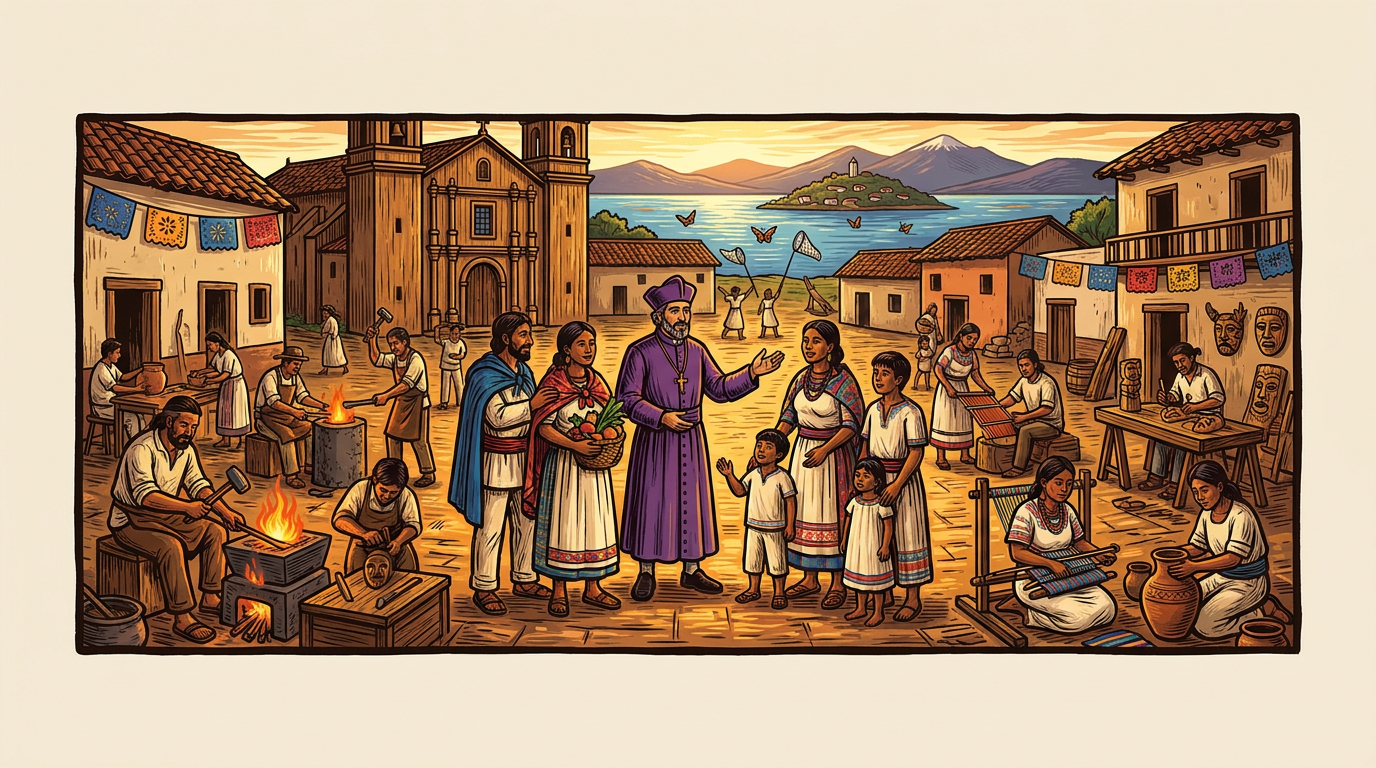
In Michoacán, the name Vasco de Quiroga was not confined to a plaque or the stern portrait of a bishop. It lives on in schools, streets, hospitals, cooperatives, and conversations in which he is called “Tata Vasco”: tata, in Purépecha, is a respectful and affectionate way of referring to a father or elder. Popular memory credits him with an enormous feat: creating artisan towns and teaching each community a trade. History, as is often the case, is more complex and far more interesting.
Quiroga did promote workshops, reorganize communities, and link certain towns with specialized activities, but he did not arrive in a land without knowledge or skilled hands. Long before the conquest, the Purépecha had mastered copper metallurgy, pottery, weaving, woodcarving, fishing, and agriculture finely attuned to lakes, mountains, and volcanic soils. Saying that a Spaniard “taught them everything” erases centuries of Indigenous technology. It is more accurate to say that he built on existing knowledge, introduced European tools and models, and helped channel production within the new colonial order.
A Jurist Enters a Wounded Land
Vasco de Quiroga was born around 1470 in Madrigal de las Altas Torres, in Castile, and trained as a jurist. He arrived in New Spain in 1531 as an oidor of the Second Audiencia, the court and governing body sent to correct the abuses of the first. He came not as an adventurous friar, but as a mature official, well versed in the law and with a very concrete idea of good Christian government. The territory he encountered was a far cry from any utopia.
In Michoacán, the conquest had left an open wound. Nuño de Guzmán, president of the First Audiencia, subjugated the region with extreme violence and in 1530 ordered the execution of Tangáxuan II, the last irecha, or supreme Purépecha ruler. Exploitation, tribute, and encomiendas were compounded by epidemics and displacement. Quiroga was sent to investigate and pacify the region; he listened to grievances, traveled through communities, and ultimately made that province the center of his public life.
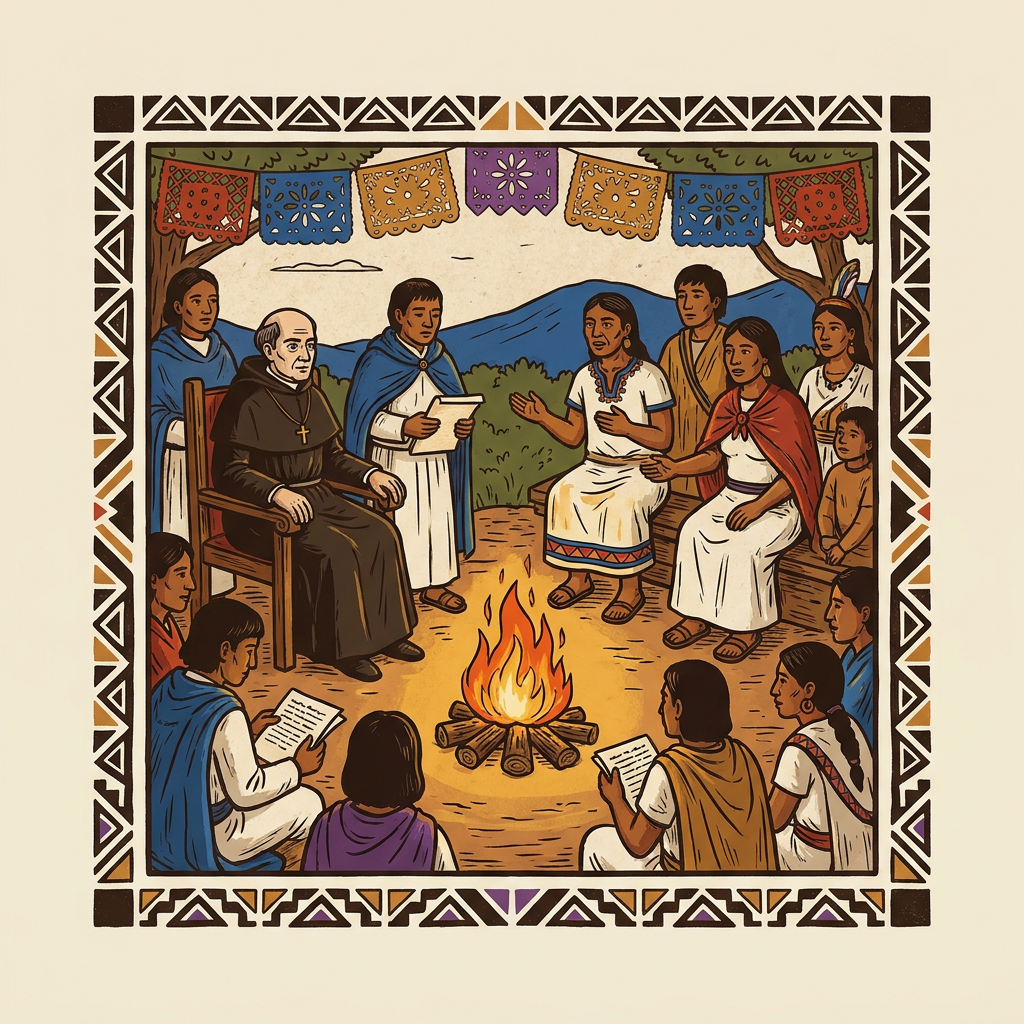
His response was legal, religious, and social all at once. In his “Información en derecho,” written in 1535, he defended Indigenous communities against plans to enslave them and laid out a vision of government inspired by Christian humanism. He was familiar with Thomas More’s “Utopia,” published in 1516, and found in it a model of community life organized around work, education, and the common good. He did not try to copy it as if tracing a tablecloth, but he did draw several ideas from that vision for his hospital-towns.
Santa Fe: A Utopia with a Kitchen
In 1532, he founded the hospital-town of Santa Fe de los Altos near Mexico City, and shortly afterward established another in Santa Fe de la Laguna, on the shores of Lake Pátzcuaro. The word “hospital” may mislead modern readers: it was not merely a place for treating the sick. It was a community with a chapel, homes, land, storehouses, teaching spaces, assistance for orphans, widows, and travelers, and rules for organizing work. Health, food, education, and worship all fit under the same institutional roof.
The “Rules and Ordinances for the Government of the Hospitals of Santa Fe,” drafted by Quiroga, proposed work schedules, the communal distribution of goods, care for the sick, the election of leaders, and the learning of trades. Families cultivated their own plots, but they also contributed to communal work whose yield supported those unable to work. There was meticulous discipline, of course: sixteenth-century humanism also liked to keep accounts. Even so, compared with the encomienda and ruthless extraction, the hospital-town offered some measure of protection and cohesion.
“Let it be arranged in each family that they learn useful and necessary trades for the said republic of the hospital.” —“Rules and Ordinances for the Government of the Hospitals of Santa Fe,” attributed to Vasco de Quiroga (modernized quotation)
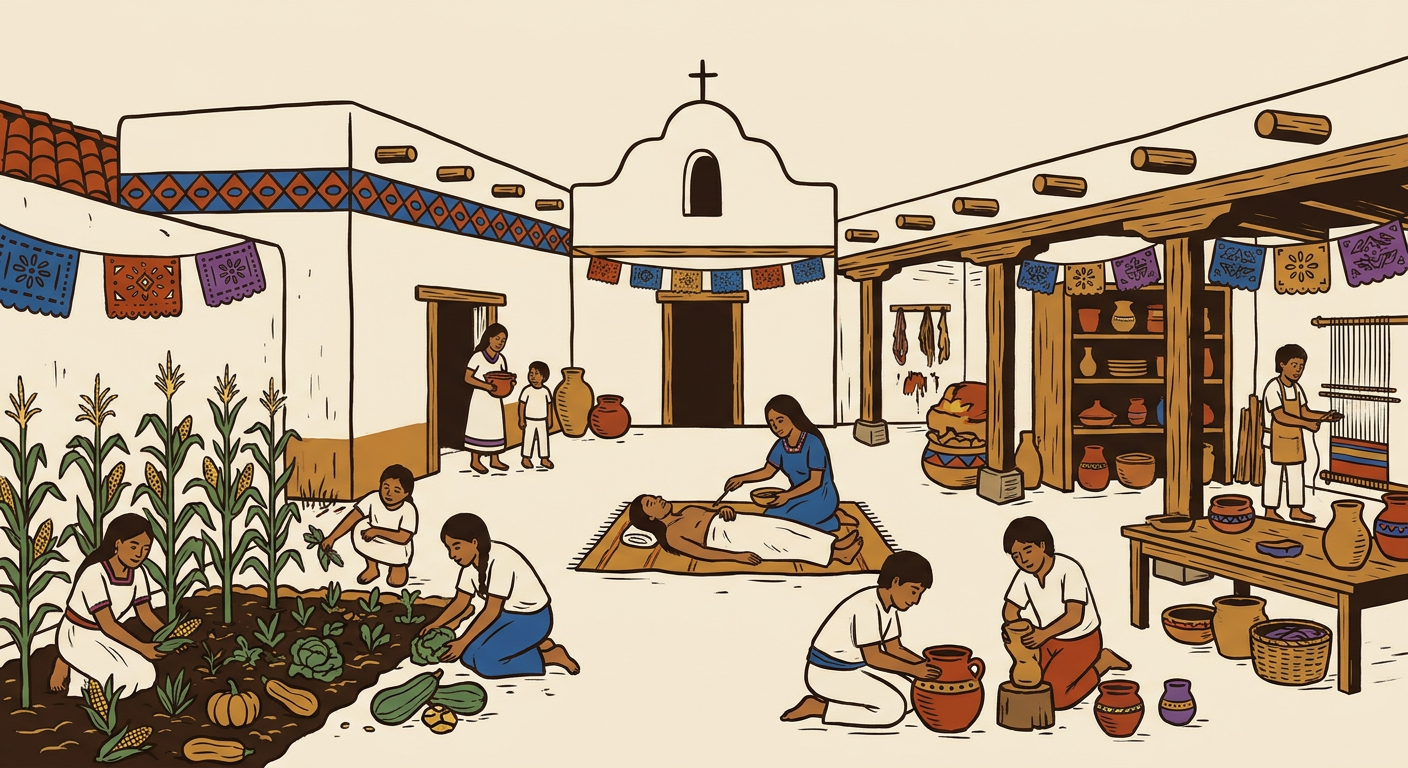
This project was not an independent Indigenous republic. It was part of evangelization and the colonial regime, imposed Christian morality, and sought to transform Native ways of life according to European ideals. Quiroga defended Indigenous people, but he also spoke from a paternalistic hierarchy typical of his time; wanting to protect them did not amount to recognizing full autonomy. That contradiction is essential to understanding him: he was an opponent of brutal abuses and, at the same time, a builder of the New Spanish order.
Who Invented the Artisan Towns?
In 1538, Quiroga was consecrated the first bishop of Michoacán. From that position, he promoted parishes, hospitals, schools, and the Colegio de San Nicolás Obispo, founded in Pátzcuaro to train clergy and teach Indigenous languages; centuries later, the institution would become a forerunner of the Universidad Michoacana. He also encouraged the consolidation of dispersed populations and the establishment of workshops. The regional network gradually took on a recognizable shape: towns associated with certain products, raw materials, and trade routes.
Tradition links Santa Clara del Cobre with metalwork; Tzintzuntzan and Patamban with pottery; Paracho with stringed instruments; Aranza with textiles; San Felipe de los Herreros with metal forging; and communities in the lake region with tule objects, nets, and boats. Specialization made it easier to teach techniques, pool tools, maintain standards, and sell surpluses in nearby markets. It also allowed towns to exchange products and reduce direct competition. It was regional economics before anyone thought to box it into a presentation with colorful arrows.
- 1Starting with materials available in each area: copper, clay, wood, plant fibers, wool, or cotton.
- 2Build on existing Purépecha knowledge and combine it with tools and techniques brought from Europe.
- 3Train apprentices within families, workshops and communities, so the craft would pass from one generation to the next.
- 4Connect products through markets, roads, parishes and hubs such as Pátzcuaro.
- 5Devote part of the work to supporting the community and caring for vulnerable people.
However, the tidy map of “one town, one craft” did not appear overnight, nor was it designed by a single mind. Researchers have noted that many specialties predated Quiroga, while others gradually took shape thanks to Indigenous artisans, friars, merchants, local authorities and the needs of the colonial market. Even several specific attributions lack documents that would identify the day and the person who introduced a technique. The idea that Tata Vasco dealt out the crafts like playing cards belongs, to a large extent, to a later memory.
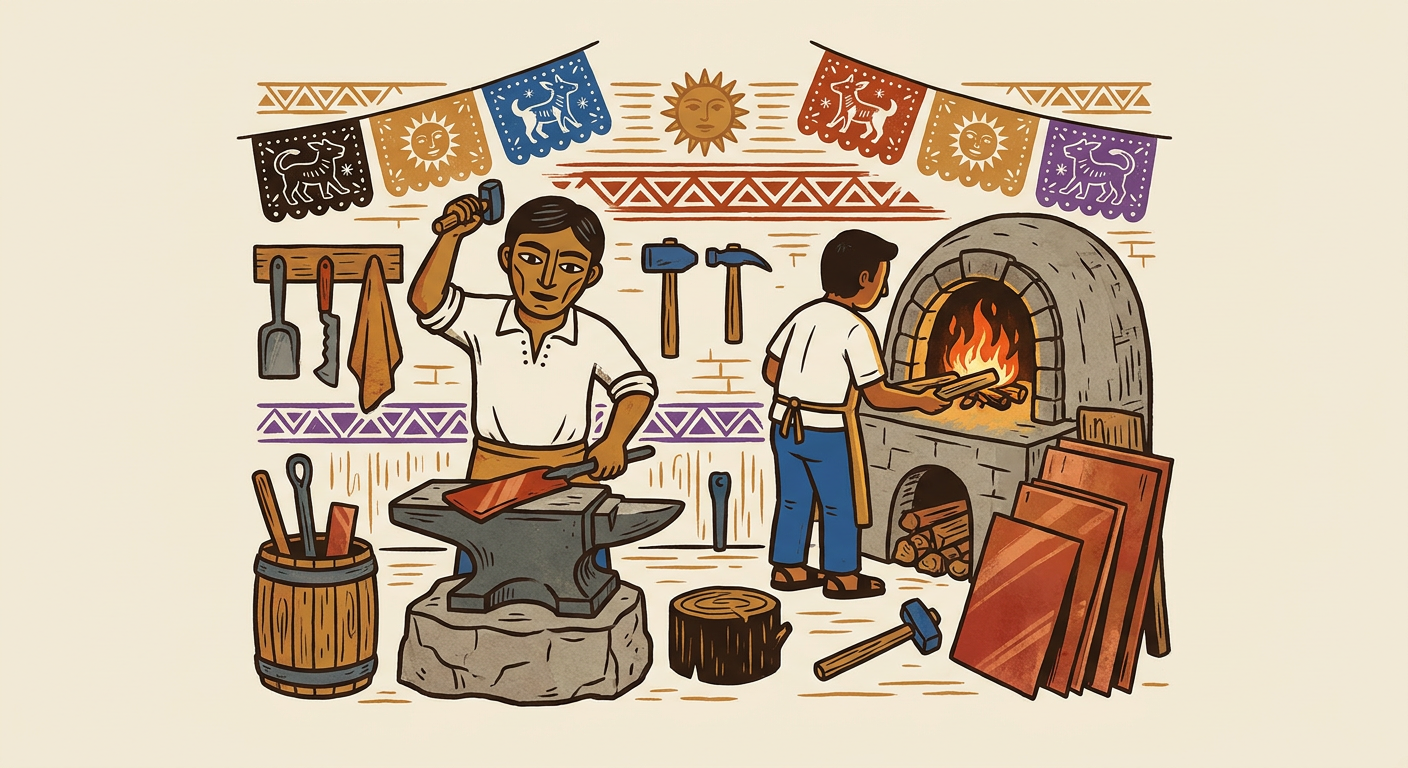
Nor should we imagine crafts remaining unchanged since the 16th century. The Paracho guitar, for example, is the result of a long history of European instruments adapted by local luthiers, not a recipe handed down in full by the bishop. Pottery changed with kilns, glazes, commercial forms and the tastes of different eras; copperwork incorporated new tools and designs; textiles responded to changing materials and markets. Tradition survives precisely because it knows how to move without ceasing to recognize itself.
The legacy and its seams
Vasco de Quiroga moved the episcopal seat from Tzintzuntzan to Pátzcuaro and sought to make this city the heart of his project. There he established institutions, promoted the hospital of Santa Marta and envisioned a grand five-nave cathedral, only part of which was built. Later, in 1580, the episcopal seat moved to Valladolid, now Morelia, after Quiroga’s death in 1565. Pátzcuaro, however, retained the urban and emotional imprint of that experiment.
His material legacy endures in techniques, fairs, family workshops and local economies, but also in a way of linking community identity with specialized work. That continuity has not come easily: artisans have faced middlemen, industrial imitations, forest loss, rising raw material costs, migration and designs sold as “inspired” without credit or payment. Quiroga’s legacy is not an untouched display case, but a site of daily struggle. Every piece that manages to support a family is worth more than any inauguration speech.
Devotion to Tata Vasco took shape over centuries through local accounts, ecclesiastical institutions and a collective memory that contrasted him with conquistadors such as Nuño de Guzmán. The affection is real, especially in communities that remember hospitals, lands and mechanisms of protection. But affection does not require turning him into a plaster saint or erasing the colonial cost of his program. His legal advocacy and social imagination can be recognized without crediting him with the collective abilities of an entire people.
Legend says Tata Vasco gave people their crafts; history reveals something more fertile: entire communities learned them, transformed them and made them their own.
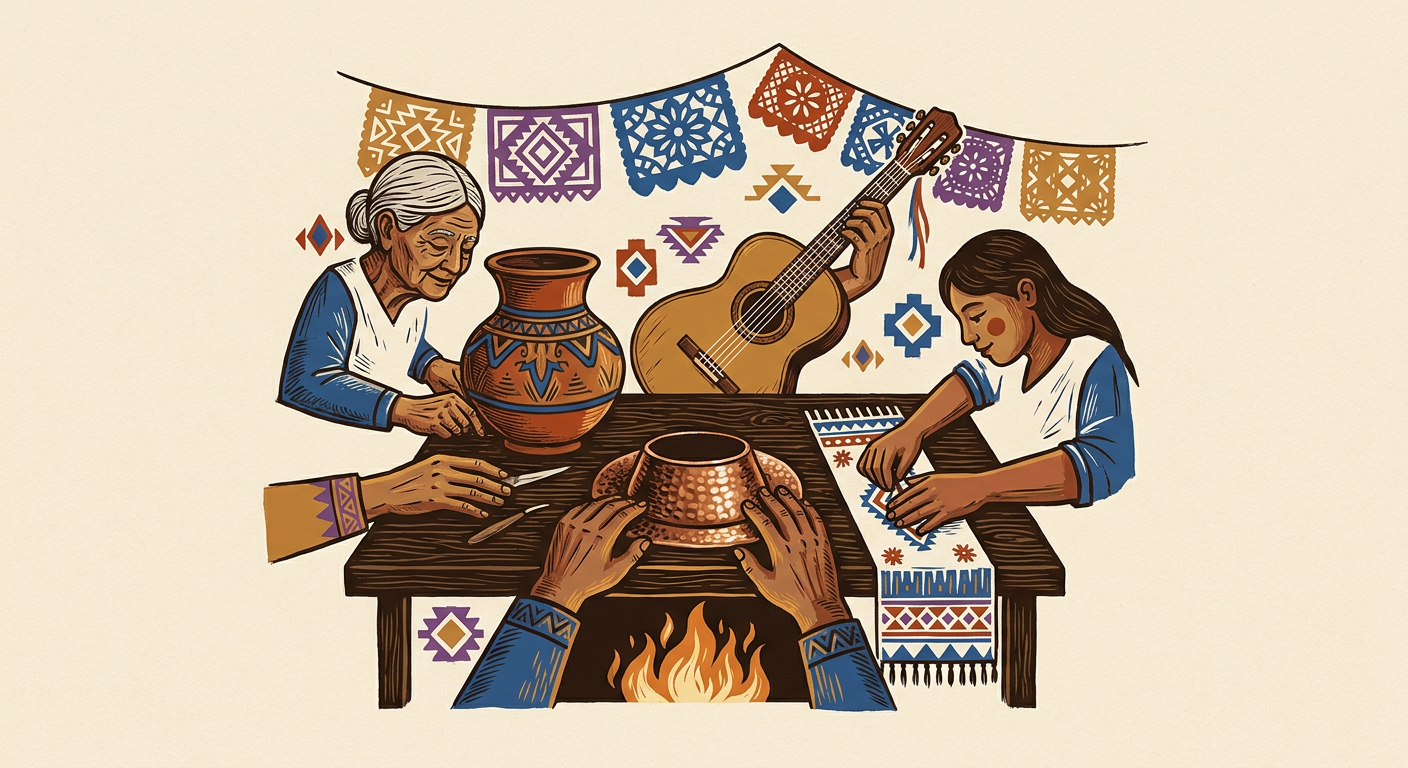
Did Vasco de Quiroga change the history of Mexico? Yes, especially by defending Indigenous populations in a time of violence, experimenting with communities of mutual aid and promoting a productive organization that left a lasting mark on Michoacán. He did not do it alone, nor did he invent the hands that had worked clay, metal, wood and fibers long before his arrival. His true importance emerges when we take him down from the pedestal and place him among the jurists, communities, artisans, women, apprentices and Indigenous authorities who negotiated the new world. Tata Vasco drew part of the map; communities have kept it alive for nearly five centuries, revising it with hammer blows, stitches and slow fire.
- Vasco de Quiroga, “Información en derecho” (1535), edition by the Universidad Nacional Autónoma de México.
- Vasco de Quiroga, “Reglas y ordenanzas para el gobierno de los hospitales de Santa Fe”, edition and studies by Rafael Aguayo Spencer.
- Fintan B. Warren, “Vasco de Quiroga and His Pueblo-Hospitals of Santa Fe”, Academy of American Franciscan History, 1963.
- Benedict Warren, “La conquista de Michoacán, 1521-1530”, Fimax Publicistas, 1977.
- Museo Regional Michoacano, Instituto Nacional de Antropología e Historia, historical materials on Vasco de Quiroga and colonial-era Michoacán.