“The Spanish never took the gold” is a tempting phrase: it sounds like a secret rescued from the drawer the teacher left locked. It is also false. There was plunder, tribute, the melting down of objects, and the shipment of metals to Europe; at the same time, a considerable share of the wealth produced in New Spain circulated here and paid for buildings, roads, haciendas, workshops, religious festivals, and private fortunes. The interesting history begins when we stop choosing between “they took it all” and “it all stayed here.”
The metal did not vanish by the magic of a caravel
In Mesoamerica, gold had ornamental, ritual, and political uses, but it did not hold the same monetary role as it did in Europe. After the Castilians arrived, many pieces were taken as spoils, presented as gifts, or demanded as tribute; they were then melted down into bars and coins. Hernán Cortés’s expedition sent Carlos V a portion of the treasure it obtained, and the Crown claimed the “royal fifth,” a tax that, at least by law, amounted to one-fifth of certain metals and spoils. This was not a neat transfer from an American vault to a Spanish one, but a violent extraction, only partially regulated and shaped by private interests.
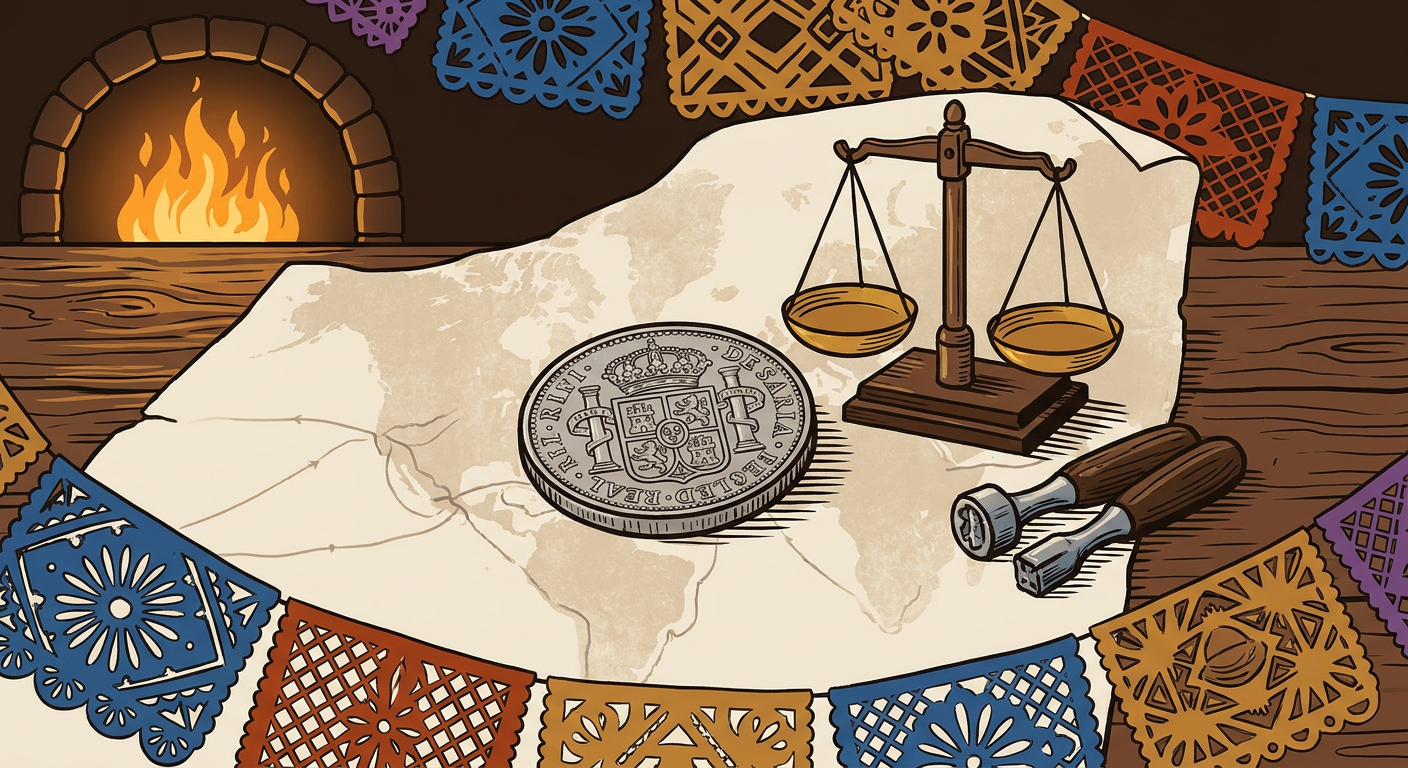
American metals did make their way to Seville and, later, Cádiz; some of them supported the expenses of the Spanish monarchy and ended up in the hands of European bankers and merchants. Another share continued on to Asia aboard the Manila galleon, where American silver bought silks, porcelain, and spices. And much wealth remained in New Spain, though not necessarily for the benefit of those who produced it: it paid wages, debts, taxes, goods, charitable works, and elite consumption. To say that a church holds “the gold” of the Americas as though it were a stone piggy bank confuses local investment, forced labor, tribute, and monetary circulation.
Wealth did not have a single destination: it crossed oceans, changed hands, and also became embedded in stone, altarpieces, debts, and inequalities.
Stone churches, flesh-and-blood accounts
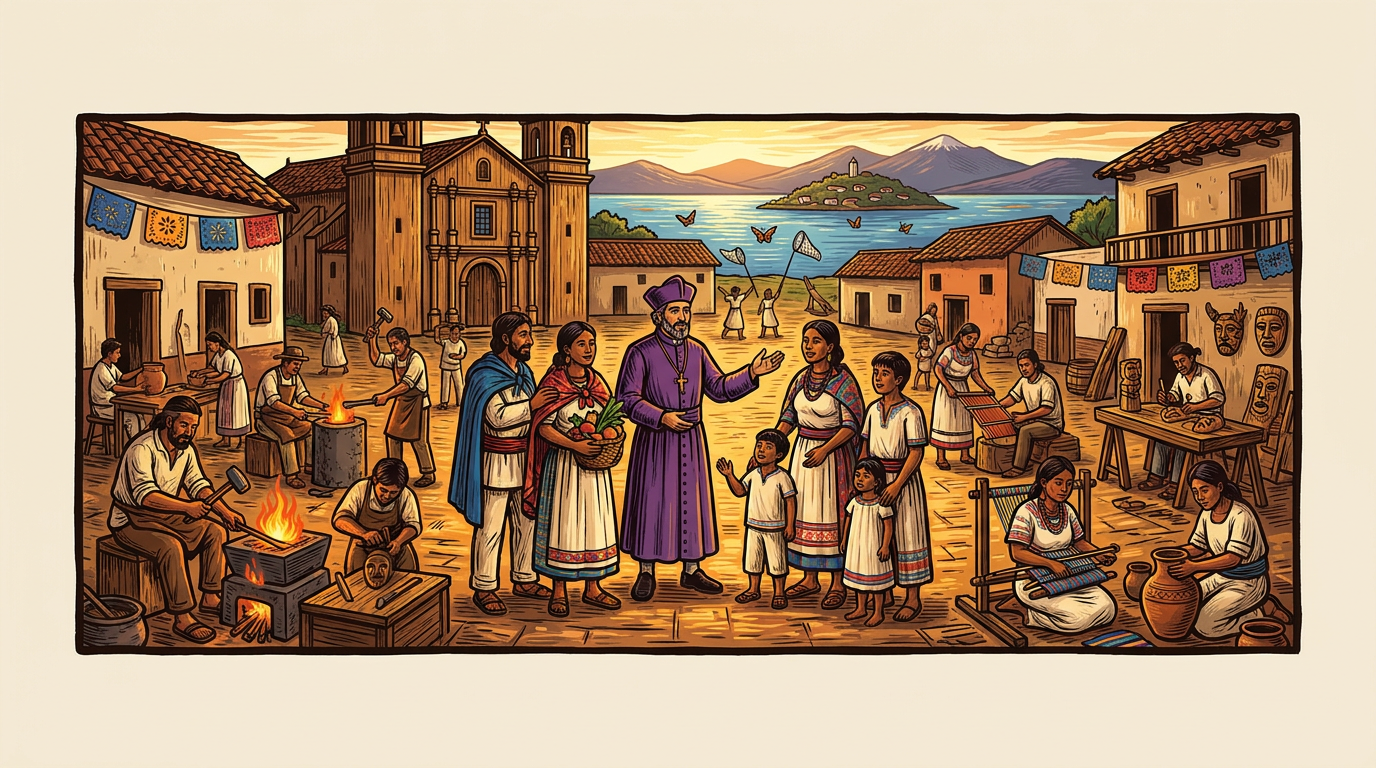
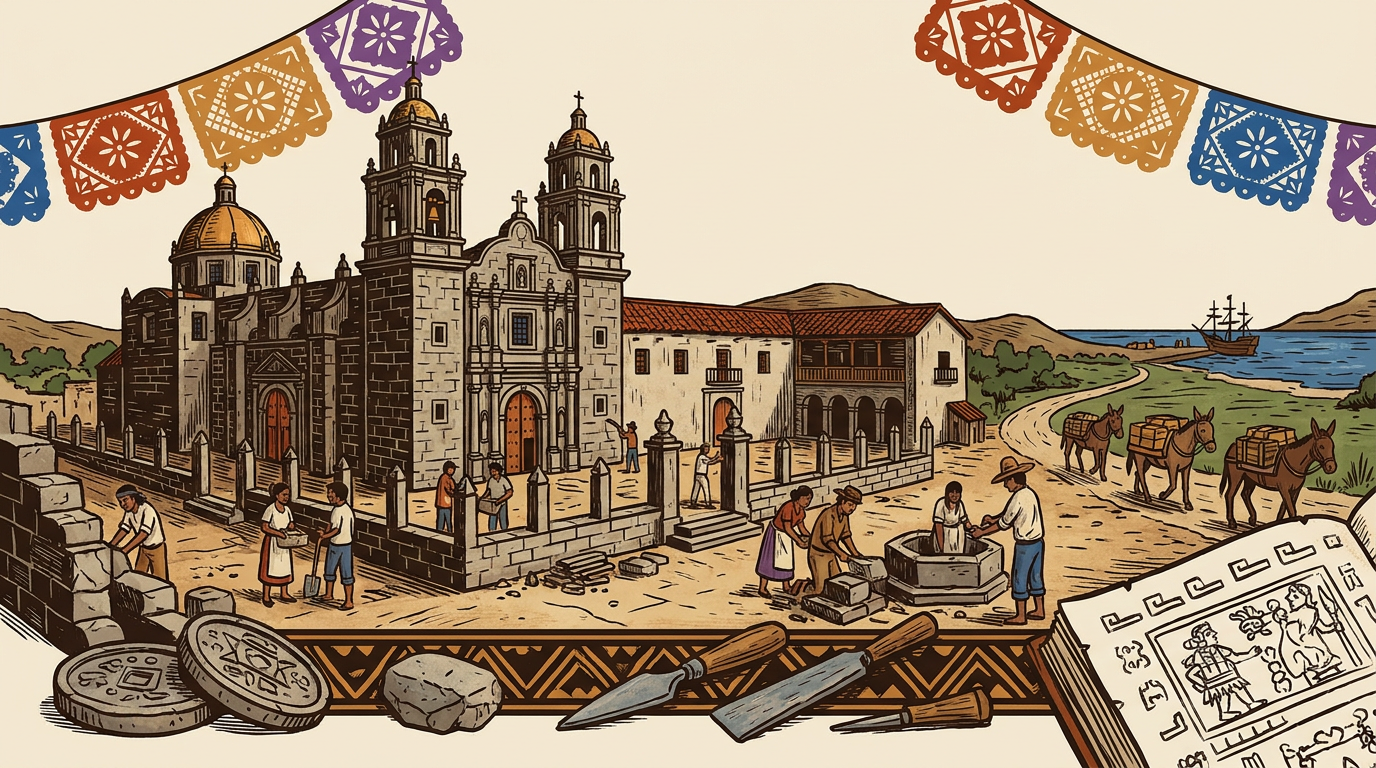
The churches, convents, and hospitals of the 16th century have a monumental presence, but they do not prove that colonial extraction did not occur. They were funded in various ways: resources from religious orders, donations from encomenderos and merchants, community revenues, alms, tribute, and Crown contributions, along with the labor of many Indigenous peoples. In several cases, communities negotiated these projects, adopted them as their own spaces, and took part in their design and decoration; in others, they bore the burden of imposed labor and obligations. Architectural beauty does not erase the social cost, though neither can it be reduced to a mere peninsular whim.
The great convent complexes in places such as Huejotzingo, Calpan, Actopan, and Yanhuitlán were centers of evangelization and territorial reorganization. Their enormous atriums, posa chapels, murals, and facades reveal the collaboration—and tensions—among friars, Indigenous authorities, and local painters, sculptors, stonemasons, and bricklayers. Many communities retained enough political and economic capacity to commission images, litigate over land, and adapt Christian symbols to their own sensibilities. They were not silent spectators: they acted within a new order that had nonetheless been imposed on them after a war and a demographic catastrophe.
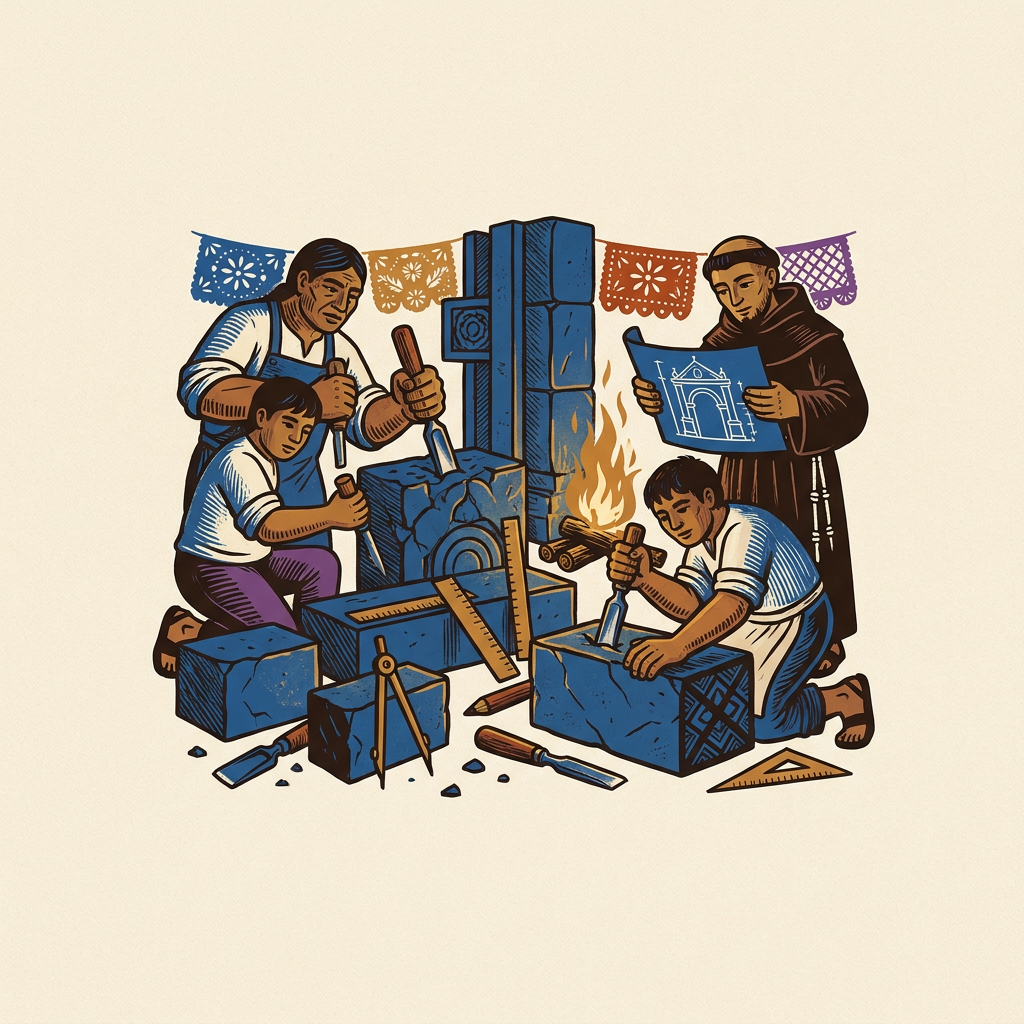
Moreover, those buildings were not raised with stacked ingots, but with earth, lime, wood, stone, technical knowledge, and human labor. Some incorporated materials from earlier structures, but we should not turn every church into a dismantled pyramid: the cases and evidence vary. New Spanish architecture grew out of European, Indigenous, African, and, over time, Asian traditions, brought together under deeply unequal power relations. Its splendor is real; so are the tributes, epidemics, and nameless hands that made it possible.
- 1Spoils and tribute: goods appropriated after war or demanded from subjugated populations.
- 2Taxation: Crown taxes on metals, trade, and production.
- 3Local investment: money allocated to churches, urban works, haciendas, workshops, and charity.
- 4Global circulation: silver sent to Europe and Asia in exchange for credit and goods.
- 5Labor: paid, communal, or coercive, depending on the period, place, and institution.
It was not a handful of people facing an unmoving continent
It is also true that the Europeans who arrived in the early years were few compared with the Mesoamerican population. But it does not follow that there was no conquest. Cortés and his men defeated Mexico-Tenochtitlan with the decisive support of tens of thousands of Indigenous allies, including Tlaxcalans and groups from the Puebla-Tlaxcala Valley, as well as enemies of and tributaries disgruntled with Mexica power. Smallpox, political divisions, the siege and military technology all played a role, although no single cause explains the fall of 1521.
It is more fitting to speak of conquests in the plural. After the capture of Tenochtitlan came campaigns, pacts, rebellions and subjugations over the course of centuries: Mixtón in the west, the so-called Chichimeca War in the north and prolonged Maya resistance, among many others. Spanish conquistadors, Indigenous auxiliaries, Africans and descendants born in the Americas all took part. A small number of Spaniards from the Iberian Peninsula were able to dominate vast territories because they did not act alone and because the Crown built institutions, alliances and mechanisms of coercion that outlasted the first soldiers.
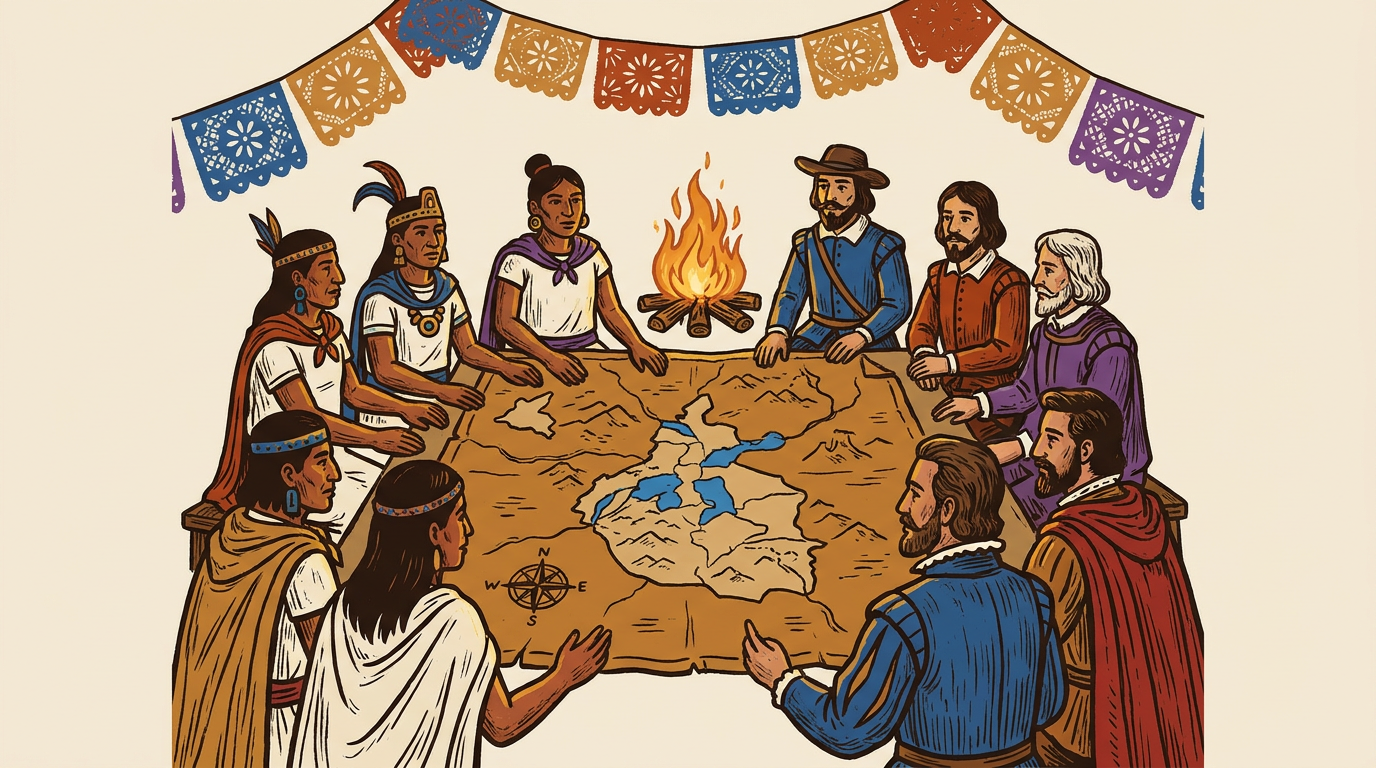
Saying “they didn’t conquer us, we mixed” does not resolve the problem of the pronoun either. Who are “we”: Mexica, Mixtec, Maya, Tlaxcalan, Spanish, African, Filipino or their descendants? Mixing did occur, of course, and began very early, but it included marriages, concubinage, family alliances, adoptions and relationships shaped by sexual violence and inequality. Mestizaje was not a family gathering where everyone brought dessert; it was a long, intimate and political process.
Mixing Does Not Erase Conquest
New Spanish society was profoundly mixed. Indigenous peoples preserved languages, town councils, communal lands and traditions; Spaniards introduced institutions, animals, crops and forms of religious practice; African and Afro-descendant people contributed labor, knowledge, music, cuisines and communities; the connection with the Philippines added Asian objects, words and practices. Something new emerged from those encounters, but not on an even playing field. The colonial order distinguished among social standings, privileges and obligations, and placed the monarchy and the Church at the center of public life.
Evangelization offers a clear example of this dual nature. Images were destroyed and rituals persecuted, but there were also translations into Nahuatl, Maya, Otomí, Purépecha and other languages; there were imposed doctrines and local reinterpretations. Indigenous artists painted Christian walls using their own pigments, techniques and visual repertoires, while confraternities turned saints and feast days into community affairs. The result was not an intact Spanish culture layered over an erased Indigenous one, but a new, fertile and conflict-ridden colonial formation.
That is why correcting a simplistic version taught in school does not require replacing it with another one. It is not true that all the gold vanished on its way to Spain, but neither is it true that wealth was never taken away; it is not true that a handful of Spaniards won on their own, but there was a conquest; it is not true that the Indigenous population disappeared, but it did suffer mass death, dispossession and subordination. The three words—extraction, conquest and mixing—can coexist in the same sentence. Grown-up history begins when we accept that discomfort.
A church can be, at the same time, a community undertaking, an instrument of evangelization, an archive of knowledge and a monument to an unequal order.
Perhaps what we were told in school was not a concerted lie, but a history that was far too narrow: bronze heroes, villains without nuance and arrows showing gold flowing in only one direction. Opening up the map allows us to see ships bound for Seville and Manila, coins spent in American markets, convents built by communities and new lineages born between several shores. Mexico is not proof that the conquest never happened, but that no conquest completely controls what is born afterward. The most enduring gold is not found only in altarpieces: it lies in the ability to look at a mixed heritage without confusing belonging with absolution.
- Bernal Díaz del Castillo, The True History of the Conquest of New Spain, edited by Guillermo Serés, Royal Spanish Academy, 2011.
- Matthew Restall, Seven Myths of the Spanish Conquest, Paidós, 2004.
- Federico Navarrete Linares, Who Conquered Mexico?, Debate, 2019.
- Enrique Florescano and Isabel Gil Sánchez, “The Era of the Bourbon Reforms and Economic Growth, 1750-1808,” in General History of Mexico, El Colegio de México.
- National Institute of Anthropology and History (INAH), Media Library and materials on 16th-century convents and New Spanish heritage.