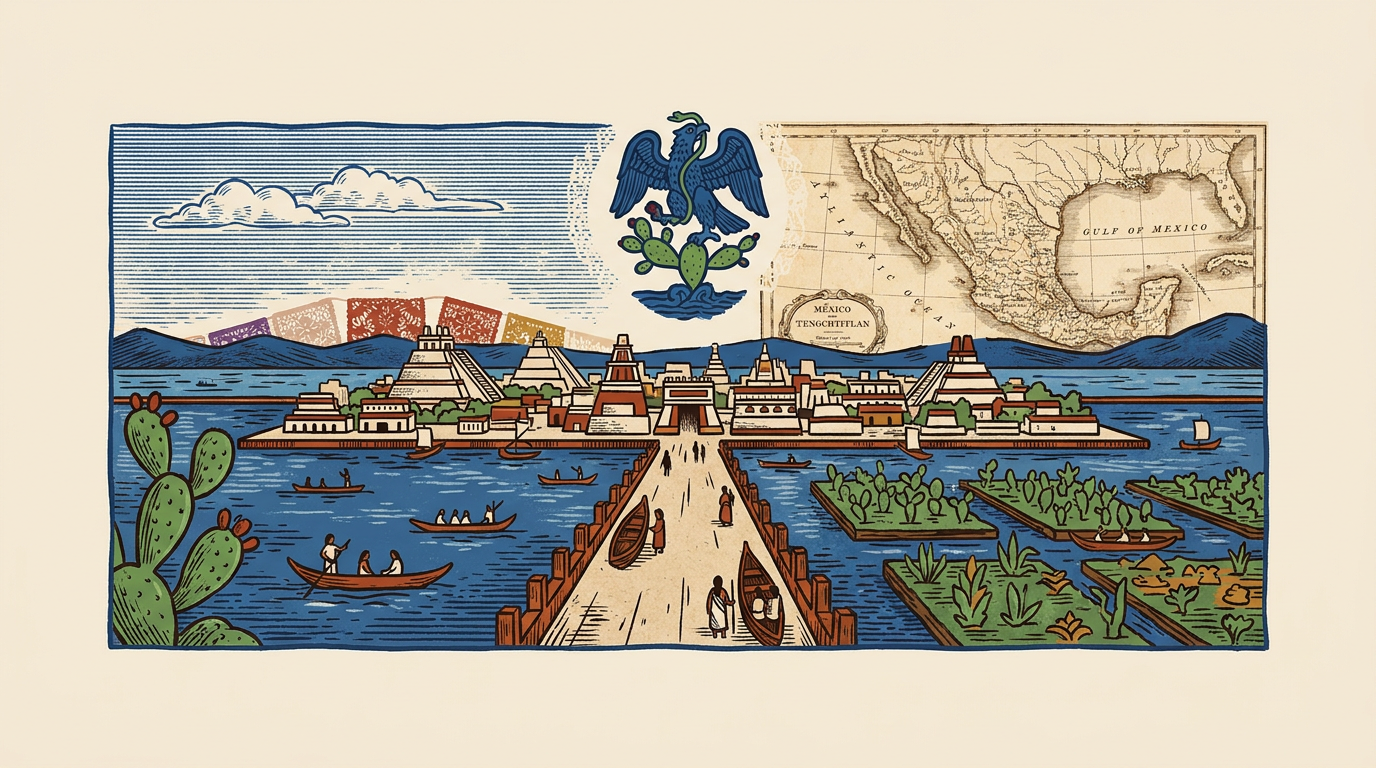
The question seems to have a delicious little catch: if the Spaniards and their allies defeated Mexica power in 1521, why did the country end up being called Mexico? Wouldn’t that be like naming a new house after the defeated neighbor? The problem lies in that “we defeated,” which throws five centuries of history into a single blender, and also in calling all the protagonists “Aztecs.” Mexico did not get its name as a posthumous tribute to the defeated empire, but because a city and a territory already known as Mexico kept, expanded and transformed that name.
First: It Was Not Spain Against “the Mexicans”
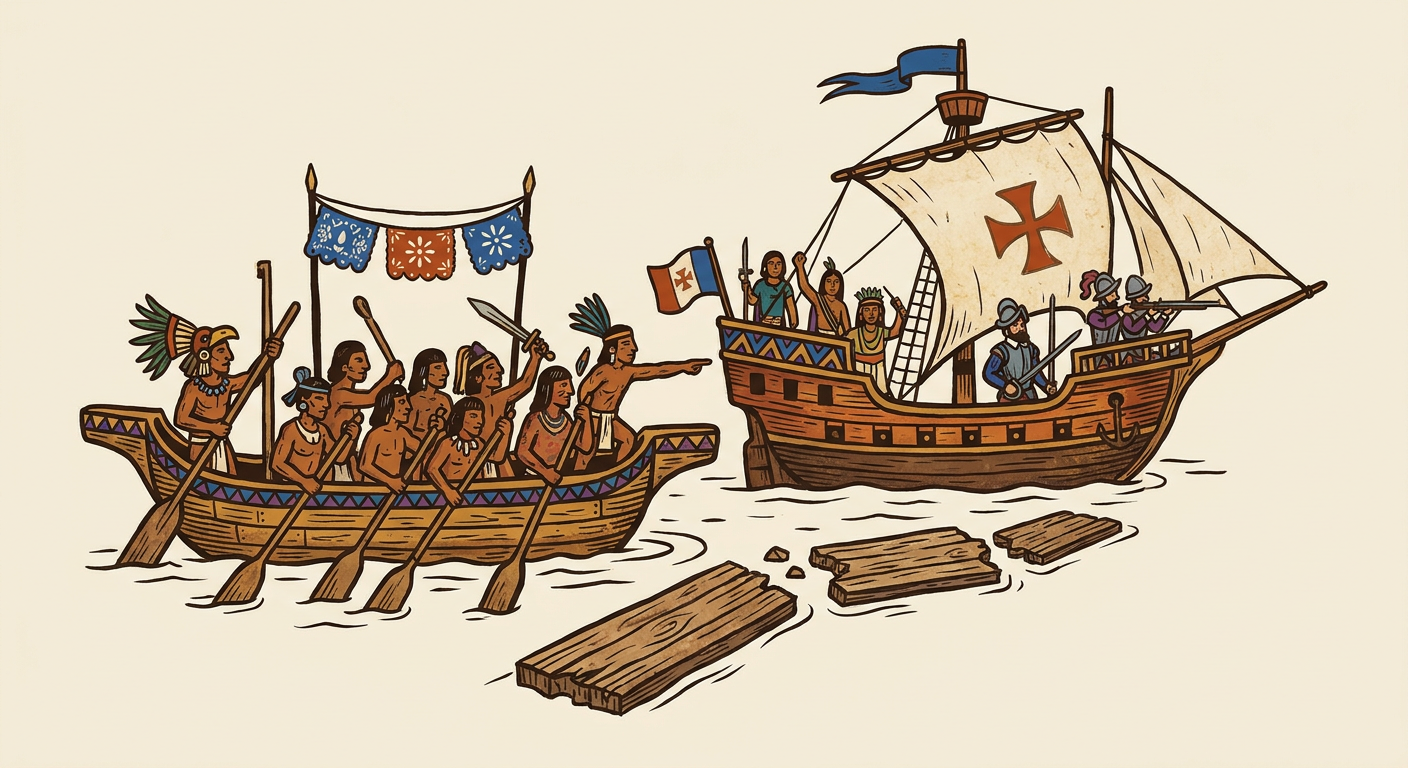
The fall of Mexico-Tenochtitlan was not a simple fight between two national sides. Hernán Cortés arrived with a few hundred Europeans, but his campaign was only possible thanks to tens of thousands of Indigenous allies, including Tlaxcalans, Huejotzingas, Chalcas and other peoples who had been subjugated, threatened or pitted against the Triple Alliance. Epidemics, political fractures and the prolonged siege of the city also played a part. Saying “the Spaniards defeated the Aztecs” erases nearly everyone who carried weapons, food, canoes, grievances and decisions.
“Aztec,” moreover, is a useful but slippery label. Colonial sources mention the connection to Aztlán, the legendary place of origin from which several peoples are said to have departed; however, those who ruled Tenochtitlan identified primarily as Mexicas or Tenochcas. In the 19th century, scholars such as William H. Prescott popularized the broad use of “Aztec” in other languages to refer to the empire and its culture. That is why today we say “Aztecs” without much trouble in conversation, but it is worth knowing that this was not the precise political name of those defeated in 1521.
Mexico Before Mexico
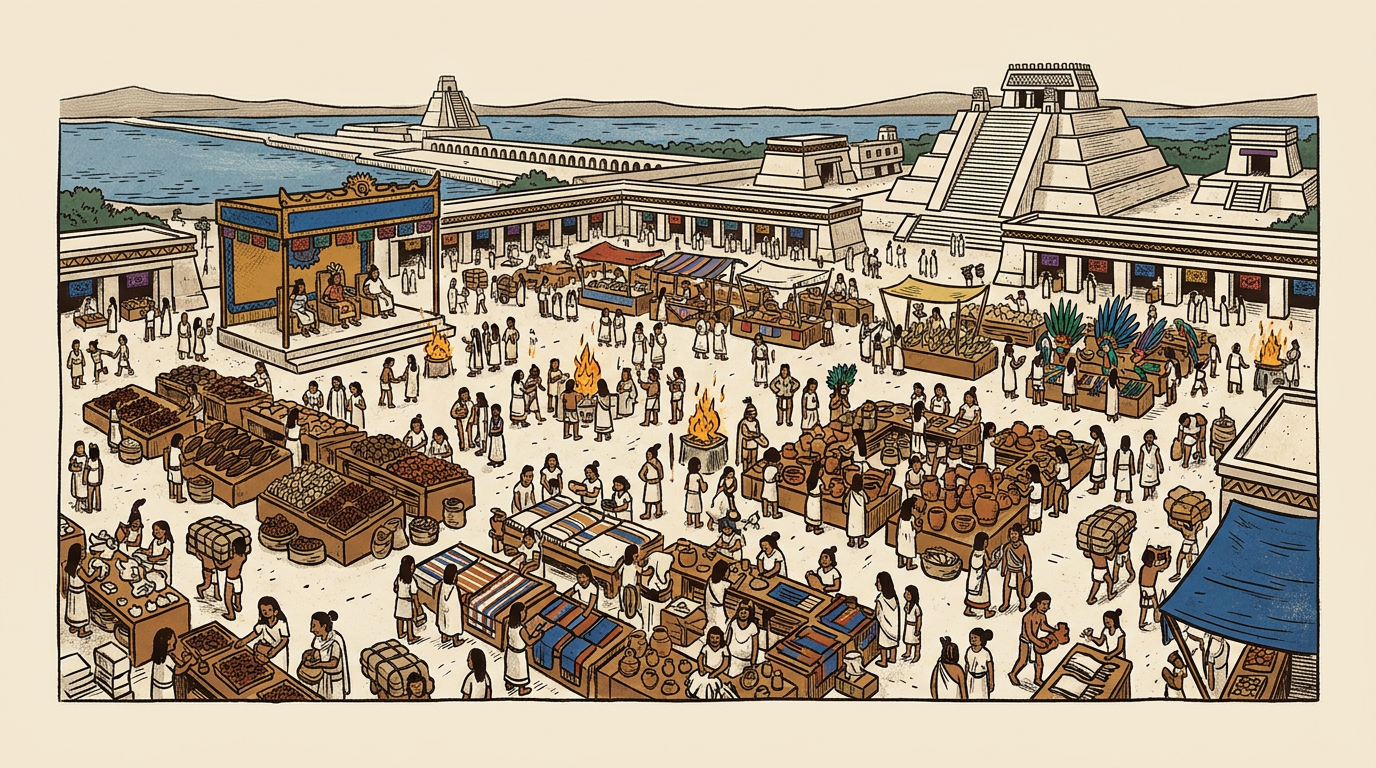
Before it became the name of a country, Mexico referred above all to Mexico-Tenochtitlan and, by extension, to the political and geographic sphere associated with it. Documents from the 16th century speak of “Mexico,” “Temixtitán” or “Mexico Tenochtitlan,” with varying spellings, because rendering Nahuatl sounds in the Latin alphabet did not come with an instruction manual. After the conquest, the city was rebuilt as the colonial capital atop the ruins of Tenochtitlan and kept the name Mexico. The seat of power changed; the city’s importance did not.
“Mexico Tenochtitlan” was not an epitaph: it remained a living name, spoken, written and used in administration after 1521.
The exact origin of the word “Mexico” remains debated. One traditional interpretation links it to Mēxihco, a Nahuatl name whose etymology has been explained in different ways, including “place at the navel of the moon,” from metztli, xictli and the locative suffix -co. Other specialists have proposed links to Mexi or Mēxitli, one of the names associated with Huitzilopochtli, protector of the Mexicas. The first explanation is very beautiful—it practically begs to be printed on a mug—but there is no definitive philological consensus; presenting it as certain would be to confuse poetry with a notarized deed.

A Capital That Gave Its Name to the Kingdom
During the three centuries of the viceroyalty, the territory did not have a single exclusive name. Its most common official name was New Spain, but “Mexico” continued to be used for the capital, the valley, the archdiocese, the audiencia and other jurisdictions; it also appeared on maps and in printed works with varying scopes. Mexico City’s enormous political, economic and religious centrality allowed its name to spread far beyond its streets and canals. Something similar had happened with Rome and later happened with several nations: capitals are good at laying claim to the entire directory.
A famous example is the work of Francisco Javier Clavijero, an exiled Jesuit from New Spain, published in Italian as Storia antica del Messico between 1780 and 1781. Clavijero used Mexico to speak of the territory’s Indigenous past and respond to European authors who looked down on the Americas. By then, the word could already bring together city, ancient memory and a New Spanish homeland. It was not a Mexica relic kept under lock and key, but a shared and increasingly broad name, even though that community was riven by profound inequalities.
- 1Mexico-Tenochtitlan: the Mexica city conquered in 1521.
- 2Mexico City: the colonial capital built atop it.
- 3New Spain: the viceroyalty, much larger than present-day Mexico.
- 4Mexico: a geographic and historical name that expanded in scope during the colonial era.
- 5United Mexican States: federal name adopted with the Constitution of 1824.
Independence needed a name
When the viceregal order crumbled, “New Spain” was hardly practical for a nation that had just separated from Spain. Insurgent documents already showed the transition: José María Morelos spoke of “Mexican America” in the Constitutional Decree of Apatzingán of 1814. In 1821, the Plan of Iguala called the new state the “Mexican Empire,” and the Act of Independence declared the “Mexican Nation” sovereign and independent. The name Mexico offered something difficult to replace: roots in ancient America, international recognition and a clear distance from the colonial power.
The federal Constitution of 1824 opened with another formulation: “Mexican Nation,” constituted as the “United Mexican States.” From then on, Mexico, Mexican Republic and United Mexican States coexisted, with different legal and political uses. None of them meant that the new country was a direct continuation of the Mexica state, as if Cuauhtémoc had left papers at a notary’s office to be picked up three centuries later. It was a modern appropriation of an ancient name, carried out by pro-independence elites who sought roots of their own while building a state across a diverse territory.
The name of the defeated and the allies
So, did “we name it Mexico” even though we defeated the Aztecs? The short answer is that this “we” did not yet exist. The people of the present-day country descend, in widely varying proportions and through very different experiences, from Indigenous peoples who were allies and enemies of Tenochtitlan, from Europeans, Africans and Asians, and from later waves of migration; reducing it all to victors versus vanquished leaves out most of the family tree. Independent Mexico inherited colonial institutions, disputed territories, living languages and reinterpreted Indigenous symbols. It chose a name that had already been in circulation for centuries and that could become a promise of unity, even if reality took time—and is still taking time—to live up to it.
What is most interesting is not that the name of the defeated survived, but that it ceased to belong to a single people. Mexico went from island city to viceregal capital, from geographic reference to national name, accumulating meanings without entirely erasing the ones that came before. To say it is to summon the Mexica, but also their adversaries, those who rebuilt the city, those who broke with Spain and those who still debate what kind of country they want to inhabit. Empires win battles; names, by contrast, survive by changing hands until they no longer have a single owner.
- Federico Navarrete, Who Conquered Mexico?, Penguin Random House, 2019.
- Camilla Townsend, Fifth Sun: A New History of the Aztecs, Oxford University Press, 2019.
- Francisco Javier Clavijero, Ancient History of Mexico, original Italian edition, 1780-1781.
- Institute of Historical Research, UNAM, Noticonquista: public history project on the conquest of Mexico.
- Chamber of Deputies, Legislative Museum: Federal Constitution of the United Mexican States of 1824.