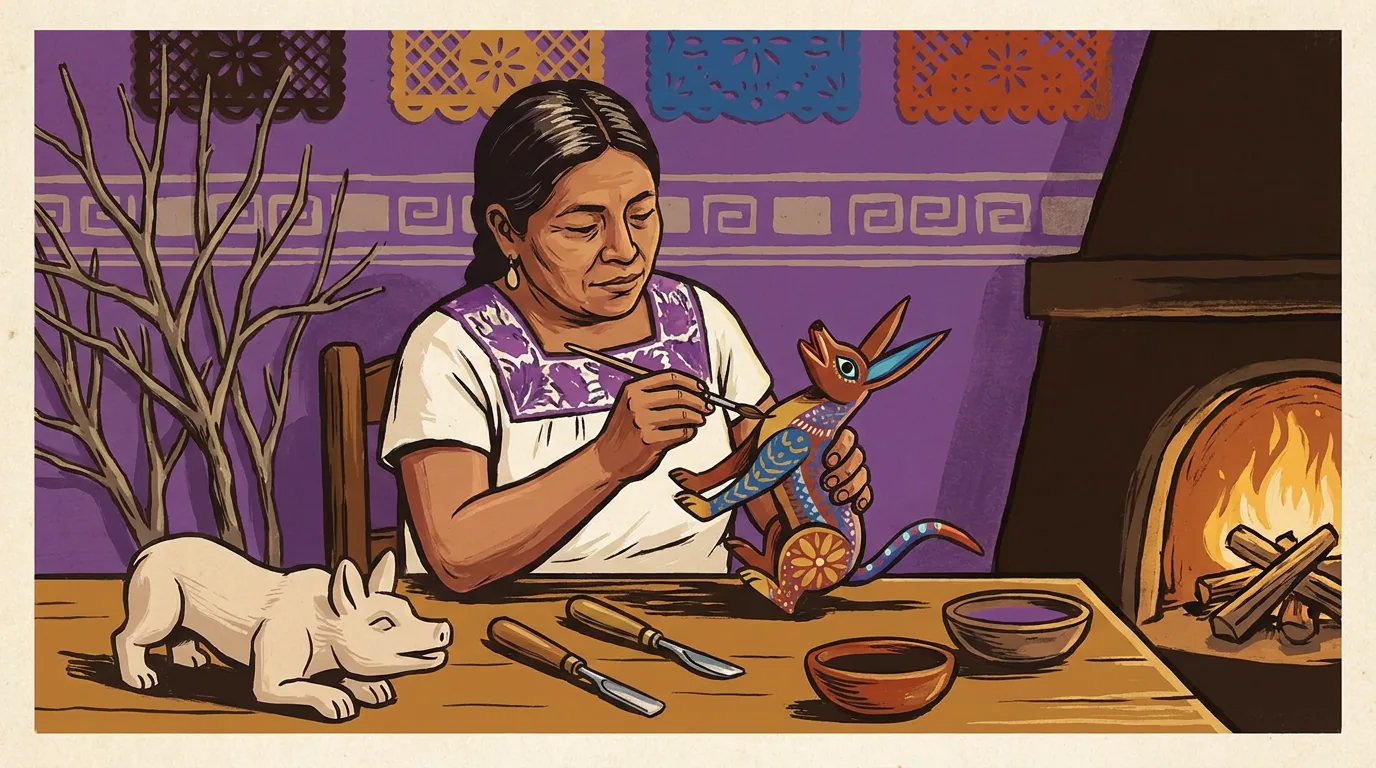
Before it has turquoise fangs, dotted wings, or a tail that seems to remember some dream, the figure is a piece of copal on a table. Someone looks at it, turns it, and finds in its knots a head, a back, perhaps an animal that does not exist but was already making noise inside. In workshops in San Martín Tilcajete, San Antonio Arrazola, and other communities in Oaxaca’s Central Valleys, that conversation between wood, knife, and color can last weeks or months. The result is often called an alebrije, although the history of the word and that of the Oaxacan craft did not begin in the same place.
One Name, Two Histories
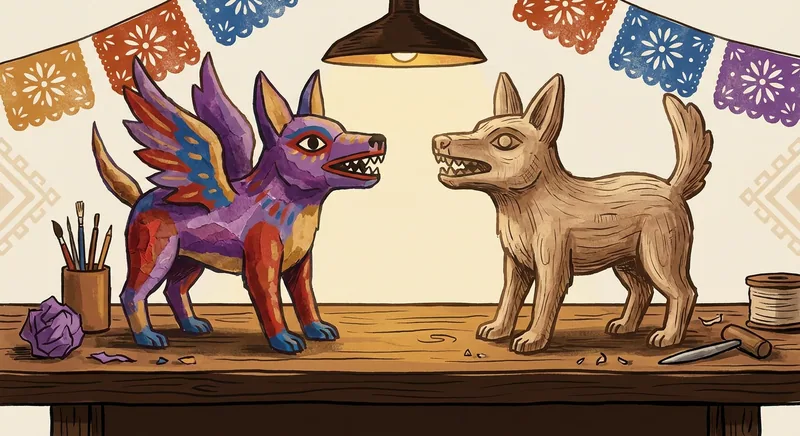
Alebrijes emerged in Mexico City in connection with Pedro Linares López, a master cartonero born in 1906. According to the most widely told family account—an oral history, not a notarized record of the dream—during an illness in the 1930s Linares saw hybrid creatures shouting the word “alebrije”; afterward, he shaped them from cardboard and papier-mâché. His fantastic beings belong to the cartonería tradition: a wire or reed frame, paper, paste, and paint. It is worth pointing this out because a cardboard creature from Mexico City and an Oaxacan copal carving are related by name, not twins from the cradle.
Woodcarving had long existed in Oaxaca, producing toys, masks, animals, saints, and objects for ceremonial or domestic use. During the second half of the 20th century, families in the Central Valleys expanded that practice into decorative and fantastic figures intended for new markets. Manuel Jiménez Ramírez, from San Antonio Arrazola, is recognized as a pivotal pioneer of these carvings; later, numerous workshops developed styles of their own. The name “alebrije” eventually came to encompass many of these pieces, although several artisans and scholars prefer to say “woodcarvings” or “copal figures” so as not to erase their local genealogy.
The Tree Is Not a Warehouse
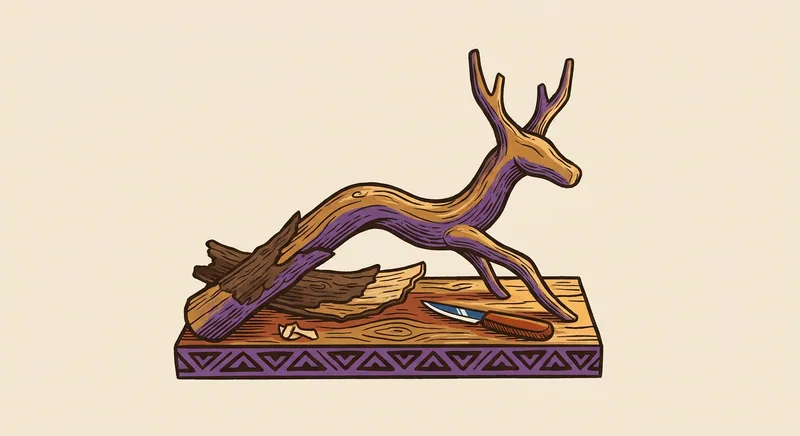
The copal used by many workshops belongs mainly to the genus Bursera, a group of resinous trees found in Oaxaca’s dry forests. It is not industrial lumber cut into perfectly squared boards: its curved branches, forks, and changes in thickness suggest poses and volumes. The carver may see splayed legs in a fork or the neck of a creature in a twisted branch. Here the design is not completely imposed; it negotiates with what the tree left written in the grain.
Selection begins with the wood’s size, shape, moisture, and condition. Traditionally, freshly cut material has been used because it is softer for rough shaping, but sourcing now requires special care: commercial demand has put pressure on wild populations and led to efforts promoting nurseries, reforestation, and responsible management. Some workshops grow copal, purchase wood from controlled sources, or take part in planting events. Planting does not automatically make up for cutting—the forest does not practice creative accounting—but it is part of an essential commitment to the craft’s continuity.
It is also important to know that “copal” refers both to various trees and to the aromatic resin obtained from some species. Here we are talking about the wood, not a block of incense miraculously transformed into a jaguar. Species and practices can vary among communities and workshops, so there is no single recipe for all of Oaxaca. Asking where the material came from is a good way to see the piece beyond its painted surface.
The alebrije’s first line is not drawn by the brush: it was already growing in the branch.
Knife, Patience, and Shade
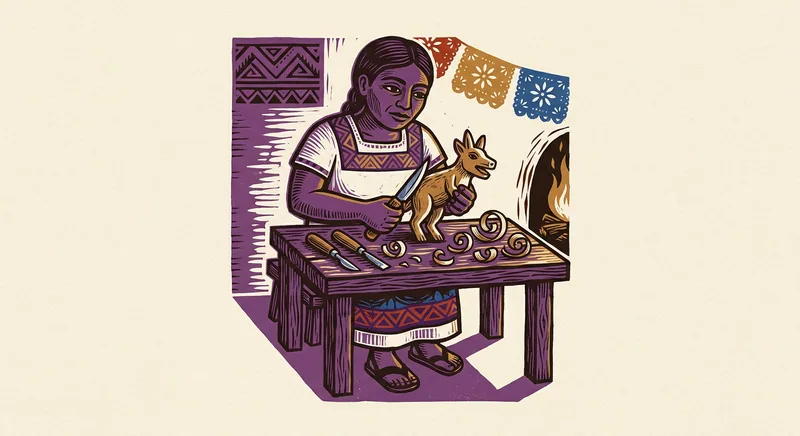
Once the piece has been selected, some of the bark is removed and rough shaping begins. A machete, knife, chisel, and gouge may be used depending on the size, detail, and customs of the workshop; the tools are not a mandatory uniform. The large volumes emerge first: torso, head, legs, snout, wings, or horns. Then come the smaller curves and transitions that make the animal look ready to leap, snort, or ask for a place on the shelf.
Many figures are made from a single piece, while others incorporate ears, tails, wings, or antlers crafted separately. These parts can be joined with dowels and adhesives, making sure the assembly is sturdy and visually seamless. Perfect symmetry is not always the goal: a slight tilt or one leg set forward can bring more life than flawless geometry. Carving is as much about removing wood as it is about knowing when to stop before the coyote ends up as toothpicks.
- 1Select a branch or section of copal for its shape, size, moisture, and condition.
- 2Remove the bark and rough-shape the piece to define the main volumes.
- 3Carve features, legs, and textures with a knife, chisel, or gouge.
- 4Craft and assemble separately any parts that require it.
- 5Let the piece dry slowly, protected from direct sunlight.
- 6Fill cracks, sand, and prepare the surface for color.
- 7Sketch the design, paint in layers, and finish the fine details.
Once the initial carving is finished, the wood must dry. The time depends on its thickness, moisture, and the climate, but it can take several weeks and even months for large pieces; rushing the process under intense sun encourages warping and cracks. Because copal loses water and contracts, some fissures are common and are filled with mixtures or pastes that each workshop prepares in its own way. The surface is then sanded and, when the style calls for it, a base coat is applied to even out the background without completely erasing the carver’s hand.
The skin is invented through color
Paint transforms the carved volume into another kind of presence. Many workshops use acrylic paints for their intensity, fast drying time, and durability, although there are also research efforts and projects reviving natural dyes. A general background color may be applied first; over it, spots, bands, and fields of color are arranged to guide the design. By this point, the animal already has skin, but it still lacks that visual shimmer the eye recognizes from afar.
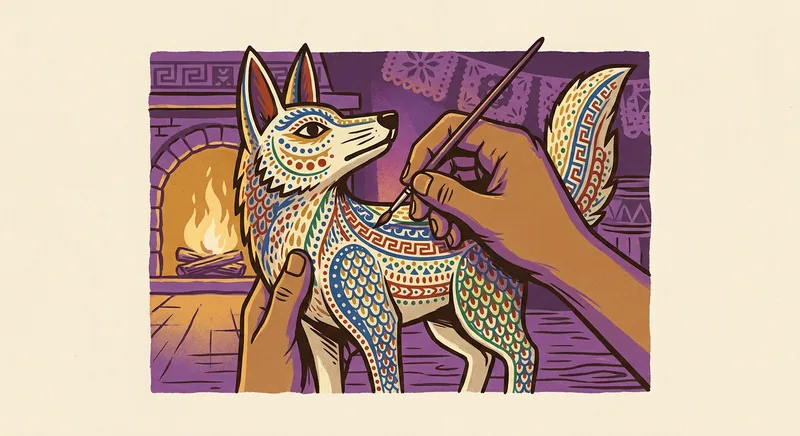
That effect comes from the details: dots, scales, grecas, flowers, crosshatched lines, and tiny rhythms drawn with fine brushes. The patterns may be in dialogue with plants, animals, textiles, architecture, or regional graphic repertoires, but not every motif is an “ancestral symbol” with a secret translation. Sometimes a row of dots is a formal decision, a color solution, or a family’s visual signature. Saddling every diamond with pre-Hispanic mystery may sell postcards, but it does not help us understand contemporary work.
The division of labor varies from home to home. One person may imagine, carve, and paint the entire figure; in other workshops, someone specializes in knife work, another hand prepares and fills cracks, and one or more painters create the intricate designs. Women have often been the ones who decisively transformed the painted surface, although for years the market placed the carver’s name front and center and left other creators in the fine print. Asking who completed each stage does not break the spell: it restores names and labor to the piece.
Not all alebrijes have to be fierce or combine half the animal kingdom in a single body. There are serene rabbits, compact armadillos, alert dogs, and hybrid creatures that look as though they ate an entire rainbow for breakfast. Value does not depend solely on how many colors fit into a centimeter, but also on the carving, balance, quality of the joinery, command of the pattern, and coherence of the piece. A simple, well-executed figure can have more character than a dragon carrying too much baggage.
Looking is also recognizing
Buying a carving means entering, if only for a moment, a network of forest, family, tools, learning, and commerce. It is wise to look for signed pieces or ones accompanied by information about the workshop, ask who carved and painted them, and learn where the copal came from. The price reflects size and detail, but also weeks of drying, years of practice, materials, middlemen, and reputation. Haggling for sport over a painstakingly crafted work is a remarkably effective way to take the figure home while leaving respect behind.
To preserve it, it is best to avoid direct sunlight, extreme humidity, sudden changes in temperature, and cleaning with harsh products. A dry cloth or soft brush is usually enough to remove dust; removable pieces should be handled by the body, not by the ears, tails, or horns. The wood continues to respond to its environment even after it has been painted, so a small change does not always spell disaster. If a significant crack appears or a joint comes loose, it is best to consult the workshop or a specialist before summoning the all-purpose glue.
The copal alebrije is neither a relic frozen in time nor an illustration of an eternal Oaxaca. It is living folk art: it engages with markets, museums, collectors, designers, environmental crises, and new generations experimenting with creatures and languages of their own. Its strength lies in that blend of continuity and invention, not in some supposed intact purity. Every well-made piece holds a double memory: the shape a branch once had in the forest and the shape that a pair of hands was able to discover within it.
- Barbash, Shepard. Oaxacan Woodcarving: The Magic in the Trees. Chronicle Books, 1993.
- Chibnik, Michael. Crafting Tradition: The Making and Marketing of Oaxacan Wood Carvings. University of Texas Press, 2003.
- International Folk Art Market. “Manuel Jiménez Ramírez,” profile and materials on Oaxacan wood carving.
- Museo de Arte Popular, Mexico City. Collections and institutional materials on Pedro Linares and Mexican cartonería.
- Comisión Nacional para el Conocimiento y Uso de la Biodiversidad (CONABIO). Enciclovida: entries on the genus Bursera and species known as copal.