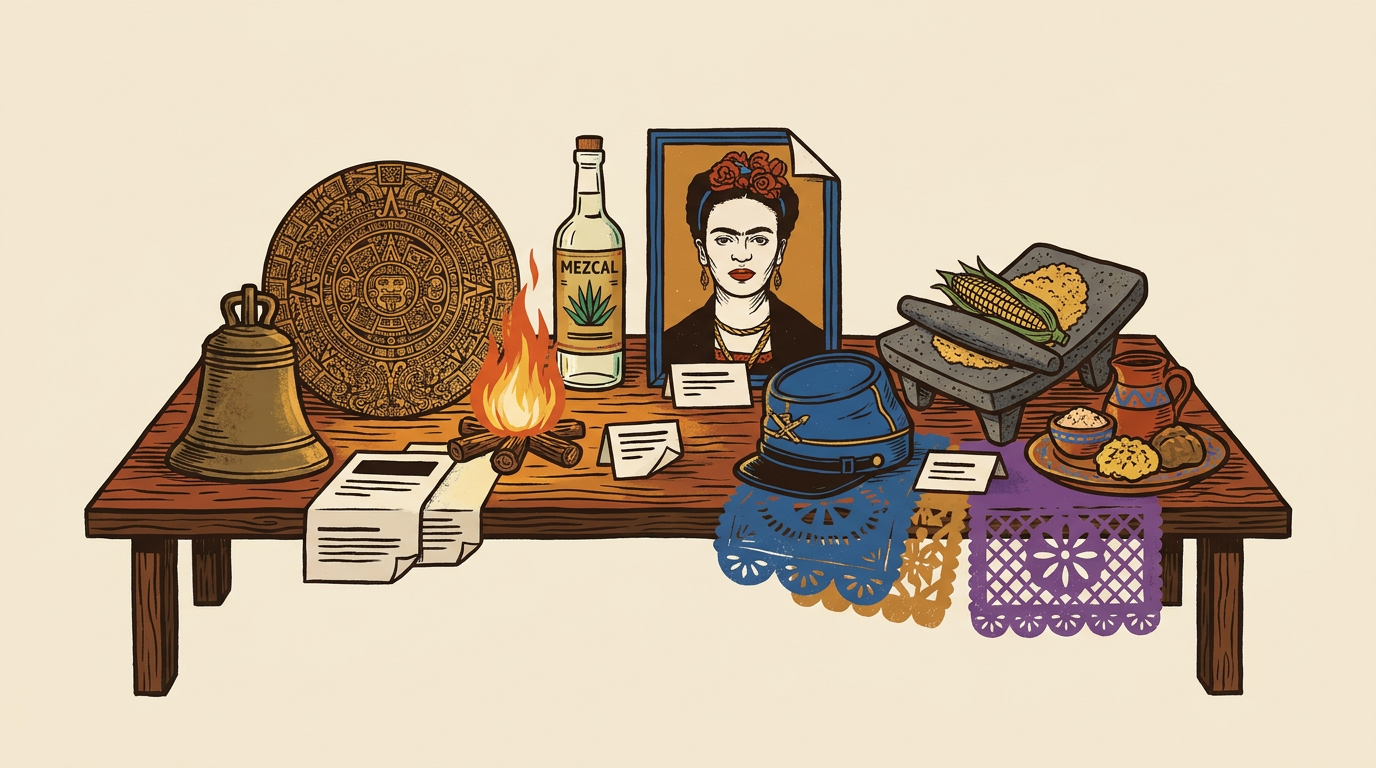
National history often arrives gift-wrapped: heroes without doubts, age-old traditions, and objects that mean exactly what the plaque says. The problem is not that everything is false, but that memory trims, blends, and rearranges things until it produces narratives cleaner than the past. The following seven cases contain real facts, but also omissions, ceremonies invented later, and plenty of marketing. Revisiting them does not diminish Mexico: it makes the country more interesting and, along the way, peels a few holy cards off our foreheads.
Bells, Stones, and a Retouched Night
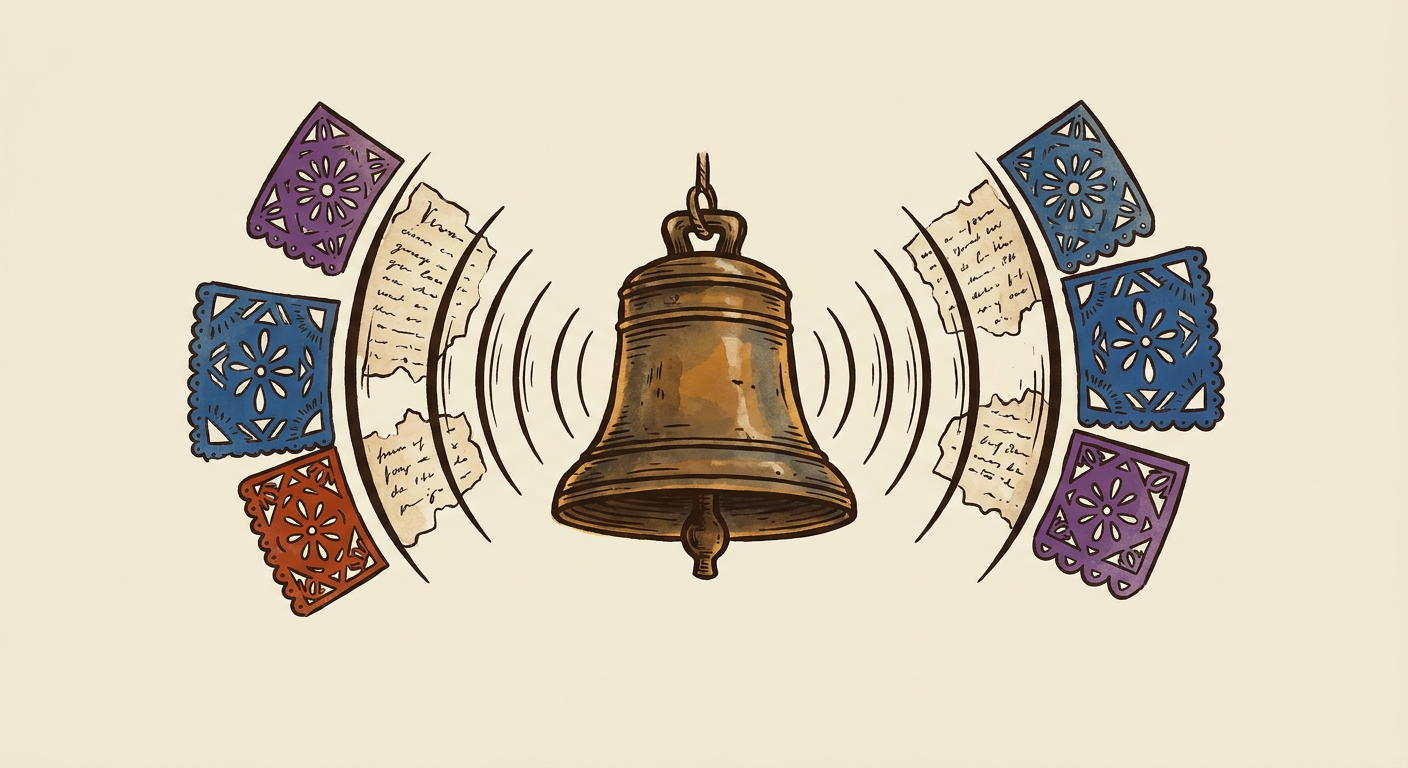
The first myth says that we know the exact words of the Grito de Dolores. In fact, there is no reliable contemporary transcription of what Miguel Hidalgo said in the early hours of September 16, 1810. Later accounts agree that he called for rebellion and cried out religious and monarchist vivas, probably to the Virgin of Guadalupe and Fernando VII; they do not substantiate the script recited today by every president. Even the ceremonial date was adjusted: the civic commemoration on the night of the 15th became established during the 19th century, not because of Porfirio Díaz’s supposed birthday whim, although his regime turned it into a grand spectacle in 1910.
There was no Grito written for national television: there was an insurgent harangue that each era voiced anew in its own way.
The second myth fits inside a souvenir shop: calling the Sun Stone the “Aztec Calendar” and assuming it served as the Mexica empire’s wall clock. The enormous monolith, carved around the Late Postclassic period and discovered in 1790, does contain calendrical signs, including the twenty days and references to cosmogonic eras. But specialists understand it better as a ritual and political monument linked to the Sun, sacrifice, and imperial power, not as an everyday timekeeping tool. Simply saying that it “did not measure time” would also be misleading: it represents a calendrical conception of time, even if it did not function as a stone almanac.
The Spirit That Crossed the Pacific
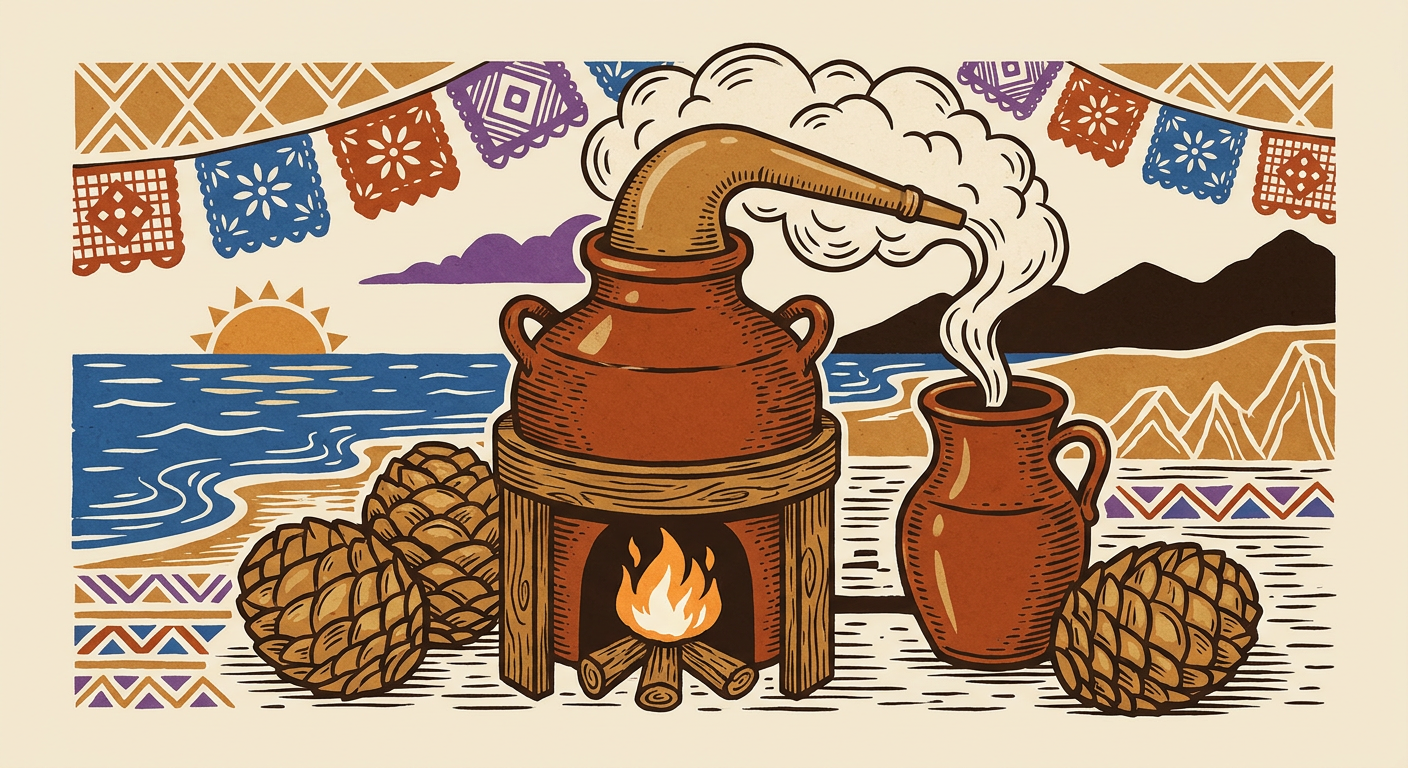
The third myth claims that tequila sprang fully formed and all on its own from a pre-Hispanic practice. Before the conquest, agave juices were fermented to produce drinks such as pulque, but there is no consensus that would allow us to attribute to Mesoamerican peoples the large-scale distillation of agave that gave rise to historical mezcales. Asian still technology reached the western coast of New Spain with Filipino workers and sailors connected to the Manila Galleon, especially from the late 16th century onward. Those devices were used to make coconut aguardiente and may have been adapted for agave; at the same time, European-style stills were also in circulation, meaning the origin was a confluence rather than a revelation that came in a single afternoon.
Tequila emerged much later as a regional variety of mezcal produced around Tequila, Jalisco, and was eventually regulated through a designation of origin in the 20th century. Its modern profile depended on haciendas, factories, railroads, government regulations, and advertising campaigns, as well as blue agave. Without the trans-Pacific route, the technical history of spirits in western Mexico would have been different; however, saying that “Filipinos invented tequila” erases four centuries of local adaptations. The Asian secret is real, but it does not need to be dressed up as an exclusive patent to be fascinating.
Heroes, Painters, and Image Campaigns
The fourth myth is not that Frida Kahlo lacked talent, but the pretense that her current fame arose spontaneously, was purely grassroots, and was always greater than that of her contemporaries. Kahlo shaped a public image with enormous intelligence through self-portraits, Tehuana clothing, photography, and international cultural networks; that clothing expressed political affinities and a carefully fashioned mestiza identity, but it also circulated within the postrevolutionary project of “Mexicanness.” André Breton, gallery owners, collectors, museums and, decades later, publishers, film, and global brands expanded her image until she became a reproducible icon. Calling all of that an elite deception robs the artist herself of agency and mistakes a documented career for a conspiracy.
It is also unfair to portray Dr. Atl as a hidden “true genius” passed over in her favor, as if art had an Olympic podium. Gerardo Murillo, Dr. Atl, was a painter, writer, promoter of muralism, passionate scholar of volcanoes, and inventor of pigments called Atl-colors; he enjoyed considerable institutional recognition and had a formidable public career. His nationalism, political views, and sympathy for fascism rightly complicate any purely celebratory reading. Rather than uncovering a censored genius, it is worth asking why the contemporary market turned Kahlo’s biography and face into a commodity easier to sell than Atl’s volcanic landscapes.
- 1Fact: Kahlo actively participated in creating her public image.
- 2Nuance: Indigenous clothing had aesthetic, political, personal, and social dimensions; reducing it to a “costume” repeats the contempt it purports to denounce.
- 3Fact: Kahlo’s international recognition began during her lifetime, but her worldwide canonization accelerated after the 1970s.
- 4Fact: Dr. Atl was not erased; he figures in the history of Mexican art, although today his image sells fewer notebooks and socks.
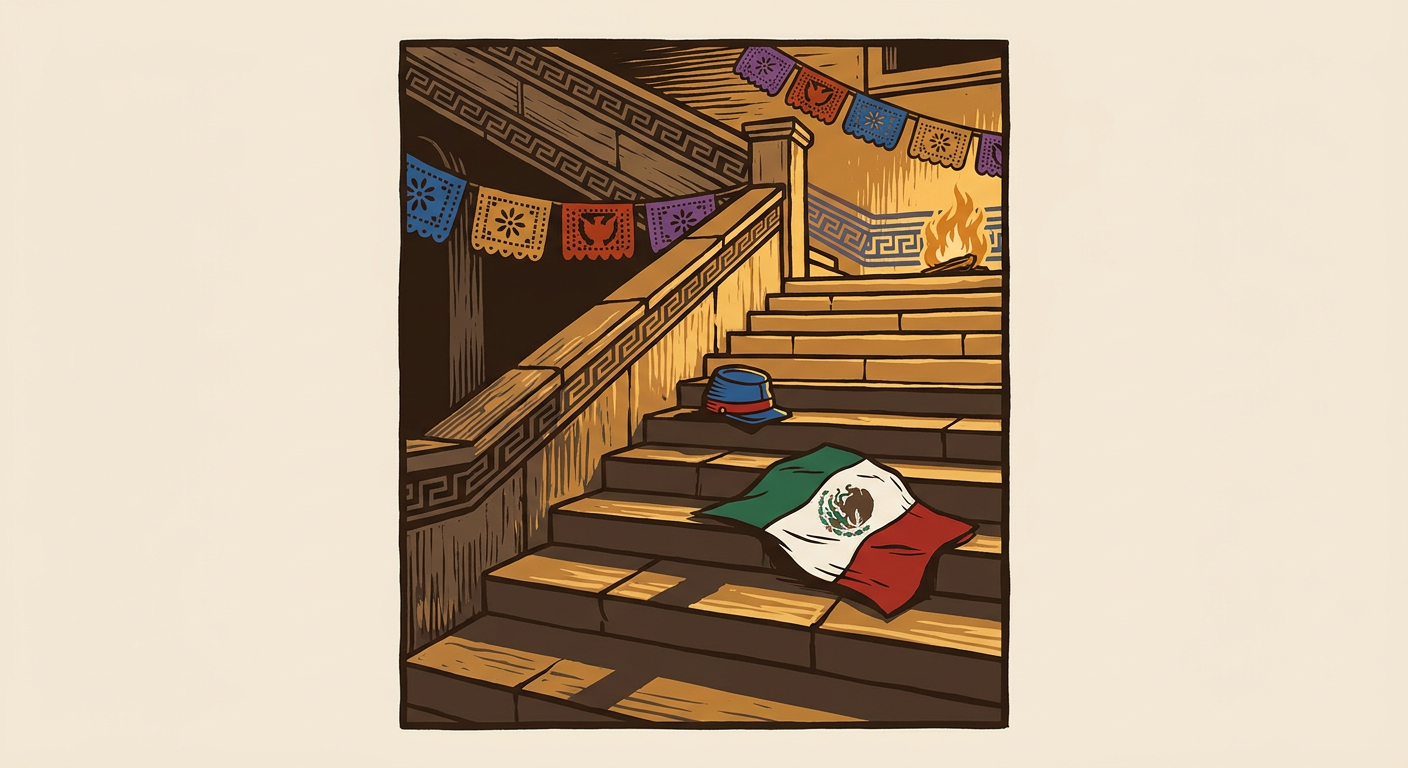
The fifth myth holds that the Niños Héroes were a complete invention. The Battle of Chapultepec did take place on September 13, 1847, during the US invasion, and cadets from the Military College died, among them the six names commemorated: Juan de la Barrera, Juan Escutia, Agustín Melgar, Fernando Montes de Oca, Vicente Suárez and Francisco Márquez. What belongs to legend is the perfectly choreographed account: that they were the only defenders, that they refused as a group to retreat and, above all, that Escutia wrapped himself in the flag and leaped to prevent its capture. There is no solid contemporary evidence of that leap; the civic cult that followed turned a painful defeat into an exemplary sacrifice.
Neither mole is a fossil nor the ofrenda an eternal display case
The sixth myth appears whenever a menu announces “authentic pre-Hispanic food” alongside ingredients that arrived after 1519. Mesoamerica contributed nixtamalized corn, beans, squash, chile, tomato, cacao, vanilla, avocado, turkey and fundamental tools and techniques such as the comal and metate. But the Mexican cuisine we recognize today was also shaped by wheat, rice, sugarcane, citrus fruits, beef, pork, chicken, dairy products, Asian spices and African and European practices. A carnitas taco, a chile en nogada or many moles are not intact survivals from the world before the conquest: they are the delicious, contentious and very Mexican children of colonial exchange.
Nor does that mean that all Indigenous continuity is invented. Nixtamalization, tortillas, tamales, numerous quelites and many communal ways of producing and eating food retain extremely ancient roots, even though their utensils, fillings or contexts have changed. The mistake lies in imagining tradition as an insect trapped in amber. A living cuisine preserves, substitutes, blends and sometimes boasts of a pre-Hispanic grandmother when it barely knew a 19th-century aunt.
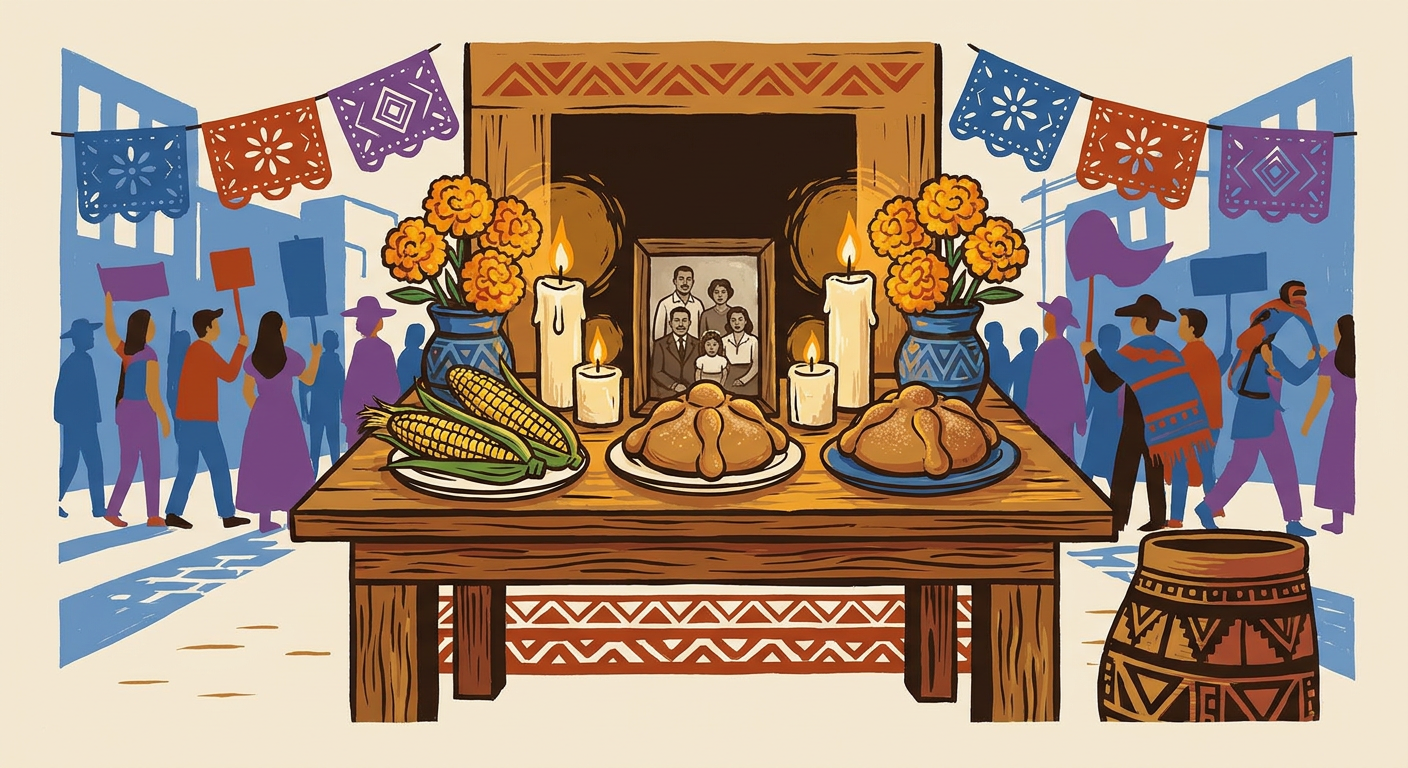
The seventh myth says that today’s Day of the Dead is an intact pre-Hispanic ceremony, preserved for five hundred years and later recognized by the world just as it had always been. In reality, Mesoamerican societies practiced various rites and festivals dedicated to the dead, but the calendar and several elements of the contemporary celebration became intertwined with the Catholic observances of All Saints’ Day and All Souls’ Day. Home altars, cemetery visits, flowers, candles, foods, printed images of skulls and regional customs came together unevenly over time. There is no single national version: a Purépecha ofrenda, a Yucatec Maya celebration and an urban school altar are not interchangeable pieces.
The “scam,” if one wants to use the word, lies in selling that diversity as a homogeneous ancestral package. The postrevolutionary state, tourism, schools, the media and commerce helped establish a national image; more recently, Mexico City’s massive parade, launched in 2016, showed that a tradition can also be born after a film imagines its spectacular version. The inscription of the Indigenous festival dedicated to the dead on UNESCO’s list of intangible cultural heritage, originally proclaimed in 2003 and incorporated into the Representative List in 2008, recognizes living community practices; it does not certify pre-Hispanic purity. The fact that a custom changes does not make it false: it makes it a custom.
Tradition is not the opposite of change: it is the way a community chooses to remember as it changes.
Debunking myths does not mean replacing patriotic bronze with after-dinner cynicism. Hidalgo did launch a decisive insurrection; the Sun Stone does speak of sacred time; the cadets did die; Frida did produce a powerful body of work; Indigenous cuisines and festivals of the dead do preserve deep continuities. What is unnecessary is the need to make every story pure, immutable and ready to be printed on a mug. Mexico loses none of its greatness when its seams are visible: through those seams came ships, ingredients, interests, sorrows and voices, and that is where memory continues its work.
- Enrique Florescano, Historia de las historias de la nación mexicana, Taurus, 2002.
- Eduardo Matos Moctezuma and Felipe Solís, El calendario azteca y otros monumentos solares, Conaculta/INAH, 2004.
- Paulina Machuca, El vino de cocos en la Nueva España: historia de una transculturación en el siglo XVII, El Colegio de Michoacán, 2018.
- Hayden Herrera, Frida: A Biography of Frida Kahlo, Harper & Row, 1983.
- Claudio Lomnitz, Idea de la muerte en México, Fondo de Cultura Económica, 2006.