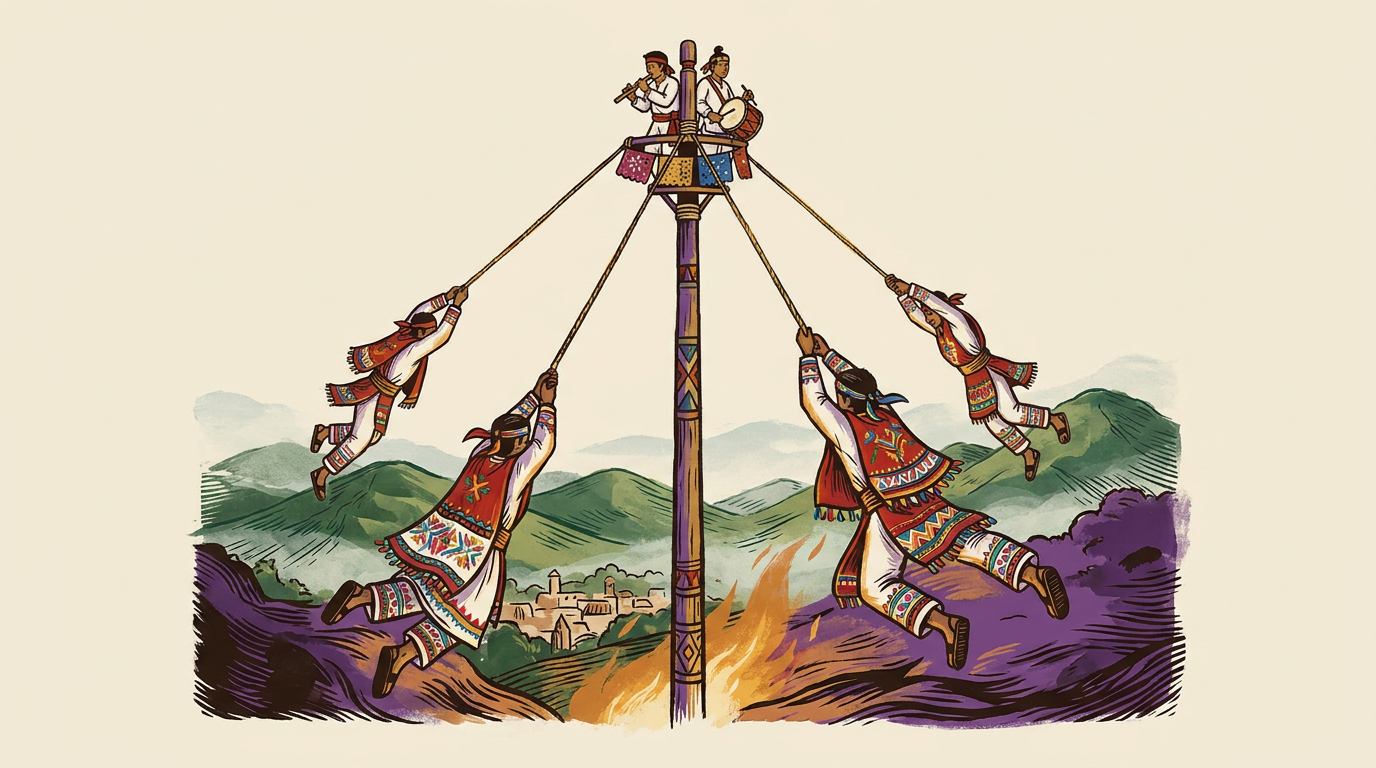
First comes the flute, high-pitched like a bird calling from the hills. Then the drum answers, and five men climb a pole that may stand around 20 meters tall: one remains at the top, playing and dancing on a narrow square platform; the other four surrender to the void, secured by ropes, tracing a spiral around the trunk. The Voladores de Papantla ceremony is not merely a feat of skill or a spectacle for the camera. It is a ritual plea, a way of ordering the world, and living knowledge that connects music, dance, territory, and community memory.
A Ceremony with Deep Roots
Although it is often immediately associated with Papantla and the Totonac people, the Voladores ceremony belongs to a broader Mesoamerican tradition. Historical accounts and colonial-era images document aerial dances among different peoples of central and eastern Mexico, with Nahua, Teenek, Otomí, and Totonac variations. There is no single, verifiable date for its birth: its roots are pre-Hispanic, but the practice we see today took shape over centuries of adaptation. To claim that it all began in a specific year would be like issuing a birth certificate to a cloud.
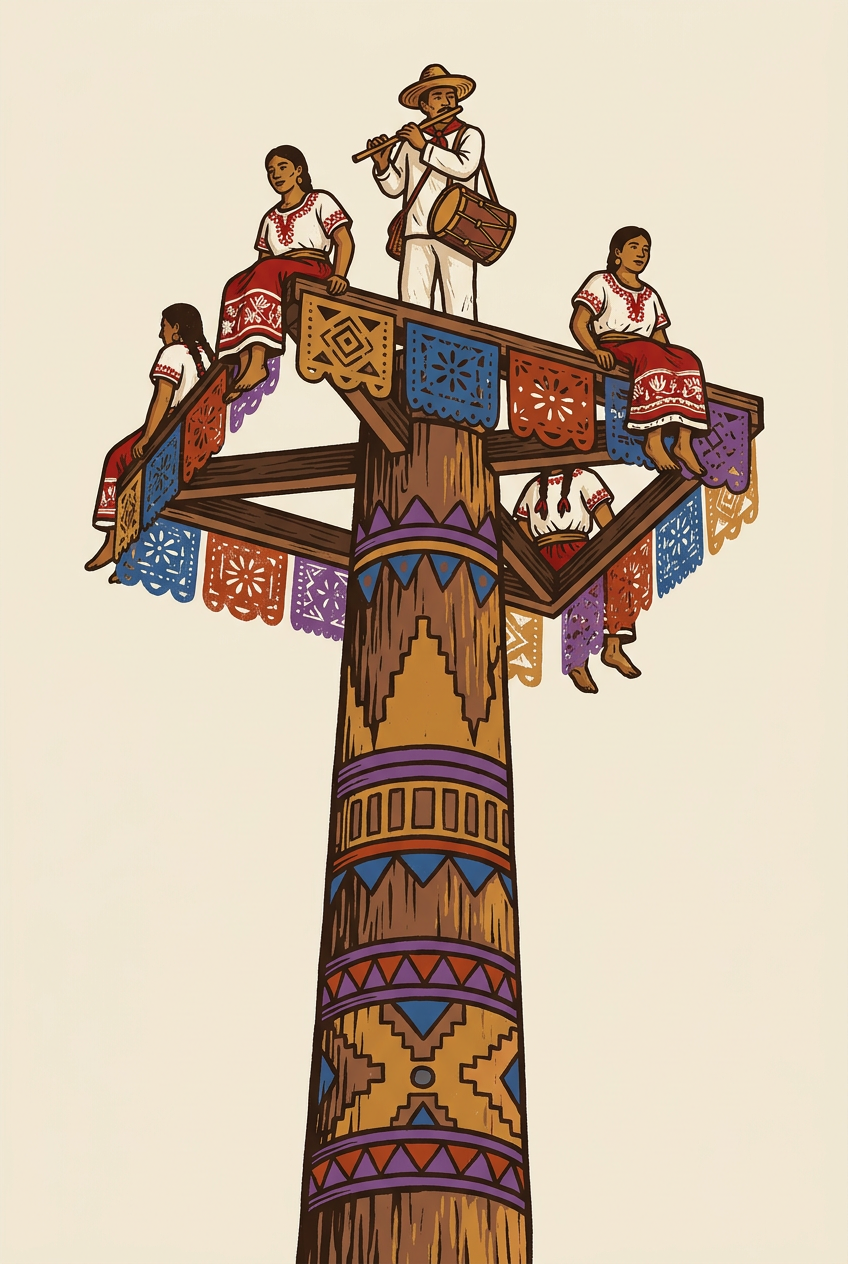
Papantla, in northern Veracruz, is one of the main centers where this tradition was preserved and developed a particularly strong public identity. The Totonacapan region—which encompasses areas of Veracruz and Puebla—was home to societies with ancient cities, trade networks, and a complex ritual life; El Tajín is its most celebrated archaeological landmark, though no simple line should be drawn between its reliefs and the ceremony as practiced today. Cultural continuity is not a highway without curves: it includes ruptures, exchanges, and reinventions. That is precisely why the ritual remains alive rather than frozen in a display case.
Why Do They Fly?
The traditional purpose of the ceremony is tied to fertility, rain, and the balance between the community, nature, and the sacred realm. A widely shared oral tradition tells how, during a drought, five young men sought out a tall tree and performed the ritual to ask for water and prevent hunger. It is an origin legend, not a verifiable historical fact, but it clearly expresses the deeper logic of the flight: to ascend and address the celestial forces, then descend, carrying the plea toward the earth. It is not about tempting gravity for the thrill of it, but about speaking with the cosmos through the body.
The caporal stands at the top and simultaneously plays a small reed flute and a drum. In traditional interpretations, the music summons and represents the forces of nature; his dance, oriented toward the cardinal points, establishes a symbolic center. The four voladores, positioned around the frame, represent the four directions of the world, while the pole serves as a vertical axis between earth and sky. Each community and each teacher may explain the symbols with nuances of their own, so it is best to avoid overly perfect translations: ancient rituals rarely fit neatly into an infographic.
- 1To ask for rain and fertility for the land.
- 2To honor the four directions and a center that brings the universe together.
- 3To give thanks and foster the continuity of community life.
- 4To pass down discipline, music, language, memory, and responsibility from one generation to the next.
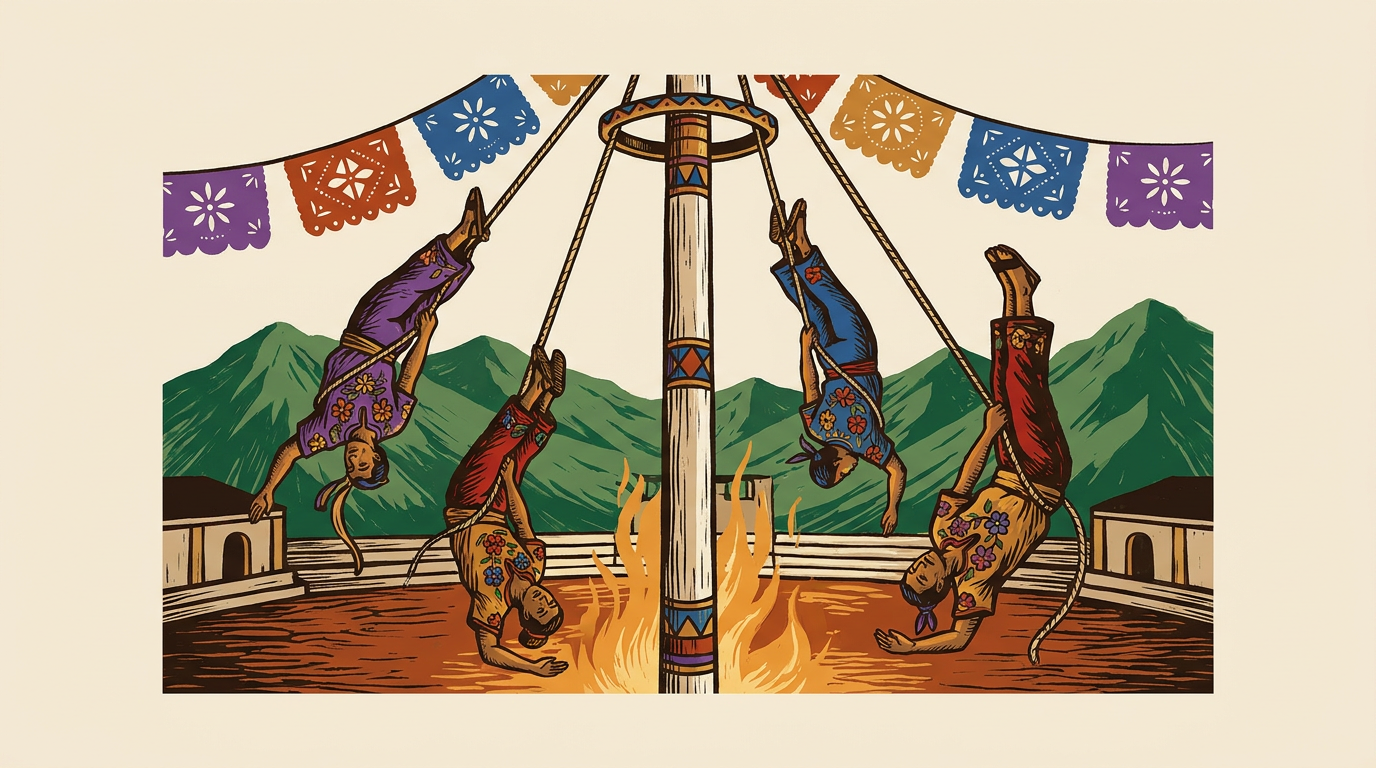
“To fly is not to fall: it is to complete a turn and return to the earth.”
The Art of Holding Up the World
The ceremony’s artistic dimension emerges from the coordination of many crafts. There is the music, simple in its instrumentation but demanding in rhythm and memory; there is the caporal’s dance, performed at a height where anyone’s knees would be begging for mercy; there are the knots, the handling of the ropes, and the physical understanding of the spin. The selection and preparation of the pole, ceremonial protocols, and the making of the attire also play a part. The result is a collective work: no one flies alone, even if it looks that way from below.
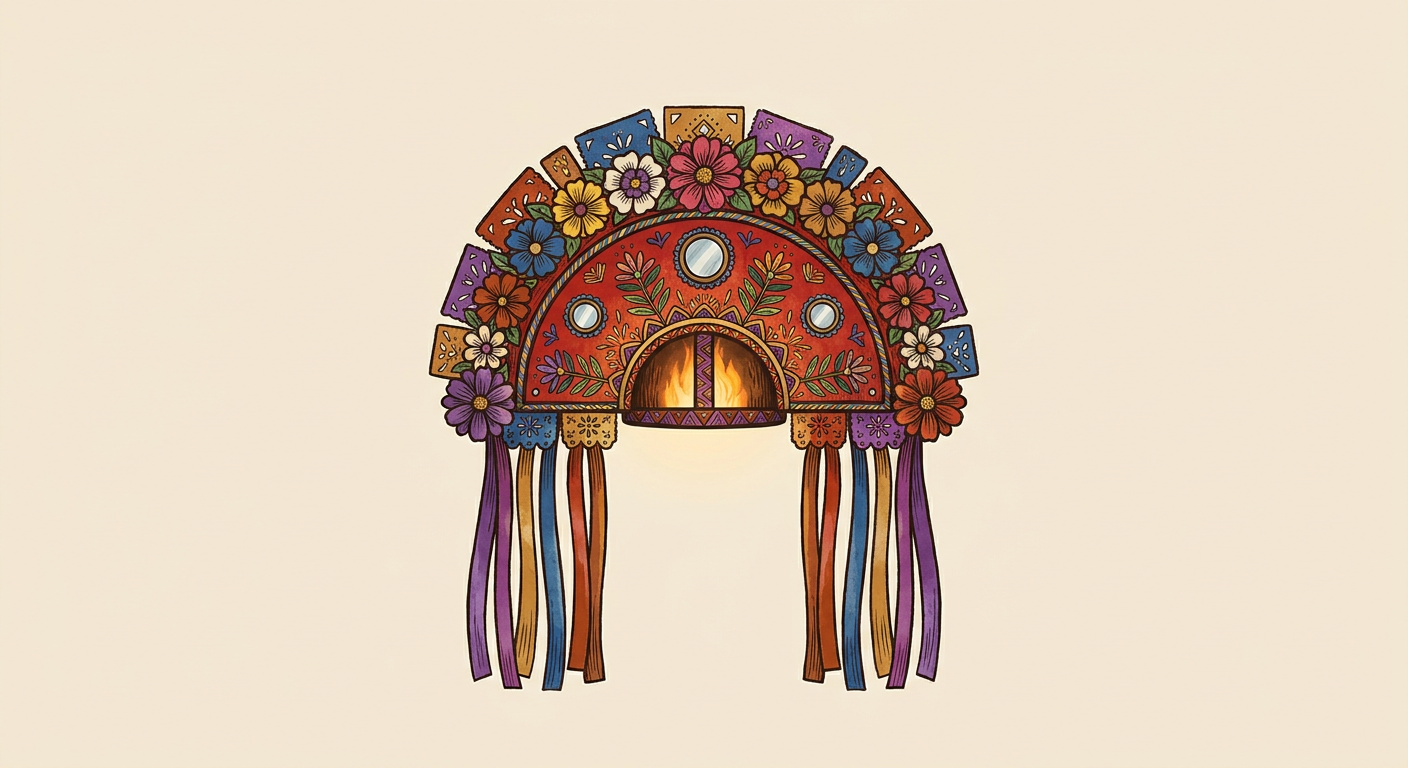
The most recognizable costumes of the Voladores de Papantla feature white pants, a white shirt, ankle boots, red velvet shorts or breeches, and a bib embroidered with flowers, birds, or other plant motifs. The semicircular headdress, adorned with artificial flowers, ribbons, and mirrors, adds movement and shine; according to traditional explanations, it may evoke the sun and vegetation. Today’s attire is not an untouched copy of the pre-Hispanic world: it incorporates materials, forms, and techniques from later periods. Its value lies precisely in that stitched-together history, not in some supposed purity without patches.
Training begins on the ground and may include prayer, respect for the pole, musical instruction, physical conditioning, and a gradual mastery of heights. A volador learns to trust his companions and to understand that the rope is no substitute for discipline. Community schools such as those associated with the Centro de las Artes Indígenas, in the Totonacapan, have strengthened transmission among girls, boys, young people, and elders. In recent years, women’s participation has also grown, though not without internal debate, as happens when a living tradition reexamines who may represent and inherit it.
Living heritage, not a fairground act
The presence of voladores in plazas, festivals, and archaeological sites provides income and visibility, but it also raises an uncomfortable question: what is lost when the rite is presented only as an attraction? Not every performance is a desecration; the groups themselves decide how, where, and for whom they fly, and many performances allow them to support their families and teach the tradition. The problem arises when its ceremonial nature is erased, when people haggle over financial contributions, or when the voladores are used as decoration for someone else’s event. Watching respectfully means recognizing the voladores as bearers of knowledge, not as feathered props.
Continuity also depends on the territory. Traditionally, tall, straight trees were used, and their selection, cutting, and transport could be accompanied by offerings and ritual permissions; today, permanent metal poles are common for reasons of safety, availability, and regulation. The loss of forests and suitable species affects a fundamental part of the knowledge associated with the ceremony. Protecting the flight therefore means protecting the ground that makes it possible: language, community, ecosystems, and dignified conditions for its practitioners.
- 1Avoid interrupting preparations, music, or offerings to take a photograph.
- 2Make a fair contribution when the group requests one, and do not haggle over their work.
- 3Do not touch the ropes, pole, altar, instruments, or attire without permission.
- 4Listen to how each community explains its ceremony, rather than imposing a single version.
- 5Share images with context and name the group or community whenever possible.
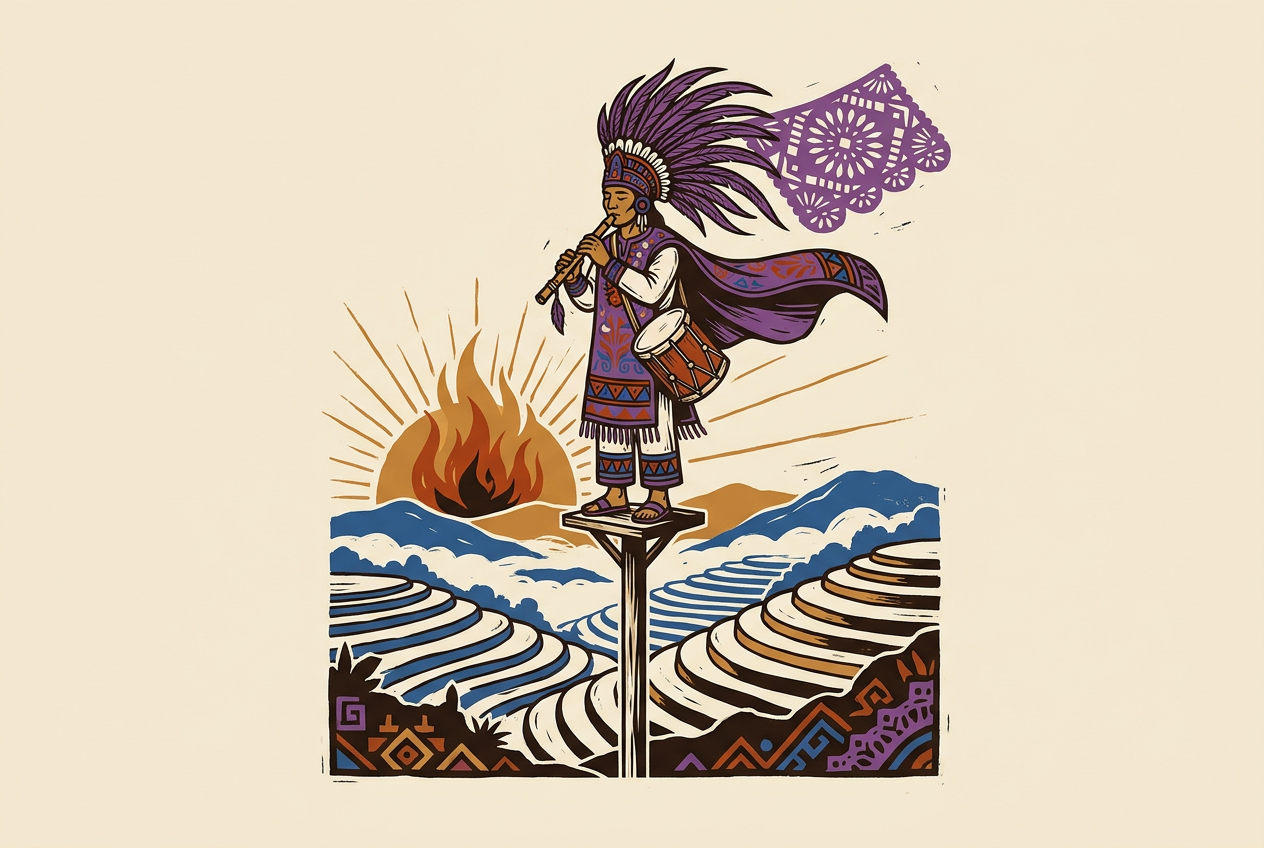
And so, asking what the Voladores de Papantla are for leads to an answer greater than rain. The ceremony calls for fertility and balance, but it also builds community, passes on knowledge, marks belonging, and sustains an ethical relationship with the territory. With each descent, the bodies turn toward the earth from which they set out: they do not escape the world, but return to it with measure, music, and memory. Perhaps that is their most enduring purpose: to remind us that no one touches the sky without owing something to the ground.
- UNESCO, “The Ritual Ceremony of the Voladores,” Representative List of the Intangible Cultural Heritage of Humanity, inscribed in 2009.
- Instituto Nacional de Antropología e Historia (INAH), public outreach materials on the ritual ceremony of the Voladores and the Totonacapan.
- Centro de las Artes Indígenas, Parque Takilhsukut, documentation on the Casa de los Voladores and the transmission of Totonac heritage.
- Guy Stresser-Péan, Le Volador chez les Indiens du Mexique et de l'Amérique Centrale, Institut d'Ethnologie, 1936.