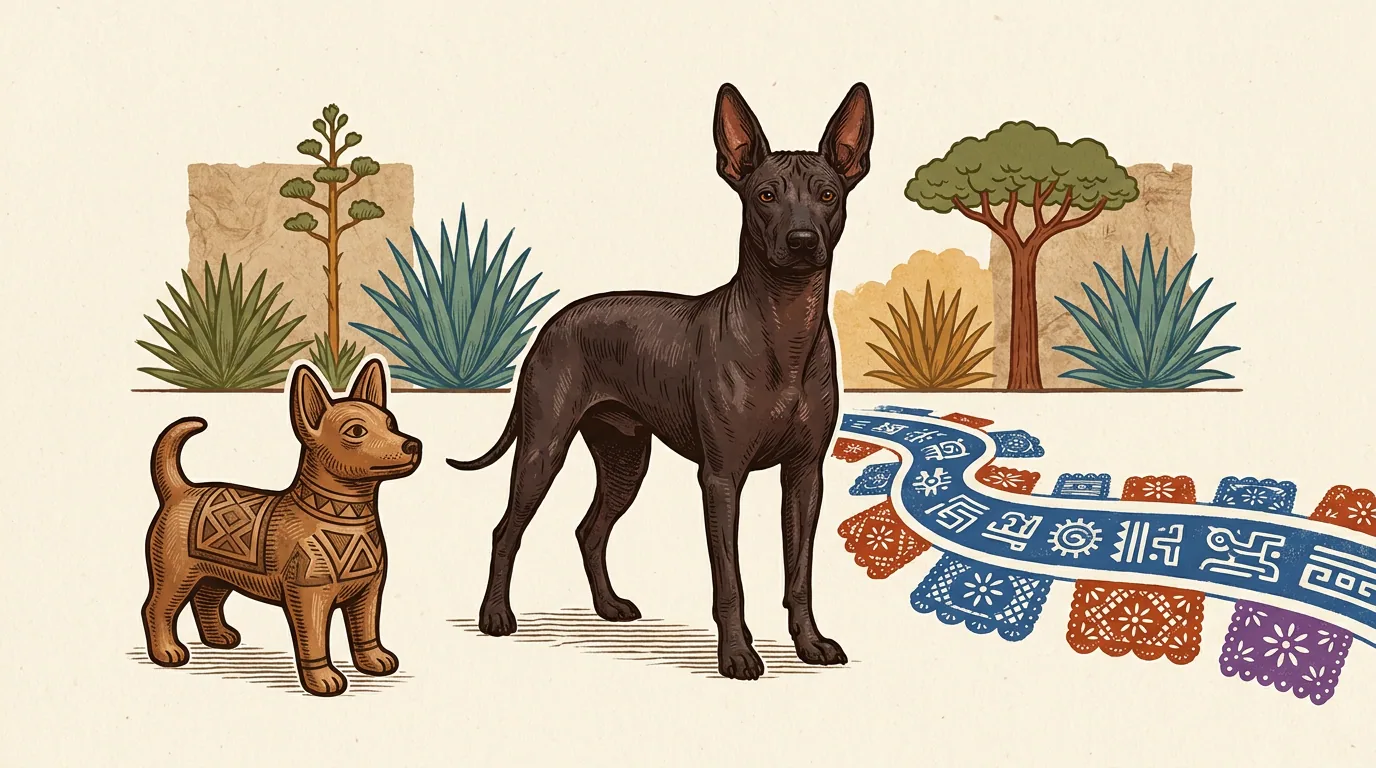
Before taking on the title of “Aztec dog” and posing very seriously at dog shows, the xoloitzcuintle was already accompanying the peoples of Mesoamerica. Its nearly hairless body, alert ears and warm skin made it a domestic, ritual and deeply symbolic animal. It was not a pet in the modern sense: it shared homes, food, burials and stories about human destiny. Fortunately, its history is far more interesting than the cliché of simply calling it the “guardian of the underworld.”
A name with teeth
The word xoloitzcuintle comes from Nahuatl and is commonly explained as the combination of Xólotl, the name of a deity, and itzcuintli, “dog.” In Mexican Spanish we also use xolo, a practical abbreviation for a word that puts the tongue to work. Although today it is associated mainly with the hairless variety, colonial sources used Nahuatl terms to distinguish among several types of dogs. In other words, not every itzcuintli was necessarily the hairless xolo we recognize today.
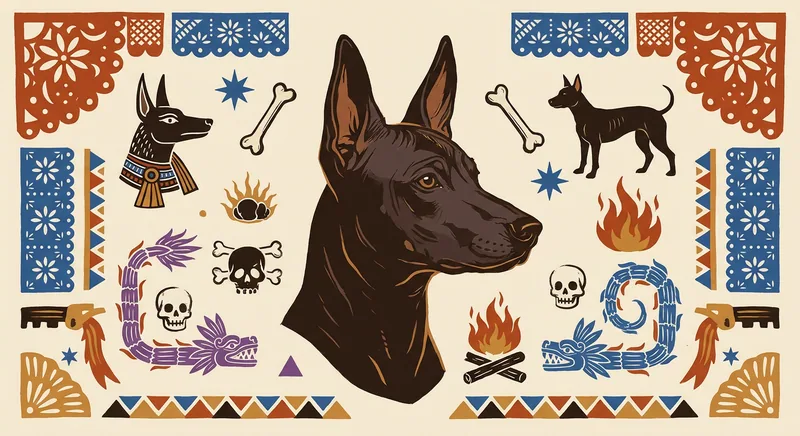
Its lack of hair is not a whim of pre-Hispanic grooming. It is due to a dominant genetic variant related to the development of the ectoderm, which also explains the frequent absence of some teeth. As a result, coated puppies may be born in a litter: they are part of the same breed and are important to its genetic diversity. Its skin, moreover, does not have an unusually high body temperature; it feels warmer to the touch because there is no coat to act as insulation.
Dogs before the Conquest
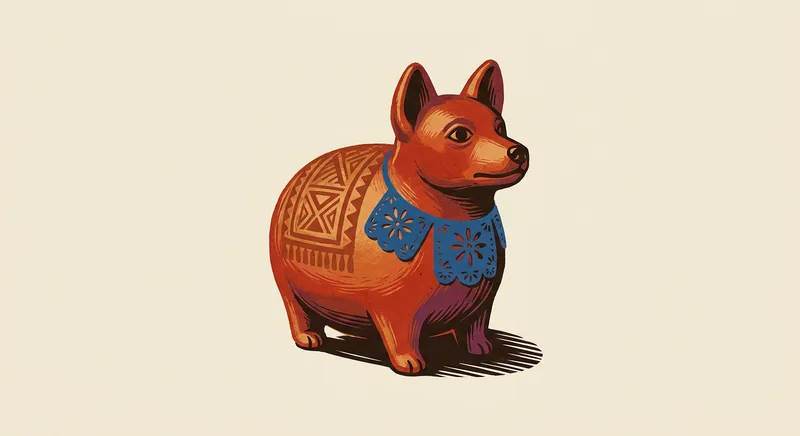
Dogs arrived on the American continent alongside human populations from Asia, thousands of years before Mexica civilization existed. Canine remains appear in very early archaeological contexts in Mesoamerica, and over time various local types developed. Dog figurines produced in Western Mexico—especially in the funerary traditions of Colima, Jalisco and Nayarit—depict sturdy animals with short legs or rounded bodies. Not all of them represent xoloitzcuintles, and mistaking every clay dog for a xolo is a modern temptation best avoided.
Archaeology and written sources show that dogs served several functions: they lived in domestic spaces, took part in ceremonies, could be placed in burials and were also consumed in certain contexts. Fray Bernardino de Sahagún described different dogs known in central Mexico during the 16th century. His accounts are valuable, though they must be read with care: they record Indigenous voices through a colonial project, not a transparent snapshot of the world before the invasion.
“Itzcuintli” means dog; behind that word were different animals, with roles ranging from companionship to ritual.
Xólotl and the path of the dead
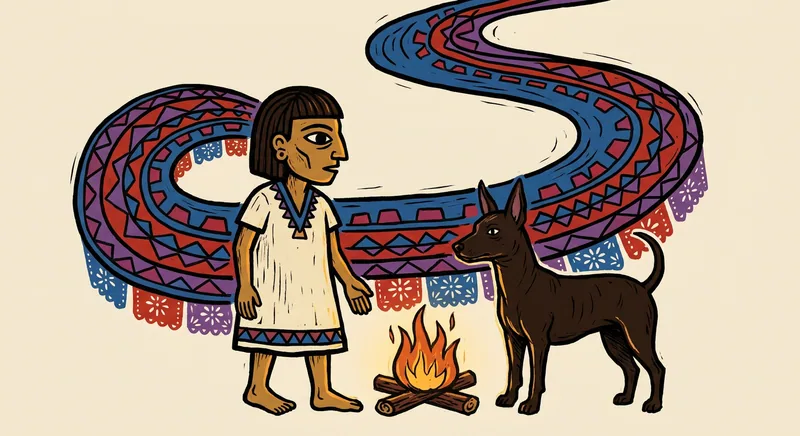
The dog’s relationship with death is documented in different Mesoamerican traditions. In Nahua stories, Xólotl—a deity linked to transformation, movement and the evening star—appears as Quetzalcóatl’s canine twin. Some interpretations connect the xoloitzcuintle with this figure and with the journey to Mictlán, the destination of many of the dead. The popular image of the dog that helps someone cross a river comes from colonial sources and funerary associations, but its details vary; there was no single “afterlife manual” for all of Mesoamerica.
- 1Domestic companion in Mesoamerican communities.
- 2Animal present in offerings and burials in certain regions and periods.
- 3Figure associated with Xólotl and with ideas about transformation and death.
- 4Source of food on specific occasions, according to historical accounts and archaeological findings.
From the brink of disappearance to an emblem
After the Conquest, native dog populations declined and mixed with animals introduced from Europe. For centuries, xolos survived mainly in communities in western and southern Mexico, far from the spotlight. In the 20th century, cultural nationalism turned its gaze toward them: artists such as Diego Rivera and Frida Kahlo brought them into their lives and into some images of a reclaimed ancient Mexico. That rescue involved some research, some affection and also a little staging, like nearly every construction of national identity.
In the 1950s, Mexican breeders and specialists organized expeditions to locate specimens and establish a breeding program. The Fédération Cynologique Internationale officially recognized the breed, now divided by size and found in hairless and coated varieties. However, preserving the xolo does not mean turning it into a living relic or attributing medicinal powers to it without evidence. It means caring for its health, preventing irresponsible breeding, and recognizing that it is a contemporary dog with an ancient history, not a museum piece that begs for kibble.
Looking at a xoloitzcuintle is like peering into a relationship between humans and dogs that has endured for thousands of years in this land. Its skin holds genetics, ancient burials, stories of Xólotl, 20th-century art, and the homes where it now sleeps under a blanket. It does not need us to cloak it in legends to be extraordinary. We need only recognize it for what it has always been: a living companion that brings the past into the present, ears standing tall.
- Bernardino de Sahagún, General History of the Things of New Spain (Florentine Codex), Book XI.
- Raúl Valadez Azúa, Animal Domestication, National Autonomous University of Mexico.
- National Institute of Anthropology and History, educational materials on Mesoamerican dogs and xoloitzcuintles.
- Fédération Cynologique Internationale, FCI Standard No. 234: Xoloitzcuintle.
- National Human Genome Research Institute, information on ectodermal dysplasia and the FOXI3 mutation in hairless dogs.